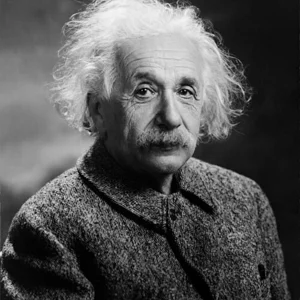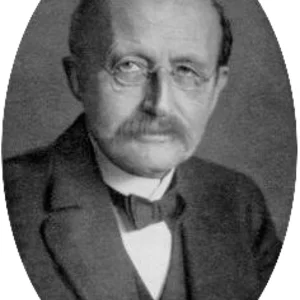

German physicist (1858–1947) who revolutionized physics by discovering quantum theory in 1900. He established that energy is emitted in small discrete portions called quanta, laying the foundations of quantum mechanics. His work marked the transition from classical physics to modern physics.
Max Planck(1858 — 1947)
Max Planck
Reich allemand
8 min read
Frequently asked questions
Famous Quotes
« Science cannot solve the ultimate mystery of nature. And that is because, in the last analysis, we ourselves are a part of the mystery that we are trying to solve.»
Key Facts
- 1900: Formulates his quantum theory while studying black-body radiation
- 1900: Introduces Planck's constant (h = 6.626 × 10⁻³⁴ J·s), a fundamental constant of physics
- 1918: Awarded the Nobel Prize in Physics for his discovery of energy quantization
- 1930: Becomes president of the Kaiser Wilhelm Society for the Advancement of Science
- 1947: Dies in Göttingen, leaving a legacy that transformed the understanding of matter and energy
Works & Achievements
Mathematical formula precisely describing the radiation emitted by a heated body, introducing for the first time the constant h (Planck's constant). This law constitutes the starting point of all modern quantum physics.
Revolutionary proposition that energy is not continuous but emitted in small discrete portions called quanta. This idea, which Planck himself considered provisional, would overturn the whole of twentieth-century physics.
Reference work synthesising Planck's research on thermodynamics prior to his discovery of quanta. It was used as a textbook in German universities for decades.
Book in which Planck systematically sets out his quantum theory of radiation. He formalises the introduction of the universal constant h = 6.626 × 10⁻³⁴ J·s, since named the 'Planck constant'.
Philosophical essay in which Planck reflects on the foundations of scientific knowledge and realism in physics. He argues that science seeks to grasp an objective reality independent of the observer.
Posthumous memoir in which Planck retraces his intellectual journey and the circumstances that led him to quantum theory. An irreplaceable document for understanding the genesis of one of the greatest scientific revolutions.
Anecdotes
In 1900, Max Planck presented his revolutionary formula on black-body radiation at a session of the Berlin Physical Society. He himself admitted he did not truly believe in his own quantum theory, regarding it as a provisional mathematical trick. It would take Einstein for the quantum hypothesis to be taken seriously.
Planck suffered devastating personal tragedies: his eldest son Karl died in combat in 1916, his twin daughters both died in childbirth in 1917 and 1919 respectively, and his son Erwin was executed by the Nazis in 1945 for his involvement in the plot against Hitler. Despite these ordeals, he continued to work until the end of his life.
When Planck was a student, his physics professor in Munich reportedly advised him against pursuing a career in the field, claiming that 'everything had already been discovered' in physics. Planck replied that he was not seeking to make great discoveries, but simply to deepen existing knowledge. He would nonetheless go on to revolutionize science as a whole.
Planck received the Nobel Prize in Physics in 1918 for his discovery of energy quanta. He used part of the prize money to purchase German war bonds, losing nearly the entire sum following the defeat of 1918. By the end of his life, he was almost financially ruined yet universally recognized in the scientific world.
In 1944, at the age of 86, Planck's home in Berlin was completely destroyed in an Allied bombing raid. He lost his manuscripts, his library, and all his personal mementos. Evacuated to Bavaria, he was eventually found by American soldiers in 1945, who brought him to safety, recognizing him as one of the greatest scientists in history.
Primary Sources
If this relation is exact, then the radiation constant b can be expressed as a function of the quantities h and k... the elementary energy ε must be proportional to the frequency of vibration.
We consider the energy E of a resonator as being composed of a finite integer number of equal parts, and we make use for this of the natural constant h = 6.55 × 10⁻²⁷ erg·s.
It was an act of despair. By nature, I am peaceful and averse to dubious adventures. But I had struggled for six years against classical thermodynamics without result. I had to find a theoretical explanation at all costs.
The discovery of the quantum hypothesis led to the idea that in nature there exists a fundamental discrete quantity, the constant h, which sets a limit to the indivisibility of physical processes.
Key Places
Planck taught theoretical physics there from 1889 to 1926, making Berlin the world center of theoretical physics. It was in this setting that he developed his quantum theory.
Max Planck's birthplace, where he was born on April 23, 1858, into a cultivated Prussian bourgeois family. 19th-century Prussia placed great value on education and the sciences.
Planck studied physics there and defended his doctoral thesis in 1879. It was there that a professor advised him against pursuing physics, believing that everything had already been discovered.
It was before this learned society that Planck presented his revolutionary formula on December 14, 1900, a date considered the birth of quantum physics.
The city where Planck took refuge after his Berlin home was destroyed, and where he died on October 4, 1947. Göttingen was at the time a major center of German mathematics and physics.
Typical Objects

An instrument used to analyze the light emitted by a heated body according to its wavelengths. Planck used it indirectly to study blackbody radiation data that led him to his quantum theory.

The daily working tool of the theoretical physicist. It was by manipulating mathematical formulas on this surface that Planck developed his famous radiation law on December 14, 1900.

An experimental device consisting of a closed cavity with a small aperture, which absorbs and re-emits all radiant energy. The study of this object's radiation is at the origin of Planck's quantum revolution.

Planck received this distinction in 1918 for his discovery of quantum theory. He used the associated financial prize to purchase war bonds, which he lost following Germany's defeat.

Planck was an accomplished musician, a talented pianist and organist. He regularly played with friends, including Albert Einstein who played the violin; music was for him an indispensable balance to scientific reflection.

The leading German scientific physics journal, in which Planck published his foundational papers on thermodynamics and quanta, and where Einstein published his four groundbreaking papers of 1905.
School Curriculum
Vocabulary & Tags
Key Vocabulary
Daily Life
Morning
Planck rose early and began his day with a walk, a habit he kept throughout his life. He then had a frugal breakfast before dedicating himself to reading international scientific correspondence and the latest issues of physics journals.
Afternoon
Afternoons were devoted to teaching at the University of Berlin, where Planck gave his famous theoretical physics lectures. He would then receive students and colleagues in his office — covered in books and calculation sheets — to discuss the latest scientific developments.
Evening
Planck's evenings were often musical: an accomplished pianist, he organized chamber music evenings where he played with friends, sometimes including Albert Einstein on the violin. He also read philosophy, particularly Kant, before retiring early.
Food
Planck followed a traditional German bourgeois diet, modest and without excess: rye bread, cold cuts, seasonal vegetables, and beer at convivial meals. He favored simple home cooking and did not consider gastronomy a priority.
Clothing
Planck invariably wore the attire of a Prussian university professor: a dark three-piece suit (black or grey), a stiff white high collar, a black tie, and most often a pince-nez. His appearance was always impeccable, reflecting the intellectual rigor that defined him.
Housing
Planck lived in a large bourgeois Berlin house in Grunewald, a residential neighborhood favored by professors and intellectuals. The house had a well-stocked study full of scientific books and a drawing room with a grand piano. It was completely destroyed by the bombing raids of 1944.
Historical Timeline
Period Vocabulary
Visual Style
Atmosphère académique allemande austère et rigoureuse, entre le laboratoire de physique berlinois et le bureau du savant, dans les tons ambrés et sépia caractéristiques de la Belle Époque et de la République de Weimar.
Sound Ambience
Ambiance sonore d'un laboratoire et d'un bureau de physicien berlinois au tournant du XXe siècle, mêlant le silence studieux de la réflexion théorique aux sons discrets des instruments scientifiques et de la vie universitaire.
Liens externes & ressources
Références
Œuvres
Loi de Planck sur le rayonnement du corps noir
1900
Hypothèse des quanta d'énergie
14 décembre 1900
Vorlesungen über Thermodynamik (Leçons sur la thermodynamique)
1897
Vorlesungen über die Theorie der Wärmestrahlung (Théorie du rayonnement thermique)
1906
Où va la science ? (Positivismus und reale Aussenwelt)
1931
Wissenschaftliche Selbstbiographie (Autobiographie scientifique)
1948