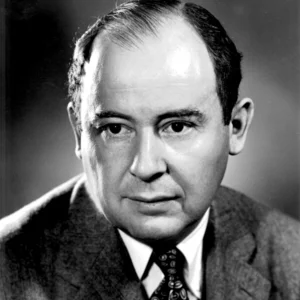

Hungarian-American mathematician and physicist (1903–1957), pioneer of modern computing and game theory. He is the founding architect of the programmable digital computer and contributed to the development of nuclear energy.
John von Neumann(1903 — 1957)
John von Neumann
Hongrie, États-Unis
7 min read
Frequently asked questions
Famous Quotes
« The computer is about to change the nature of mathematics.»
« If people do not believe that mathematics is simple, it is only because they do not realize how complicated life is.»
Key Facts
- 1930: Major contribution to game theory and economic equilibrium
- 1945: Design of the foundational architecture of modern computers (von Neumann architecture)
- 1945–1955: Development of the EDVAC (Electronic Discrete Variable Automatic Computer)
- 1944–1945: Participation in the Manhattan Project for the atomic bomb
- 1956: Final contributions to the theory of self-reproduction and cellular automata
Works & Achievements
A foundational work that provided quantum physics with a rigorous mathematical basis. It remains an essential reference in theoretical physics to this day.
The founding book of game theory, which mathematically analyzed decision strategies in competitive situations. It revolutionized economics, military strategy, and the social sciences.
A technical document describing for the first time the architecture of the stored-program computer (memory, processing unit, input/output). It defined the model known as the 'von Neumann architecture', still in use today.
Von Neumann laid the theoretical foundations for automata capable of self-reproduction, establishing the groundwork for theoretical computer science and artificial life.
Von Neumann developed the mathematical calculations enabling the implosion detonation of the plutonium bomb, making the Fat Man bomb dropped on Nagasaki technically feasible.
His final, unfinished work, in which von Neumann compares the logical structures of the human brain and the computer. A visionary text that foreshadowed computational neuroscience.
Anecdotes
John von Neumann possessed a prodigious memory that astonished his colleagues. He could recite word for word books he had read years earlier, such as the entirety of the Budapest telephone directory or entire passages from Dickens. During one demonstration, he recited from memory the first page of A Tale of Two Cities after having read it only once.
During the Manhattan Project at Los Alamos, von Neumann would regularly arrive in a luxury car, impeccably dressed in a three-piece suit, contrasting sharply with the austere atmosphere of the secret laboratory. He would mentally solve complex ballistic calculations during the drive, and his hand estimates often rivaled the results produced by calculating machines.
Von Neumann was known for hosting lavish parties at his large Princeton home, inviting Nobel laureates and political figures alike. He loved detective novels and jokes, and his wife Klára said he was capable of working in the middle of deafening noise, with the radio blaring and lively conversations going on around him.
During the design of ENIAC and the first computers, von Neumann wrote in 1945 a foundational technical report describing the architecture of the modern computer — the famous 'First Draft of a Report on the EDVAC'. This document, circulated without his authorization with only his name in the header, credited him as the father of what became known as the von Neumann architecture, which upset his collaborators Eckert and Mauchly.
Diagnosed with bone cancer in 1955, likely due to his exposure to radiation during nuclear tests, von Neumann continued working until the very end. The U.S. military assigned him bodyguards at the hospital, fearing that in his weakened state he might inadvertently disclose military secrets. He died in 1957, leaving unfinished his last work on the connections between the human brain and the computer.
Primary Sources
An automatic computing system is a (usually highly composite) device, which can carry out instructions to perform arithmetic and logical operations on numbers... The instructions which govern this operation must be given to the device in some form which it is able to interpret.
We wish to find the mathematically complete principles which define 'rational behavior' for the participants in a social economy, and to derive from them the general characteristics of that behavior.
The importance of the purely logical approach to automata theory cannot be overstated. The logical structure of an automaton is more fundamental than its physical realization.
The nervous system is based on two types of communications: those which do not involve the precise value of a number, and those which do. The digital computer operates on the first principle entirely.
Key Places
Von Neumann's birthplace, then the intellectual and cultural capital of the Austro-Hungarian Empire. There he received an exceptional education and showed extraordinary mathematical genius from childhood.
Institution where von Neumann worked from 1933 until the end of his life. There he rubbed shoulders with Einstein, Gödel, and other great minds, and developed his theories on computers and automata.
Secret laboratory of the Manhattan Project where von Neumann made decisive contributions to the implosion calculations for the atomic bomb. He regularly crossed the continent to work there.
US Army ballistics research center where von Neumann participated in work on shell trajectories and collaborated on the design of the ENIAC.
Institution where von Neumann served as Privatdozent from 1926 to 1929, teaching mathematics during a period of great intellectual ferment in Europe.
Typical Objects

Universal analog calculation instrument used by scientists of the era. Von Neumann used it for quick estimates, although he often preferred mental arithmetic.

Symbol of mathematical work of the time, the blackboards at Princeton were covered in formulas written by von Neumann during his famous seminars.

Programming medium for the early computers that von Neumann helped design. They allowed instructions and data to be entered into machines such as the ENIAC.

Mechanical calculator used at the Los Alamos laboratory to perform ballistic calculations. Von Neumann supervised entire teams operating these machines in parallel.

Von Neumann was always impeccably dressed in a dark suit and tie, even in the secret laboratories of the New Mexico desert, which set him clearly apart from his colleagues.

Von Neumann was fond of luxury cars and drove a Cadillac, although he was reputed to be a dangerous and distracted driver, frequently lost in his thoughts.
School Curriculum
Vocabulary & Tags
Key Vocabulary
Tags
Daily Life
Morning
Von Neumann woke up early and began his day by reading the newspapers, paying close attention to international political news. He enjoyed a hearty breakfast in his large house on Westcott Road in Princeton before walking or driving to the Institute for Advanced Study.
Afternoon
His afternoons were devoted to seminars, meetings with colleagues, or consultations for the U.S. military and government. He frequently traveled by plane or train between Princeton, Washington, and Los Alamos, solving mathematical problems during the journeys.
Evening
Von Neumann's evenings were often festive: he regularly hosted dinners and receptions at his home, bringing together mathematicians, physicists, and political figures. He enjoyed listening to music, watching comedy films, and reading detective novels before going to bed.
Food
Von Neumann appreciated fine cuisine and generous meals, a reflection of his Hungarian bourgeois upbringing. He was fond of Central European specialties and rich dishes, and never missed the opportunity for a good meal during his many travels across the United States.
Clothing
He invariably wore a dark three-piece suit, a white shirt, and a tie, even in informal settings or in the laboratory. This sartorial elegance stood in contrast to the casual attire of most of his scientific colleagues.
Housing
Von Neumann lived in a large and beautiful home in Princeton, known for its lively parties. The house was well furnished and reflected a taste for bourgeois comfort and hospitality, inherited from his wealthy family background in Budapest.
Historical Timeline
Period Vocabulary
Visual Style
Une esthétique en noir et blanc des années 1940-1950, mêlant l'élégance formelle des universités américaines de l'époque, les vastes salles de machines aux parois couvertes d'équations, et la tension dramatique de la Guerre froide naissante.
Sound Ambience
Un univers sonore mêlant le cliquetis des calculatrices mécaniques et des premiers ordinateurs à relais, les discussions animées de mathématiciens dans les couloirs de Princeton, et l'atmosphère tendue des laboratoires secrets de la Seconde Guerre mondiale.
Liens externes & ressources
Références
Œuvres
Fondements mathématiques de la mécanique quantique (Mathematische Grundlagen der Quantenmechanik)
1932
Theory of Games and Economic Behavior (avec Oskar Morgenstern)
1944
First Draft of a Report on the EDVAC
1945
Théorie des automates cellulaires
1948-1952
Contributions au Projet Manhattan (calculs d'implosion)
1943-1945
The Computer and the Brain
1958 (posthume)