 flip
flipLong-Distance Runner’s Savoury Porridge
Long-Distance Runner’s Savoury Porridge
Why this dish? Turing was a near-Olympic-level long-distance runner: he covered miles between Bletchley and his lodgings. Oat porridge, cheap and filling, was the quintessential morning fuel — simple and functional, just like him.
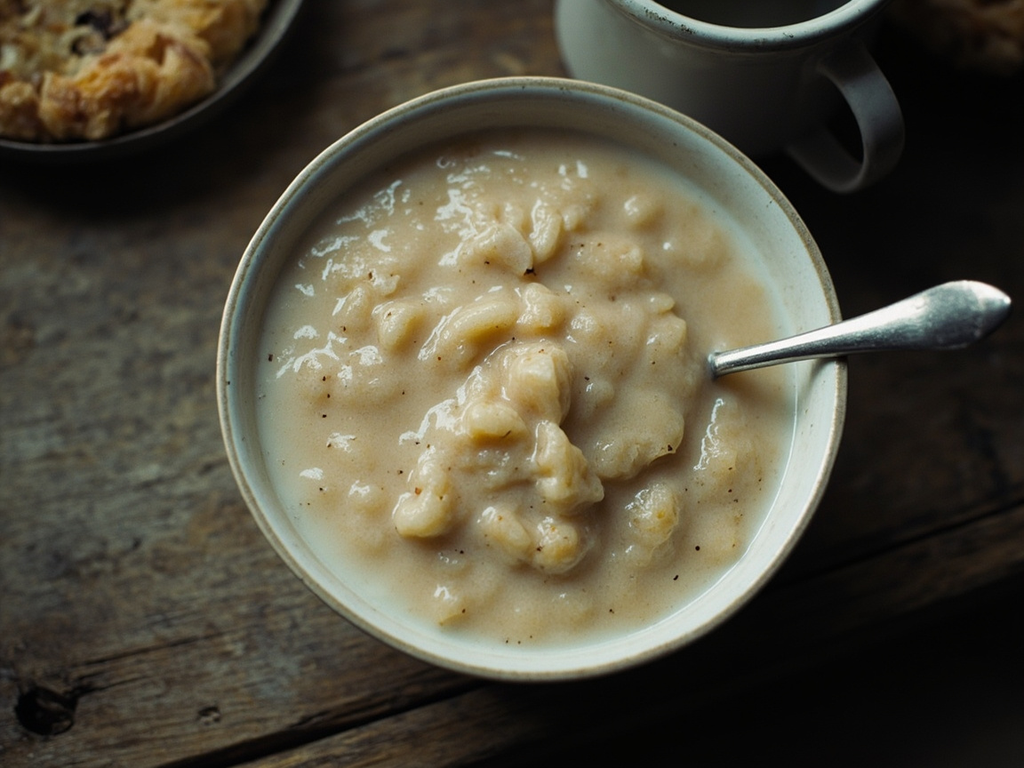
A bowl of oats cooked in water, thick and comforting, salted in the traditional Scottish style rather than sweetened. Austerity itself, but a warmth that stays with you all morning of calculations.
I never understood wasting time complicating the first meal. Oats, water, a pinch of salt — you stir until it’s smooth, and that’s that. I used to have a solid bowl before heading out for a run; you know, I covered several miles on that, and it cleared my mind far better than any meeting. The efficiency of a good porridge, you see, is that it demands no thought: you can save that for the serious things.
- •Oatmeal — a good handful per person (cereal base)
- •Water — three times the volume of oats (cooking liquid)
- •Salt — a pinch (traditional Scottish seasoning)
- •Milk (rationed) — a splash, if available (creaminess)
Long-Distance Runner’s Savoury Porridge
A bowl of oats cooked in water, thick and comforting, salted in the traditional Scottish style rather than sweetened. Austerity itself, but a warmth that stays with you all morning of calculations.
Why this dish? Turing was a near-Olympic-level long-distance runner: he covered miles between Bletchley and his lodgings. Oat porridge, cheap and filling, was the quintessential morning fuel — simple and functional, just like him.
I never understood wasting time complicating the first meal. Oats, water, a pinch of salt — you stir until it’s smooth, and that’s that. I used to have a solid bowl before heading out for a run; you know, I covered several miles on that, and it cleared my mind far better than any meeting. The efficiency of a good porridge, you see, is that it demands no thought: you can save that for the serious things.
Ingredients (period version)
- Oatmeal — a good handful per person (cereal base)
- Water — three times the volume of oats (cooking liquid)
- Salt — a pinch (traditional Scottish seasoning)
- Milk (rationed) — a splash, if available (creaminess)
Ingredients
- Oatmeal (rolled oats) — 60 g (cereal base)
- Water — 300 ml (cooking liquid)
- Salt — 1 pinch (seasoning)
- Whole milk — 50 ml (to pour over at serving)
Method
- Put the oats and cold water in a saucepan, add the pinch of salt.
- Bring gently to a boil, stirring with a wooden spoon.
- Reduce the heat and simmer for 5 to 8 minutes, stirring regularly, until thick and creamy.
- Pour into a bowl, add a splash of cold milk in a ring around the edge (traditional method), and eat very hot.
How it was made : In Scotland and the North, porridge was eaten standing up, salted, sometimes prepared the night before in a “porridge drawer” and sliced cold. Sugar was a southern luxury; under rationing, salting it was also an economy.
The contemporary twist : A pinch of flaky Maldon salt at serving, and the splash of milk replaced by a swirl of cream for a hot-cold contrast.
Sources : F. Marian McNeill, The Scots Kitchen (1929) · Andrew Hodges, Alan Turing: The Enigma (1983)
Alan Turing · Charactorium