 flip
flipWartime Carrot Cake (Eggless)
Wartime Carrot Cake (Eggless)
Why this dish? When sugar, butter and eggs were scarce, the carrot — heroine of the Ministry of Food’s “Dr Carrot” — provided natural sweetness to cakes. An occasional treat, for a birthday or a Sunday, in the austere England that Turing lived through.
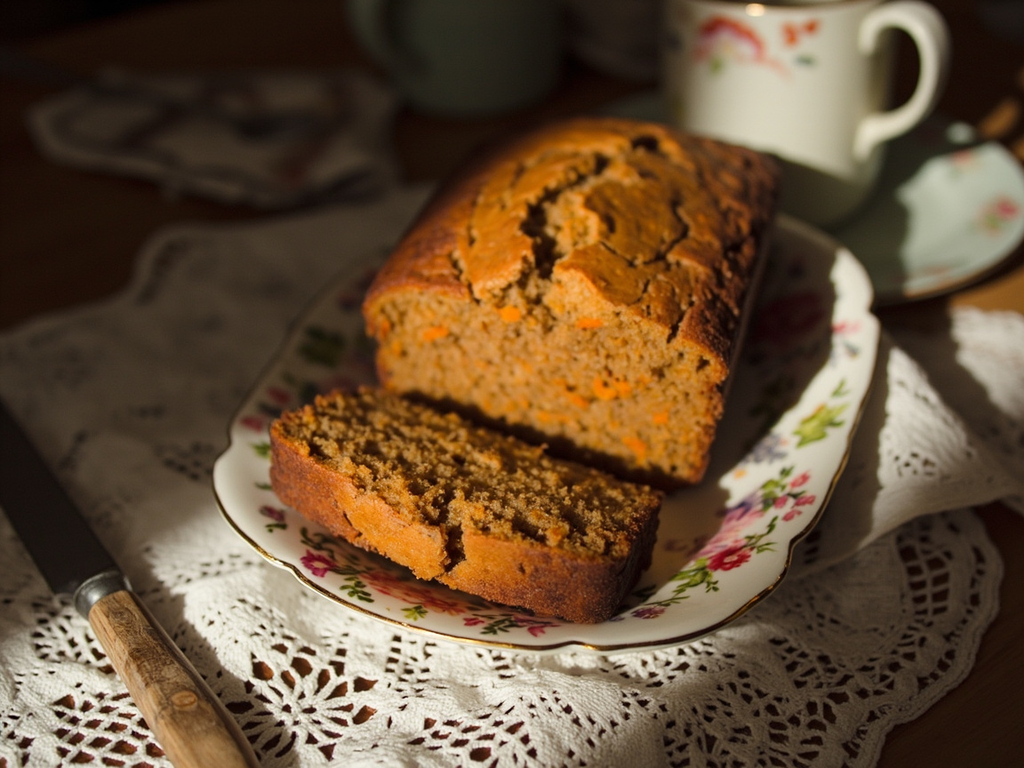
A moist, spice-scented cake, sweetened by grated carrot rather than rationed sugar, with no eggs or butter in quantity. A celebration when almost everything was lacking.
Some will tell me that a cake without eggs or real sugar is not a real cake; I reply that it is precisely the kind of constraint that forces ingenuity. The carrot provides the sugar, the spices do the rest, and the result is surprisingly decent. I confess I was never a gourmand — I eat what works — but a slice of this with a strong tea on a Sunday, that made the week bearable.
- •Grated carrots — two cups (natural sugar, moistness)
- •Flour (National Flour) — two cups (structure)
- •Vegetable fat or margarine — a good spoonful (fat)
- •Golden syrup or rationed sugar — whatever little you have (additional sweetener)
- •Spices (cinnamon, nutmeg) — a pinch of each (flavour)
- •Baking soda — a spoonful (leavening without eggs)
- •Milk or water — to make the batter (binder)
Wartime Carrot Cake (Eggless)
A moist, spice-scented cake, sweetened by grated carrot rather than rationed sugar, with no eggs or butter in quantity. A celebration when almost everything was lacking.
Why this dish? When sugar, butter and eggs were scarce, the carrot — heroine of the Ministry of Food’s “Dr Carrot” — provided natural sweetness to cakes. An occasional treat, for a birthday or a Sunday, in the austere England that Turing lived through.
Some will tell me that a cake without eggs or real sugar is not a real cake; I reply that it is precisely the kind of constraint that forces ingenuity. The carrot provides the sugar, the spices do the rest, and the result is surprisingly decent. I confess I was never a gourmand — I eat what works — but a slice of this with a strong tea on a Sunday, that made the week bearable.
Ingredients (period version)
- Grated carrots — two cups (natural sugar, moistness)
- Flour (National Flour) — two cups (structure)
- Vegetable fat or margarine — a good spoonful (fat)
- Golden syrup or rationed sugar — whatever little you have (additional sweetener)
- Spices (cinnamon, nutmeg) — a pinch of each (flavour)
- Baking soda — a spoonful (leavening without eggs)
- Milk or water — to make the batter (binder)
Ingredients
- Finely grated carrots — 200 g (moistness and sweetness)
- Flour — 250 g (structure)
- Margarine or neutral oil — 80 g (fat)
- Brown sugar — 80 g (sweetener)
- Golden syrup — 1 tbsp (moisture)
- Cinnamon and nutmeg — 1 tsp cinnamon, ½ tsp nutmeg (spices)
- Baking soda — 1 tsp (leavening)
- Milk — 120 ml (binder)
Method
- Preheat the oven to 180°C and line a small loaf tin.
- Mix the flour, spices and baking soda.
- Cream the margarine with the sugar and golden syrup, add the grated carrots.
- Fold in the spiced flour and milk until a soft, smooth batter forms.
- Pour into the tin and bake for 35–40 minutes; check with a skewer that comes out clean.
- Let cool slightly before turning out.
How it was made : The Ministry of Food distributed recipes for carrot cakes and puddings to compensate for the lack of sugar and dried fruit. The wholemeal “National Flour” replaced white flour, and baking soda compensated for the absence of eggs.
The contemporary twist : A light cream cheese and orange zest frosting — an unthinkable luxury in 1943 — to transform the wartime improvisation into today’s teatime treat.
Sources : Ministry of Food, Dr Carrot campaign leaflets (1940-1942) · Marguerite Patten, We’ll Eat Again (1985)
Alan Turing · Charactorium