 flip
flipWoolton Pie (The Minister’s Pie)
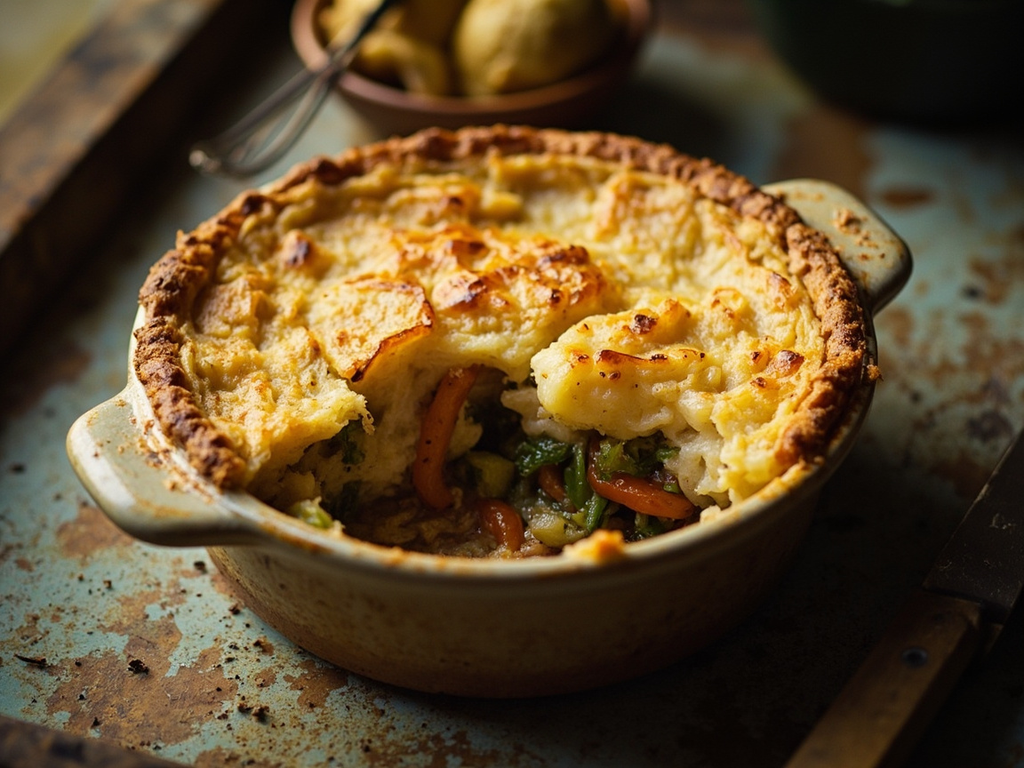
Woolton Pie (The Minister’s Pie)
Why this dish? Named after Lord Woolton, Minister of Food, this meatless vegetable pie was THE official rationing dish, served in canteens like the one at Bletchley Park where Turing lunched between Enigma sessions.
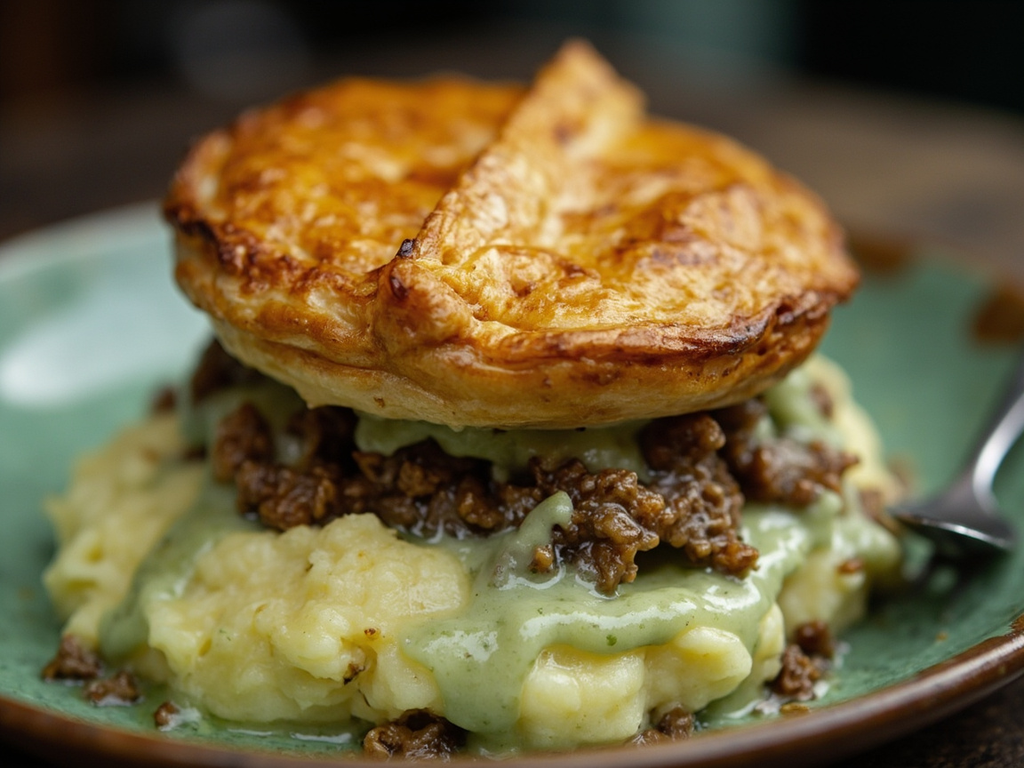
A generous pie of root vegetables bound in a sauce, topped with a potato or pastry crust. The patriotic dish par excellence, designed by the Savoy’s chef to feed a nation without meat.
At the canteen, they served this pie so often you could have made a theorem of it. Nothing but vegetables — turnips, carrots, leeks, potatoes — and yet, with a little Marmite in the sauce, it was perfectly satisfying. I ate absently, my mind elsewhere, on the rotors and the day’s settings; but I must admit a good golden crust on top made the work more tolerable. We had no choice, so we might as well find it good.
- •Potatoes — in quantity (filling and crust)
- •Carrots, turnips, swede (rutabaga) — whatever the ration book allows (heart of the pie)
- •Leeks or onions — a few (aromatic)
- •Oatmeal — a spoonful (sauce thickener)
- •Yeast extract (Marmite) — a spoonful (umami, depth)
- •Parsley — a bunch (freshness)
Woolton Pie (The Minister’s Pie)
A generous pie of root vegetables bound in a sauce, topped with a potato or pastry crust. The patriotic dish par excellence, designed by the Savoy’s chef to feed a nation without meat.
Why this dish? Named after Lord Woolton, Minister of Food, this meatless vegetable pie was THE official rationing dish, served in canteens like the one at Bletchley Park where Turing lunched between Enigma sessions.
At the canteen, they served this pie so often you could have made a theorem of it. Nothing but vegetables — turnips, carrots, leeks, potatoes — and yet, with a little Marmite in the sauce, it was perfectly satisfying. I ate absently, my mind elsewhere, on the rotors and the day’s settings; but I must admit a good golden crust on top made the work more tolerable. We had no choice, so we might as well find it good.
Ingredients (period version)
- Potatoes — in quantity (filling and crust)
- Carrots, turnips, swede (rutabaga) — whatever the ration book allows (heart of the pie)
- Leeks or onions — a few (aromatic)
- Oatmeal — a spoonful (sauce thickener)
- Yeast extract (Marmite) — a spoonful (umami, depth)
- Parsley — a bunch (freshness)
Ingredients
- Potatoes — 800 g (mashed topping)
- Carrots — 300 g (filling)
- Turnip and swede (rutabaga) — 300 g total (filling)
- Leeks — 2 (aromatic)
- Oatmeal — 2 tbsp (thickener)
- Marmite (or strong vegetable stock) — 1 tsp (umami)
- Chopped parsley — 3 tbsp (freshness)
- Milk, a little butter — for the mash (binding the crust)
Method
- Dice carrots, turnip, swede and leeks; cook in simmering water for 10 minutes.
- Reserve the cooking water; stir in oatmeal and Marmite to make a short sauce, add parsley.
- Mix vegetables with the sauce and pour into a baking dish.
- Mash the cooked potatoes with a little milk, spread in a thick layer over the vegetables, score with a fork.
- Bake at 200°C for 25–30 minutes, until the crust is golden.
How it was made : The official recipe was distributed by the Ministry of Food in 1941. Created by Francis Latry, chef at the Savoy, it existed in versions with a pastry or potato crust, depending on what was available at home.
The contemporary twist : A mashed potato crust blended with a little grated sharp cheddar and a touch of English mustard, to embrace the umami that Marmite establishes as an undertone.
Sources : Ministry of Food, wartime recipe leaflets (1941) · Marguerite Patten, We’ll Eat Again (1985)
Alan Turing · Charactorium