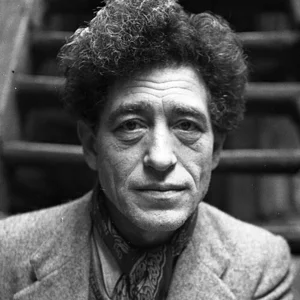

Swiss sculptor and painter, a major figure in 20th-century art. After a Surrealist period, he developed a unique style of extremely elongated, slimmed-down human figures that became an emblem of the postwar human condition.
Alberto Giacometti(1901 — 1966)
Alberto Giacometti
Suisse, France
6 min read
Frequently asked questions
Famous Quotes
« In the street, people dissolve into the distance like water.»
Key Facts
- Born in 1901 in Borgonovo, in the Val Bregaglia (Switzerland), into a family of artists
- Settled in Paris in 1922 and moved in Surrealist circles during the 1930s
- Developed his characteristic thread-like figures after 1945 (Walking Man)
- Awarded the Grand Prize for sculpture at the Venice Biennale in 1962
- Died in 1966 in Chur (Switzerland); his work appeared on the former Swiss 100-franc banknote
Works & Achievements
Surrealist sculpture with a suspended mechanism, deemed provocative and charged with erotic tension. It cemented his reputation among the Surrealists.
A fragile construction in wood and wire, like a dreamlike architecture. One of the major works of Surrealism.
A thread-like figure in mid-stride, which became the emblem of Giacometti's art and of the postwar human condition.
A large figure extending its arm, one of his most famous sculptures. A bronze cast of this work broke sales records.
Small figures scattered across a base, evoking the loneliness of passersby in the modern city.
A series of hieratic female figures shown at the Venice Biennale. Variations on a single theme, modeled and then cast.
A series of monumental, motionless figures intended for a square in New York. A static counterpoint to Walking Man.
A series of painted portraits with nervous lines, bearing witness to his obsessive quest for likeness.
Anecdotes
Giacometti grew up in the small village of Stampa, in Italian-speaking Switzerland, in a family of artists: his father Giovanni was a respected post-impressionist painter. As a child, Alberto made his first sculpture, a bust of his brother Diego, around the age of 13. Diego would become his assistant and his model for his entire life.
In the 1930s, Giacometti belonged to the Surrealist group around André Breton. But he was expelled from the movement in 1935 because he had gone back to working from a live model, which the Surrealists considered too traditional.
For years, Giacometti was haunted by a strange problem: his sculptures shrank under his fingers until they became tiny, sometimes no bigger than a pinhead. He recounted that at the end of the war, all his figures representing several months of work fit into six matchboxes.
In 1938, Giacometti was knocked down by a car on the Place des Pyramides in Paris and injured his foot, which left him with a limp for the rest of his life. Yet he said he had felt a curious sense of joy, as if something was finally happening to him.
His Paris studio on the Rue Hippolyte-Maindron, which he occupied from 1926 until his death, measured barely more than 20 m². Tiny, dusty and cluttered, he lived and worked there for forty years, refusing to move even when he became famous and wealthy.
Primary Sources
All my figures stubbornly shrank to a dizzying smallness. A large figure seemed false to me and a small one intolerable, and then often they became so tiny that with one last stroke of the knife they vanished into dust.
I don't know whether I work in order to make something or to find out why I cannot make what I would like to make. It is in the most exact resemblance that the unknown lies.
Halfway between being and nothingness, his statues reinvent man at a distance. Giacometti knows that space is a cancer of being, eating everything away.
He kept saying it was impossible, that he would never manage to render what he saw, and he would begin the face over and over again, erasing what he had just painted.
Key Places
Giacometti's native village in an Italian-speaking Alpine valley. He returned there regularly throughout his life to work in the family studio.
A tiny, cluttered studio where he lived and worked from 1926 to 1966. A legendary site of 20th-century art.
An art school in Montparnasse where he studied sculpture under Antoine Bourdelle starting in 1922.
The city where he took refuge during the Second World War, from 1941 to 1945. There he met Annette Arm, his future wife.
A town in the canton of Graubünden where Giacometti died on 11 January 1966. He is buried near Stampa.
Typical Objects

A small rotating stand on which Giacometti shaped his figures so he could see them from every angle. Essential for modeling a free-standing statue.

The raw material of his sculptures, which he kneaded, added to and took away from endlessly. The works in plaster and then in bronze all began as a figure of clay.

Blade and point tools with which he cut, scraped and thinned the material. It was with the stroke of a knife that his figures sometimes ended up as dust.

An often massive, wide base on which his slender figures stand, creating a strong contrast of scale. For Giacometti, the base is an integral part of the work.

The white material in which he cast his figures before bronze founding. Many original plasters survive and show the marks of his fingers.

Giacometti was also a painter: he made portraits in grey and brown tones, the face outlined with nervous lines. He often painted the same close relations, such as Diego or Annette.
School Curriculum
Vocabulary & Tags
Key Vocabulary
Daily Life
Morning
Giacometti often woke up late, having worked part of the night. His morning began in the small neighborhood café, where he would have a coffee and smoke one cigarette after another.
Afternoon
He spent the afternoon in the studio, modeling clay or painting close friends who would pose for hours on end. He would erase and start over endlessly, never satisfied with the likeness.
Evening
In the evening, he enjoyed the cafés and brasseries of Montparnasse, discussing art and philosophy with friends like Sartre and Beckett. Afterward, he would return to the studio to work late into the night.
Food
His life was frugal and chaotic: plenty of coffee, alcohol, and a considerable number of cigarettes. Meals, often eaten in the neighborhood bistros, came well after his work.
Clothing
He wore worn clothes stained with plaster, indifferent to elegance even after becoming wealthy. The rumpled suit and tousled hair were part of his familiar silhouette.
Housing
He lived for forty years in his cramped studio on the rue Hippolyte-Maindron, barely more than 20 m², without comfort, its walls covered with drawings and plaster dust. He always refused to leave it.
Historical Timeline
Period Vocabulary
Liens externes & ressources
Références
Œuvres
Le Palais à quatre heures du matin
1932
L'Homme qui marche
1947 puis 1960
La Place (City Square)
1948
Femmes de Venise
1956
Grande Femme debout
1960