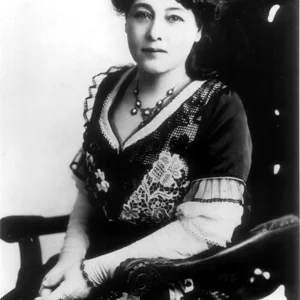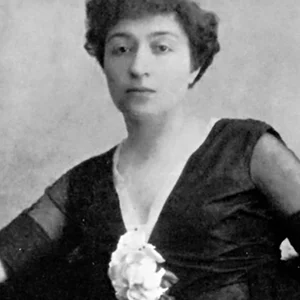

Aleksandra Exter was a Russian-Ukrainian painter and designer, a leading figure of the early 20th-century Russian avant-garde. A pioneer of Cubo-Futurism and Constructivism, she revolutionized theatrical sets and costumes.
Aleksandra Exter
Aleksandra Aleksandrovna Exter
6 min read
Frequently asked questions
Key Facts
- Born in 1882 in Białystok (Russian Empire), she trained in Kyiv and then in Paris, where she mingled with the Cubists
- A key figure of Russian Cubo-Futurism in the 1910s, close to Malevich and the avant-garde movements
- Designed revolutionary sets and costumes for Tairov's Chamber Theatre in Moscow from 1916 onward
- Created the futuristic costumes for the Soviet science-fiction film *Aelita* (1924)
- Emigrated to Paris in 1924, where she taught and continued her work until her death in 1949
Works & Achievements
Pioneering scenography for the Kamerny Theatre: architectural volumes and sloping planes replace painted backdrops. A founding act of theatrical constructivism.
Tairov's staging of Oscar Wilde, in which Exter unleashes vivid colours and dynamic forms. A high point of her aesthetic of colour-as-movement.
An exuberant constructivist set bristling with staircases and walkways for the Kamerny Theatre. Considered the pinnacle of her stage language.
Futuristic outfits in metal and gleaming materials for Protazanov's film. A lasting reference point for the science-fiction imagination on screen.
Abstract paintings with fragmented planes and intense colours. They acclimatise Parisian Cubism to the Russian avant-garde.
Unique works painted and illuminated by hand during her Parisian exile. A testament to her creativity under precarious conditions.
Anecdotes
During his stays in Paris before 1914, Aleksandra Exter frequented the studios of Montparnasse and mingled with Picasso, Braque, and the poet Guillaume Apollinaire. A true bridge between the avant-gardes, she brought Cubism back to Kiev and Moscow, becoming a living link between Parisian and Russian art.
In 1916, she revolutionized Russian theater with her sets for the play *Famira Kifared* (Thamyris the Cithara-Player) at Alexander Tairov's Kamerny (Chamber) Theatre in Moscow. Instead of flat painted backdrops, she built geometric volumes, inclined planes, and staircases where the actors themselves became elements of the composition.
In 1924, she designed the futuristic costumes for the Soviet science-fiction film *Aelita*, which features a queen of Mars. Her angular outfits made of metal, cellophane, and shiny materials inspired the visual imagination of aliens and robots in cinema for decades.
Exter did not simply paint costumes: she designed *marionnettes* and articulated figurines like genuine Cubist sculptures, treating the human body as an assemblage of cones, cylinders, and colorful disks.
After going into exile in France in 1924, she taught at Fernand Léger's Académie Moderne in Paris and handcrafted sumptuous one-of-a-kind artist's books (illuminated manuscripts), earning a modest living far from the fame she had known in Russia.
Primary Sources
Exter does not decorate the stage, she builds it: her sets are living architectures where color and volume act out the drama alongside the performer.
The set must cease to be a painted illustration and become a rhythmic floor on which the actor moves through real space.
Martian costumes: Alexandra Exter — a world of metal, glass and light for the city of Mars.
Key Places
City in the Russian Empire (now in Poland) where Aleksandra Exter was born in 1882.
City of her youth and training at the Art School; she later opened her own studio-school there.
Capital of the avant-gardes where she met Picasso and Braque, and later the site of her exile from 1924 onward.
Alexander Tairov's Chamber Theatre, where Exter revolutionized stage design between 1916 and 1921.
Town in the southern suburbs of Paris where she spent her final years and died in 1949.
Typical Objects

Scale model in cardboard and wood depicting the staircases, ramps and geometric volumes of the stage. Exter uses it to test the layout of the space before full-scale construction.

Stage garment with sharp geometric shapes, made of colorful fabrics, metal and shiny materials. It turns the actor's body into an abstract, dynamic figure.

Opaque water-based paint in vivid colors, the favored tool for her set and costume projects. It allows the crisp, contrasting flat areas of color typical of her style.

Articulated figure conceived as a small sculpture of geometric assembly. Exter makes it an autonomous art object as much as a stage character.

Unique volume painted and illuminated entirely by hand, created in exile in Paris. Each copy is an original work blending text and abstract compositions.

Stretched support for her abstract paintings with fragmented planes and intense colors. It is on these canvases that she acclimatizes Parisian Cubism to the Russian avant-garde.
School Curriculum
Vocabulary & Tags
Key Vocabulary
Daily Life
Morning
In Kyiv or Moscow, Exter often begins the day in her light-flooded studio, surrounded by gouaches and models. She sketches the first designs for costumes or sets before her students and collaborators arrive.
Afternoon
The afternoon is spent at the theater, in rehearsal, where she adjusts the volumes of the set and has the actors try on the costumes. She discusses with the director Tairov how color should “perform” at the same time as the text.
Evening
In the evening, she rejoins the avant-garde circles: poets, painters, and theater people debate the new art over a cup of tea. These conversations feed her projects and weave a network linking Kyiv, Moscow, and Paris.
Food
Her diet follows the resources of the time: Russo-Ukrainian cuisine based on black bread, soups (borscht), vegetables, and scalding tea served from the samovar. During the civil war and exile, meals became more frugal and uncertain.
Clothing
A modern woman and artist, she loves clothing with bold lines and designs her own geometric fashion models. She experiments with colors and patterns, making her own outfit an extension of her art.
Housing
She lives and works in studio-apartments, in Kyiv and then Moscow, transformed into creative laboratories. In exile, she settles modestly in Fontenay-aux-Roses, near Paris, in a simpler dwelling.
Historical Timeline
Period Vocabulary
Liens externes & ressources
Références
Œuvres
Décors de «Famira Kifared»
1916
Costumes et décors de «Salomé»
1917
Décors de «Roméo et Juliette»
1921
Livres d'artiste manuscrits
1930-1940