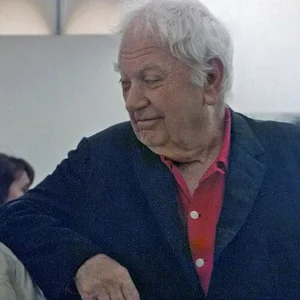

American sculptor and visual artist (1898-1976), Alexander Calder was the inventor of the “mobile,” a suspended, articulated sculpture set in motion by the air. He also created “stabiles,” large fixed abstract sculptures made of metal.
Alexander Calder(1898 — 1976)
Alexander Calder
États-Unis
6 min read
Frequently asked questions
Key Facts
- Born in 1898 in Lawnton (Pennsylvania) into a family of artists, first trained as a mechanical engineer
- Created his miniature wire “Circus” in Paris in the 1920s, a performance that made him famous
- Invented the “mobile” around 1931-1932 (a term proposed by Marcel Duchamp), an abstract sculpture in motion
- Developed the “stabiles” (a term suggested by Jean Arp), monumental fixed sculptures installed in public spaces
- Died in 1976 in New York, leaving behind a major body of work in 20th-century art
Works & Achievements
Miniature circus made of wire and salvaged materials, which Calder brought to life in live performances. A founding work, now kept at the Whitney Museum.
The first abstract sculptures set in motion, some initially driven by motors, then by air currents alone. A major invention in modern sculpture.
Mobile commissioned for the grand staircase of the Museum of Modern Art in New York, which became an icon of mobile art.
Large stabile-mobile installed in front of the UNESCO headquarters in Paris, a symbol of postwar monumental art.
Hanging mobile created for the terminal of New York's international airport, integrating art into modern public space.
Bright red monumental stabile installed in Grand Rapids, Michigan — the first public sculpture funded by an American federal program; it became the city's emblem.
A 16-meter stabile of vermilion-red painted steel, standing in a Chicago plaza in contrast with the surrounding black skyscrapers.
Anecdotes
In 1926, the young Calder set up a miniature circus in Paris made entirely of wire, corks, fabric, and buttons. For whole evenings, he himself brought to life his acrobats, wild beasts, and trapeze artists before an audience of dazzled artists such as Joan Miró and Fernand Léger.
It was the painter Marcel Duchamp who, in 1931, coined the word “mobiles” for Calder's suspended, moving sculptures. The following year, the sculptor Jean Arp invented in return the word “stabiles” to describe his large fixed works resting on the ground.
Calder was trained as an engineer: he earned a degree in mechanical engineering before turning to art. This training explains his genius for balance, for his mobiles hang in suspension thanks to a precise calculation of weights and points of support.
In 1930, a visit to the studio of the painter Piet Mondrian turned Calder's world upside down. Faced with the rectangles of primary colors pinned to the wall, he imagined setting them in motion: this shock pushed him toward abstract art and the idea of movement.
Calder also made jewelry by hand — hundreds of brooches, necklaces, and bracelets in hammered brass and silver wire, which he often gave to his female friends. Many artists and celebrities proudly wore his unique creations.
Primary Sources
"Why must art be static? The next step in sculpture is motion."
"A mobile is, in a way, a little private celebration; an object defined by its movement and having no other existence."
Duchamp proposes the term "mobile" to name the animated sculptures that Calder exhibits in Paris.
"Disparities in form, size and color, set in motion, create contrasts, and it is out of these contrasts that the work is born."
Key Places
Calder's birthplace, in 1898, into a family where the father and grandfather were sculptors and the mother a painter.
City where Calder settled in 1926, created his Circus and invented the mobile, in contact with the European avant-gardes.
Farm and studio where Calder settled in 1933 and designed many of his mobiles and stabiles.
Village in the Touraine region where Calder set up a second studio in 1953, producing his immense stabiles in a nearby foundry.
Engineering school where Calder earned his degree in mechanical engineering in 1919, a formative training for his art of balance.
City where Calder studied at the Art Students League, exhibited at the MoMA and the Whitney, and where he died in 1976.
Typical Objects

Hanging sculpture made of metal rods and painted plates, articulated and set in motion by air currents. It is Calder's major invention.

Large fixed abstract sculpture made of bolted steel sheet, often painted black or bright red. Set on the ground, it engages in dialogue with architecture and public space.

Calder's favorite material in his early years, which he twisted and bent to “draw in space.” He made portraits, animals, and the figures of his circus out of it.

Workshop tools that Calder, trained as an engineer, handled with virtuosity to cut, bend, and assemble metal without always resorting to welding.

A set of miniature figurines made of wire, cork, fabric, and buttons depicting a complete circus. Calder animated them himself during improvised performances.

Brooches, necklaces, and bracelets that Calder shaped by hand from spirals of brass or silver wire. Unique pieces given as gifts or worn by those close to him.

Paintings with bright colors and simple shapes (circles, spirals, suns) that Calder produced in great numbers, especially at the end of his life.
School Curriculum
Vocabulary & Tags
Key Vocabulary
Daily Life
Morning
Calder often began early in his vast studio in Roxbury or Saché, surrounded by tools and sheets of metal. Dressed in a simple shirt, he cut, bent, and hammered, patiently calculating the balance of each piece.
Afternoon
In the afternoon, he assembled his mobiles, suspending the elements to test how they swayed at the slightest breath of air. For the large stabiles, he worked with the workers of a nearby foundry to scale up his maquettes.
Evening
In the evening, Calder gladly welcomed artist friends, played the harmonica, and sometimes still put on his miniature circus. He and his wife Louisa loved conviviality and long conversations.
Food
Living between America and the Touraine countryside, Calder enjoyed simple French cooking and good wines. Meals at his home were warm, generous moments shared with his guests.
Clothing
He was most often seen in a work shirt, sometimes red, stained from the studio, with no concern for elegance. Sturdy and warm-hearted, he cultivated the air of a craftsman rather than a society artist.
Housing
Calder lived in large country houses with vast studios, one in Roxbury, Connecticut, the other near Saché in Touraine. These spaces gave him the room he needed for his increasingly monumental works.
Historical Timeline
Period Vocabulary
Liens externes & ressources
Références
Œuvres
Cirque Calder
1926-1931
Lobster Trap and Fish Tail
1939
Spirale (mobile de l'UNESCO)
1958
.125 (mobile de l'aéroport JFK)
1958
Flamingo
1974