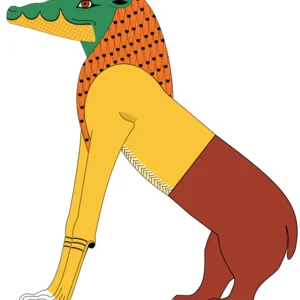

Ammit is a hybrid Egyptian deity, part lion, part hippopotamus, part crocodile. She presides over the Weighing of the Heart in the Hall of Judgment of the Dead. Souls deemed unworthy are devoured by her, condemned to the second death.
Ammit
Ammit
10 min read
Frequently asked questions
Key Facts
- Ammit is composed of the three animals most feared by the ancient Egyptians: lion, hippopotamus, and crocodile
- She presides in the Duat (the realm of the dead) during the Judgment of Osiris
- Her role is attested in the Book of the Dead (New Kingdom, c. 1550 BCE)
- She devours the hearts of the deceased whose sins tip the scales against the feather of Ma'at
- Souls she swallows suffer the 'second death' — total annihilation with no hope of rebirth
Works & Achievements
A collection of illustrated magical and funerary spells placed in tombs to guide the deceased through the Duat. Ammit appears systematically in the vignette of Chapter 125, depicting the Weighing of the Heart.
An exceptional copy of the Book of the Dead, now held at the British Museum in London. It contains the most well-known and detailed depiction of the Weighing of the Heart, with Ammit crouching beside Anubis's scales.
Another masterpiece of the Book of the Dead (British Museum), created for a royal scribe under Ramesses II. The judgment scene is remarkable for its iconographic precision, showing Ammit waiting in front of the scales.
A royal funerary text describing the sun's nightly journey through the twelve hours of the underworld. It details the entities and dangers of the Duat, including devouring beings — the tradition to which Ammit belongs.
A royal funerary text complementing the Amduat, describing the twelve guarded gates of the Duat. It reinforces the concept of the judgment of the dead and the punishment awaiting impure souls, who are devoured by Ammit.
A corpus of funerary spells inscribed on the interior of wooden coffins, accessible to a broader elite. They represent the earliest evidence of the fear of judgment and devouring in the afterlife, foreshadowing the role of Ammit.
Anecdotes
Ammit is not a goddess in the classical sense: she is neither prayed to, nor worshipped, nor given a temple. She is a dreaded entity, a threat looming over every soul of the deceased. Her role is purely punitive: to devour the hearts of impure souls, condemning them to the 'second death' — the total and final annihilation of their being.
Her hybrid body is no accident: the crocodile head, lion's forequarters, and hippopotamus hindquarters represent the three most dangerous and feared animals in the Nile world. Each part symbolizes a form of absolute terror, making Ammit the very embodiment of what the Egyptians feared most in the natural world.
During the Weighing of the Heart, Ammit stands beside the scales, ready to pounce. The deceased's heart is placed on one pan, opposite the feather of Ma'at — symbol of truth and justice. If the heart is heavier than the feather, weighed down by sins committed in life, Ammit devours it immediately. This scene is depicted in numerous papyri from the Book of the Dead.
The name 'Ammit' literally means 'Devourer of the Dead' or 'Bone Eater' in ancient Egyptian. She is also called 'Ahemait,' meaning 'she who devours the dead.' Unlike protective deities, she offers no chance of redemption: her presence serves as a reminder to the living of the importance of leading a just life, in accordance with Ma'at.
The fear of Ammit had a profound influence on Egyptian society: funerary texts such as the 'Negative Confessions' (Chapter 125 of the Book of the Dead) list up to 42 transgressions that the deceased declares they have not committed. This ritual was meant to convince the divine judges not to hand the soul over to the Devourer — a kind of plea delivered from beyond the grave.
Primary Sources
Ammit is depicted sitting before the scales, jaws open, awaiting the verdict. The scribe Ani recites his negative confessions before the forty-two divine judges in order to avoid being handed over to the Devourer.
The Judgment vignette shows Ammit crouching beside the scales of Anubis, part crocodile, part lion, part hippopotamus. Thoth records the outcome of the weighing on his tablets while Horus leads Hunefer before Osiris.
Ammit appears in the scene of the Hall of Osiris in her classic hybrid form. The text specifies that the soul of the deceased, if judged pure, will be permitted to join the solar barque of Ra, thus escaping devourment.
This royal funerary text describes the nightly journey of the sun through the twelve hours of the night across the underworld. It mentions the dangers that threaten impure souls, among them permanent destruction by the devouring entities of the Duat.
Funerary spells predating the Book of the Dead already describe the Hall of Judgment and the threat of devourment for guilty souls. These texts are the direct ancestors of the vignettes in which Ammit appears.
Key Places
A mythological place in the Duat (Egyptian underworld) where the Weighing of the Heart takes place. This is where Ammit resides and carries out her role as the Devourer, under the authority of Osiris and the forty-two divine judges.
The religious and political capital of the New Kingdom, Thebes was the main center for producing the Book of the Dead papyri in which Ammit appears. The west bank of the Nile was home to necropolises and royal tombs in the Valley of the Kings.
The royal necropolis of the New Kingdom, carved into the limestone rock. The walls of tombs belonging to pharaohs such as Thutmose III and Ramesses II are decorated with scenes from the Book of the Dead and the Amduat, including depictions of the tribunal of Osiris with Ammit.
A sacred city dedicated to Osiris, god of the dead and president of the tribunal before which Ammit awaits her verdict. The Temple of Seti I at Abydos contains depictions of the Osirian cult directly connected to the judgment of souls.
The ancient capital of Egypt and a major religious center dedicated to Ptah. Memphis is also associated with Sokar, the funerary god, and with numerous rites connected to the passage into the Duat where Ammit dwells.
Typical Objects

The central instrument of the Judgment of the Dead, the scale is the object around which Ammit waits. The verdict of the weighing determines whether or not she is permitted to devour the heart of the deceased.

A symbol of truth and divine justice, placed on one of the pans of the scale. If the heart of the deceased is heavier than this feather, Ammit is permitted to devour it.

The symbolic organ of the ancient Egyptians, seat of conscience and morality. It is what Ammit devours if the deceased led an impure life, condemning the soul to the second death.

Placed on the chest of mummies to protect the heart during judgment. Its inscription asked the heart not to testify against its owner before the divine judges — and thus not to give Ammit cause to act.

An illustrated papyrus scroll placed inside the coffin, containing the magic spells needed to navigate the Duat and pass the Weighing of the Heart, thereby outwitting Ammit.

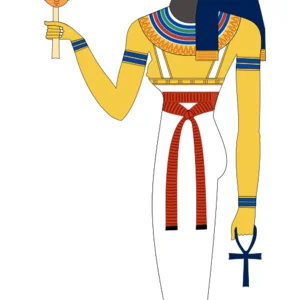
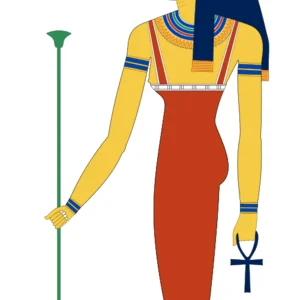
An attribute of deities and funerary officiants, the was scepter symbolizes divine power over the Duat. The gods present at the judgment, such as Anubis or Thoth, hold it during the weighing that Ammit oversees.

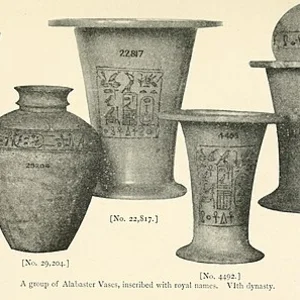
One of the four canopic jars containing the organs of the embalmed deceased. Their presence during funerary rites is directly linked to preserving the physical integrity of the dead — an essential protection against the threat that Ammit represents.
School Curriculum
Vocabulary & Tags
Key Vocabulary
Daily Life
Morning
In Egyptian mythology, Ammit has no daily life in the human sense. She resides permanently in the Hall of Two Truths, at the heart of the Duat, ever ready to carry out her function. At the symbolic dawn of each cycle, when Ra's barque begins its nightly journey, the souls of the dead pass through the gates of the underworld to stand before the tribunal of Osiris.
Afternoon
At the heart of the judgment, Ammit stands motionless beside the great ceremonial scales, watching each weighing conducted by Anubis. She takes no initiative — she waits for the verdict to be rendered. Only if the heart is weighed down by the deceased's wrongdoings does she spring forward and devour it, fulfilling the will of the forty-two divine judges.
Evening
Once the devouring is complete, Ammit returns to her state of waiting. Her act is not portrayed as cruel, but as necessary to the cosmic order. She is the guardian of Ma'at, universal truth: without her, impure souls could corrupt the paradise of Aaru (the Field of Reeds), disturbing the eternal harmony over which Osiris presides.
Food
Ammit feeds on the hearts of those souls judged unworthy — her sole mythological sustenance. This heart is not a physical organ but the seat of the deceased's moral conscience. By devouring it, Ammit erases every trace of the condemned soul's existence, inflicting upon it the 'second death' — total and irreversible annihilation.
Clothing
Ammit is not depicted wearing clothing: her body is that of a composite beast. In funerary vignettes, she appears bare, in all her hybrid animal nature. Egyptian artists rendered her with deliberate anatomical precision — the open jaws of a crocodile, the mane of a lion, the bulk of a hippopotamus — the better to emphasize her terrifying, non-human nature.
Housing
Ammit dwells in the Duat, the Egyptian underworld, and more specifically in the Hall of Two Truths (Aaru-en-Ma'at). This mythical place has no geographical location; it is conceived as a vast divine courtroom, its walls adorned with hieroglyphs, lit by a supernatural light, where Osiris sits enthroned and surrounded by the forty-two divine assessors.
Historical Timeline
Period Vocabulary
Visual Style
Art égyptien ancien du Nouvel Empire : style hiératique aux contours noirs marqués, palette de turquoise, or, ocre et lapis-lazuli, représentation hybride et symbolique d'Ammout dans la salle du jugement.
Sound Ambience
Atmosphère funéraire solennelle de l'Égypte ancienne : chants rituels, battements de tambour lents, balance qui grince et silence du Duat entrecoupé d'incantations de prêtres.
Liens externes & ressources
Références
Œuvres
Livre des Morts (Reu nu pert em heru)
v. 1550 av. J.-C. (Nouvel Empire), compilé jusqu'à l'époque ptolémaïque
Papyrus d'Ani
v. 1275 av. J.-C.
Papyrus de Hunefer
v. 1275 av. J.-C.
Amdouat ('Ce qui est dans le Duat')
v. 1479 av. J.-C., Nouvel Empire
Livre des Portes (Iru Arit)
v. 1295 av. J.-C., XIXe dynastie
Textes des Sarcophages
v. 2055-1650 av. J.-C., Moyen Empire