
Cat goddess of ancient Egyptian mythology, Bastet is the daughter of the sun god Ra and the protector of the home, women, and children. Venerated by the Egyptian people since the Old Kingdom, she embodies both maternal gentleness and protective power. Her cult, centered in Bubastis (Lower Egypt), reached its peak during the 1st millennium BCE.
Bastet
Bastet
8 min read
Frequently asked questions
Key Facts
- Attested from the Egyptian Old Kingdom (c. 2700 BCE) in the form of a lioness, later depicted as a domestic cat from the New Kingdom onward
- Her great temple at Bubastis (Tell Basta, Nile Delta) was one of the most visited in Egypt, according to Herodotus (5th century BCE)
- Thousands of mummified cats have been found in the necropolises of Bubastis, offered as votive gifts to the goddess
- The annual festival of Bastet was, according to Herodotus, the largest and most joyful in Egypt, drawing hundreds of thousands of pilgrims
- Identified with the Greek goddess Artemis during the Ptolemaic period, reflecting the religious syncretism of the Mediterranean world
Works & Achievements
A grand religious complex described by Herodotus as one of the most beautiful in Egypt, serving as the center of an annual pilgrimage. Archaeological remains at Tell Basta confirm its importance.
Thousands of bronze statuettes depicting the cat goddess were produced and found throughout Egypt and the Mediterranean, testifying to the widespread diffusion of her cult.
A collection of liturgical songs and prayers in honor of Bastet, passed down orally by priestesses and recorded on papyrus, celebrating her attributes of protection and joy.
A great religious celebration described by Herodotus, drawing hundreds of thousands of participants who traveled by river, combining music, dance, and offerings.
A cycle of myths in which Bastet embodies the vengeful eye of Ra, protecting the sun god against the serpent Apophis, transmitted through funerary texts and religious papyri.
Anecdotes
Originally, Bastet was depicted as a fierce lioness, symbolizing the warrior power of the sun. It was only from the New Kingdom onward that she gradually took on the appearance of a domestic cat, embodying gentleness, fertility, and the protection of the home.
The city of Bubastis, the center of Bastet's cult in the Nile Delta, hosted a great festival in her honor every year. The Greek historian Herodotus, who visited Egypt in the 5th century BCE, describes processions by boat along the Nile, filled with music, singing, and celebrations attended by tens of thousands of pilgrims.
Cats were considered sacred in ancient Egypt, largely because of their connection to Bastet. Killing a cat, even accidentally, was punishable by death. Millions of mummified cats have been found at Bubastis and other sanctuaries dedicated to the goddess, offered as votive gifts by worshippers.
Bastet was also the goddess of music and joy. Her emblematic instrument was the sistrum, a kind of metal rattle whose jingling was believed to ward off evil spirits and please the goddess. Priestesses of Bastet would play the sistrum during ritual ceremonies.
In Egyptian solar mythology, Bastet could take the form of the Eye of Ra to protect her father the sun god. She was thus associated with both the gentle light of the moon and the protective rays of the sun, symbolizing the duality between tenderness and power.
Primary Sources
"The Egyptians flock to Bubastis for the festival of Bastet. More wine is consumed there than at any other time of year, and the crowd of pilgrims can reach seven hundred thousand people, men and women together."
Among the oldest religious texts in human history, the Pyramid Texts mention protective feline deities associated with the deceased king, in a solar context linked to Ra.
"I am the great cat who sits beside the Persea tree at Heliopolis, on the night the battle was fought and the day the enemies of Nebertcher were destroyed." This image evokes Bastet or an assimilated deity battling the serpent Apophis.
Votive stele depicting worshippers offering mummified cats to Bastet, with hieroglyphic inscriptions invoking the goddess's protection over the household and fertility.
A fragment of a religious hymn celebrating Bastet as "Lady of Bubastis, Eye of Ra, protector of the living," describing her combined attributes of gentleness and ferocity.
Key Places
A city in the Nile Delta and the main center of Bastet's cult, where her great temple stood — described by Herodotus. Archaeological excavations have uncovered thousands of mummified cats.
A burial site near Memphis where cemeteries of mummified cats dedicated to Bastet were discovered, reflecting the wide geographical reach of her cult.
A major Egyptian religious city and center of the solar cult of Ra, Bastet's father. The solar myths linking Bastet to the Eye of Ra were developed there by the priests.
The religious capital of Egypt during the New Kingdom, where Bastet was worshipped alongside Sekhmet and Mut in temples dedicated to feline deities.
The administrative capital of the Old and Middle Kingdoms, where the cult of Bastet stood alongside those of Ptah and Sekhmet, reflecting the diversity of the Egyptian pantheon.
Typical Objects

A metallic percussion instrument used in rituals honoring Bastet. Its jingling sound was believed to ward off evil forces and bring joy to the goddess.

A figurine depicting Bastet as a seated cat, often adorned with a collar or earrings. A typical votive offering left by worshippers at her temple.
A statuette depicting a priestess or the goddess holding a sistrum, reflecting the close connection between Bastet and sacred music during religious ceremonies.

Millions of cats were ritually sacrificed and mummified as offerings to Bastet, testifying to the importance of her cult and the sacred status of cats in ancient Egypt.

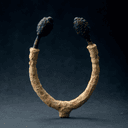
A semicircular protective collar topped with a feline head, an emblem of Bastet worn as an amulet to protect its bearer.

An iconographic attribute of Bastet, the basket she carries on her arm symbolizes the domestic home and her role as protector of the household and family.

An amulet in the shape of an eye representing the Eye of Ra, of which Bastet is a manifestation. A widely used symbol of protection and healing in ancient Egyptian religion.
School Curriculum
Vocabulary & Tags
Key Vocabulary
Tags
Daily Life
Morning
At sunrise, the priestesses of Bastet would open the naos — the sacred shrine — to "awaken" the goddess's statue: they ritually washed it, anointed it with perfumed oils, and presented offerings of food and lotus flowers. The temple would fill with the jingling of sistrums and ritual chants welcoming the sun god Ra, Bastet's father.
Afternoon
In the middle of the day, worshippers could leave their votive offerings — bronze cat figurines, mummified cats, jewelry — in the temple's offering halls. Healers connected to the cult of Bastet would consult with the sick, as the goddess was also invoked against illness and evil spirits. Sacred cats roamed freely within the temple precinct, fed and cared for by the priests.
Evening
At sunset, a second ceremony would close the naos, accompanied by incense and sung prayers. The priestesses played the sistrum and harp to "lull" the goddess to sleep. During major festivals, the celebrations continued into the night with music, dancing, and wine libations — as Herodotus reported with astonishment.
Food
The temple's priests and priestesses lived off the food offerings made to the goddess: bread, poultry, fish from the Nile, vegetables, fruit, and beer. Fish was particularly associated with Bastet. The sacred cats also received special food, a mark of their divine status.
Clothing
The priestesses of Bastet wore long robes of fine white linen, braided hairstyles or black wigs, and pectoral necklaces of turquoise faience and gold. During the most solemn rituals, they might wear a ceremonial mask in the shape of a cat's head. Ordinary worshippers wore amulets in the shape of the Wedjat eye or a small cat figurine.
Housing
Bastet's symbolic home was her temple at Bubastis, surrounded by water channels — evoking a sacred island — and planted with trees, according to Herodotus. Priestesses lived in quarters adjoining the temple. In Egyptian homes, a small statuette or a niche dedicated to Bastet protected the household, reflecting her role as guardian of the home.
Historical Timeline
Period Vocabulary
Visual Style
Style égyptien ancien avec représentation frontale stylisée de Bastet, palette chaude en ocre, or et bleu lapis-lazuli, hiéroglyphes et temple en grès.
Sound Ambience
Atmosphère sonore d'un temple de Bastet à Bubastis : tintement de sistres, chants rituels de prêtresses et présence feutrée des chats sacrés au bord du Nil.
Liens externes & ressources
Références
Œuvres
Temple de Bastet à Bubastis
construit et agrandi de l'Ancien Empire au IXe siècle avant J.-C.
Corpus des statuettes en bronze de Bastet
Basse Époque, 664–332 avant J.-C.
Hymnes à Bastet (tradition orale et papyrus)
Nouvel Empire et Basse Époque
Fête annuelle de Bubastis
attestée du IIe millénaire au Ve siècle avant J.-C.
Mythes solaires de l'Œil de Rê
Moyen et Nouvel Empire, vers 2000–1070 avant J.-C.