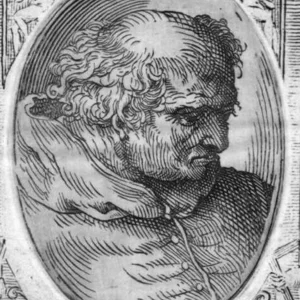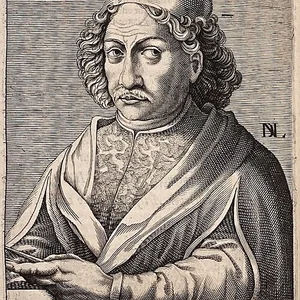

Florentine sculptor, painter, and goldsmith of the 15th century, Verrocchio ran one of the most influential workshops of the Italian Renaissance. He trained Leonardo da Vinci, among others. His sculptural work, including the equestrian statue of Bartolomeo Colleoni in Venice, exemplifies the revival of ancient art.
Andrea del Verrocchio(1435 — 1488)
Andrea del Verrocchio
République florentine
9 min read
Frequently asked questions
Key Facts
- Born around 1435 in Florence, died in 1488 in Venice
- Ran a renowned Florentine workshop where Leonardo da Vinci served as his apprentice (c. 1466–1476)
- Created the bronze *David* (c. 1473–1475), now held at the Bargello in Florence
- Created the equestrian statue of Bartolomeo Colleoni in Venice (1480–1488), a masterpiece of Renaissance sculpture
- Worked under the patronage of Lorenzo de' Medici
Works & Achievements
Bronze sculpture commissioned by the Medici depicting the young David victorious over Goliath. A masterpiece of Florentine casting, it was sold by the Medici to the Florentine Signoria in 1476 and is now held at the Bargello Museum in Florence.
Funerary monument in porphyry, marble, and bronze in the Basilica of San Lorenzo in Florence, commissioned by Lorenzo the Magnificent. It testifies to Verrocchio's mastery in combining noble materials with refined architectural ornamentation.
Painting executed with his apprentice Leonardo da Vinci, who painted one of the angels and the background landscape. According to Vasari, the superior quality of Leonardo's angel convinced Verrocchio to give up painting altogether. Now held at the Uffizi Gallery, Florence.
Bronze sculptural group for a niche at Orsanmichele in Florence, commissioned by the merchant guild Arte della Mercanzia. This monumental work reveals an expressive naturalism of striking modernity, depicting Saint Thomas touching the wound of the risen Christ.
Marble bust of a young woman holding flowers, remarkable for its vivacity and grace. Held at the Bargello Museum in Florence, it illustrates Verrocchio's ability to convey movement and psychological depth in stone.
Masterpiece of Renaissance equestrian sculpture, commissioned by the Republic of Venice. Verrocchio worked on it until his death in 1488; Leopardi completed it and the statue was unveiled in 1496 in the Campo Santi Giovanni e Paolo in Venice.
Anecdotes
When Verrocchio entrusted his young apprentice Leonardo da Vinci with painting an angel in the Baptism of Christ (c. 1475), he could not have imagined that this gesture would change the history of art. According to Giorgio Vasari, upon seeing the angel painted by Leonardo — of a quality so far superior to his own contribution — Verrocchio reportedly decided never to touch a paintbrush again, acknowledging that his pupil had surpassed him.
In 1479, the Republic of Venice commissioned Verrocchio to create a monumental equestrian statue in honor of the condottiere Bartolomeo Colleoni. The artist devoted the last nine years of his life to this colossal masterpiece. He died in Venice in 1488 and never saw his work completed: the statue was cast and installed in the Campo Santi Giovanni e Paolo by Alessandro Leopardi in 1496.
Verrocchio's bottega was a true school of Florentine art. Among his apprentices were Leonardo da Vinci, Pietro Perugino (future master of Raphael), and Lorenzo di Credi. This Florentine workshop trained some of the greatest artists of the High Renaissance, making Verrocchio one of the most influential artistic educators of his century.
Before becoming a sculptor, Verrocchio first made his mark as a goldsmith, learning to work precious metals with extreme precision. He even took the name of his goldsmith master, Giuliano di Giovanni da Verrocchio. This training accounts for the exceptional delicacy of his bronzes, where the details — flowing hair, intricate drapery, expressive hands — display a refinement worthy of the decorative arts.
The Medici were Verrocchio's greatest patrons. Lorenzo the Magnificent entrusted him with prestigious commissions, including the porphyry and bronze tomb for family members at San Lorenzo. This privileged relationship placed the artist at the heart of Florentine power and made his bottega one of the most sought-after in the city.
Primary Sources
Allora Andrea si vergognò tanto che un fanciullo ne sapesse più di lui, che mai più volle toccare i colori. (Then Andrea was so ashamed that a child knew more than he did, that he never wished to touch colors again.)
Fu data la commissione a fare il cavallo di bronzo a maestro Andrea del Verrocchio fiorentino, come il più eccellente maestro che si trovasse in quel tempo per sì fatto lavoro. (The commission was given to master Andrea del Verrocchio of Florence, recognized as the most excellent master to be found at that time for such a work.)
Andrea del Verrocchio fu orafo e sculptore e pittore fiorentino e fu maestro di Lionardo da Vinci. (Andrea del Verrocchio was a Florentine goldsmith, sculptor, and painter, and was the master of Leonardo da Vinci.)
Andrea di Michele di Cione, detto Verrocchio, scultore et orafo, con bottega in Santo Ambrogio. Register confirming the workshop's activity and its location in the Florentine quarter of Sant'Ambrogio.
Key Places
Verrocchio's birthplace and the center of all his artistic activity. His bottega, in the Sant'Ambrogio district, was one of the most renowned of the Quattrocento, attracting commissions from the Medici and training Leonardo da Vinci as well as other great masters.
Verrocchio settled here in the final years of his life to oversee the creation of the equestrian statue of Bartolomeo Colleoni. He died there in 1488; his assistant Alessandro Leopardi completed the work, which was unveiled in 1496.
A Florentine religious and commercial building for which Verrocchio created his bronze sculptural group *The Incredulity of Saint Thomas* (1466–1483), commissioned by the powerful merchant guild Arte della Mercanzia.
The Medici pantheon in Florence, where Verrocchio created the sumptuous porphyry and bronze tomb of Giovanni and Piero de' Medici (1472), commissioned by Lorenzo the Magnificent to honor his ancestors.
The Venetian square where the equestrian statue of Bartolomeo Colleoni stands today — Verrocchio's posthumous masterpiece, unveiled in 1496. It is regarded as one of the greatest equestrian sculptures of the Italian Renaissance.
Typical Objects

Essential tools for marble sculptors, the claw chisel (a toothed chisel) was used to achieve textured surfaces before final polishing. Verrocchio wielded them with a precision inherited from his training as a goldsmith.

To cast his monumental bronzes, Verrocchio used crucibles resistant to temperatures exceeding 1,000 °C. The bellows fanned the furnace embers needed to melt the metal in his workshop.

Before any bronze casting, Verrocchio would model a wax prototype coated in clay. Once fired, the wax melted and drained away, leaving a mold into which liquid bronze was poured, reproducing every last detail of the sculpture.

The compass was used to transfer precise measurements onto sculptures and to verify proportions according to ancient canons. A key instrument for any Renaissance artist concerned with harmony and correct proportion.

Drawing (disegno) was the foundation of all creation for Verrocchio. He prepared his sculptures and paintings through numerous preparatory studies, some of which were passed on to his apprentices as teaching models.

Before running his great bottega, Verrocchio had been a goldsmith. His hammers and anvils were used to work silver and gold into very thin sheets. This training accounts for the remarkable decorative precision found throughout his bronzes.
School Curriculum
Vocabulary & Tags
Key Vocabulary
Daily Life
Morning
Verrocchio rose at dawn, like all Florentine craftsmen of the Quattrocento. He devoted the early hours of the day to overseeing his bottega: assigning tasks to his apprentices (garzoni), correcting work in progress, and sketching new projects. For a master of his standing, teaching and passing on his craft were an integral part of the trade.
Afternoon
The afternoon was reserved for the most demanding work: chiseling marble, modeling wax, or overseeing a bronze casting. When an important commission was underway, Verrocchio might visit the Medici palace to consult with his patrons and present his models. Several projects were often run simultaneously in the workshop.
Evening
In the evening, Verrocchio inspected the day's work by torchlight, checking proportions and finishing details with a goldsmith's precision. Florence also offered intellectual exchange in the humanist circles close to the Medici, where artists, philosophers, and poets debated the ideals of Antiquity and the dignity of the arts.
Food
Like any prosperous Florentine craftsman, Verrocchio subsisted mainly on bread, vegetables, legumes, and meat or fish on feast days. Tuscan wine accompanied meals, often diluted with water as was the custom. A successful master could afford more varied fare, including roasted meats and Tuscan cheeses.
Clothing
Verrocchio wore the dress of a well-to-do Florentine craftsman: a tunic (giubbone) of wool or linen, hose, and a more elaborate cloak for his appointments with the Medici. In the workshop, a thick leather apron protected him from spatters of molten metal and marble dust.
Housing
According to Florentine tax records (catasto), Verrocchio lived in the Sant'Ambrogio quarter of Florence, most likely within or near his bottega. The workshop of a master sculptor-painter served simultaneously as a workplace, a teaching space, and a communal living environment, where apprentices rubbed shoulders daily with wax models and works in progress.
Historical Timeline
Period Vocabulary
Liens externes & ressources
Références
Œuvres
Tombeau de Giovanni et Piero de Médicis
1472
L'Incrédulité de saint Thomas
1466-1483
Dame au bouquet (Buste de femme)
c. 1475-1480