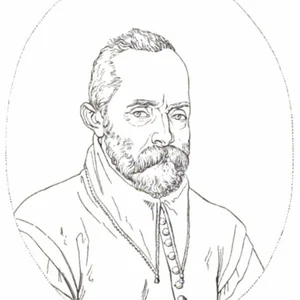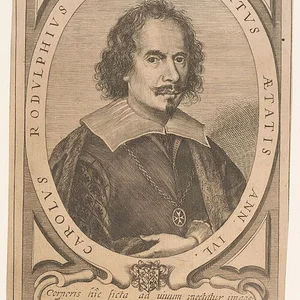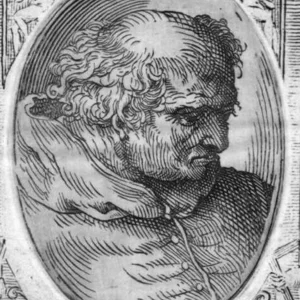

Italian architect and painter of the Renaissance (1444–1514), Bramante is considered the father of High Renaissance architecture. He designed the plan for the new St. Peter's Basilica in Rome and created the Tempietto, a masterpiece of classical architecture.
Bramante(1444 — 1514)
Bramante
9 min read
Frequently asked questions
Key Facts
- 1444: born in Monte Asdrualdo (present-day Fermignano), in the Marche region
- 1499: arrives in Rome after the Sforza are expelled from Milan, his adopted city
- 1502: construction of the Tempietto of San Pietro in Montorio, considered the manifesto of High Renaissance architecture
- 1506: laying of the foundation stone of the new St. Peter's Basilica in Rome, according to his plans
- 1514: dies in Rome; his plans for St. Peter's will be taken up and modified by Michelangelo
Works & Achievements
A small circular temple with a Doric colonnade erected on the Janiculum Hill, considered the first perfect masterpiece of the High Renaissance. Its centralized plan, rigorous proportions, and ambulatory made it the definitive model of classical architecture for generations to come.
Bramante conceived a Greek cross plan topped by an immense dome inspired by the Pantheon; the foundation stone was laid on April 18, 1506. Although modified after his death by Raphael, Michelangelo, and other architects, his centralized vision remains at the heart of the building as it stands today.
A vast architectural complex linking the Apostolic Palace to the Belvedere Villa, this monumental multi-level corridor revolutionized the design of palatial outdoor spaces and had a lasting influence on Renaissance garden architecture.
Bramante added a centrally planned tribune covered by a dome to Milan's Gothic church — one of his first major achievements. The church, which houses Leonardo da Vinci's *The Last Supper*, is today a UNESCO World Heritage Site.
Bramante's first major commission in Rome, this cloister with two levels of superimposed arcades demonstrated his mastery of ancient architecture and introduced the papal city to an architect of an entirely new caliber.
Julius II commissioned Bramante to design a vast palace of justice intended to serve as the administrative center of a renewed Rome. The project never progressed beyond drawings, yet it stands as testament to the monumental urban ambitions shared by the architect and his patron.
Anecdotes
In Milan, Bramante faced an extraordinary architectural challenge: the church of Santa Maria presso San Satiro had no room to build a real choir. He invented a false apse using trompe-l'œil, painting a perspective so convincing on a flat wall that visitors believed they were looking at several meters of depth. This tour de force testifies to his simultaneous mastery of painting and architecture.
When Pope Julius II entrusted him in 1506 with the reconstruction of St. Peter's Basilica, Bramante proposed a Greek cross plan topped by an immense dome inspired by the ancient Pantheon. The construction required demolishing entire sections of the old Early Christian basilica, which earned him the ironic nickname 'Mastro Ruinante' — the master demolisher. He died in 1514, long before the completion of the work he had envisioned.
Bramante and Raphael were close: the architect, who had known the young painter in Urbino, introduced him to the papal court in Rome. According to Vasari, Bramante even recommended Raphael to Julius II for the decoration of the Vatican Rooms. By contrast, his relationship with Michelangelo was strained: the latter accused him of having worked against him with the pope, and publicly criticized his plan for St. Peter's.
The Tempietto of San Pietro in Montorio (1502) is so perfect in its proportions that the architect and theorist Andrea Palladio, half a century later, cited it as the absolute model in his treatise 'The Four Books of Architecture'. This small circular temple, measuring just 4.5 meters in interior diameter, synthesizes all the rules of ancient architecture and was immediately recognized as a masterpiece of the Renaissance.
Trained in Urbino at the court of Duke Federico da Montefeltro, Bramante rubbed shoulders in his youth with Piero della Francesca, from whom he absorbed rigorous theories on mathematical perspective. This pictorial training nourished his entire architectural practice: his buildings are constructed like three-dimensional paintings, where each column and each arcade responds to precise laws of proportion inherited from Vitruvius and Roman antiquity.
Primary Sources
Bramante was the first to bring to light the good and difficult architecture, which had lain buried for so many centuries, and to bring it, with beautiful style, to its full perfection.
Wishing that the basilica of the Prince of the Apostles, foundation and ornament of the Roman Church, be raised to a new dignity, We have resolved to undertake its reconstruction according to a plan worthy of the majesty of God.
The Tempietto of San Pietro in Montorio is the most perfect work of the moderns, in which Bramante demonstrated that the rules of the Ancients could be applied with all their rigor and beauty.
Bramante was the first to bring good architecture back to light, which from antiquity until that time had been hidden.
Key Places
A small town in the Marche region, near Urbino, where Bramante was born in 1444. This cultural cradle, close to the humanist court of Urbino, would shape his entire artistic and intellectual formation.
The ducal court of Federico da Montefeltro, one of the most brilliant centers of the Italian Renaissance, where Bramante trained alongside the finest artists and theorists of his time.
The city where Bramante worked for twenty years under Ludovico Sforza, completing the tribune of Santa Maria delle Grazie and the celebrated trompe-l'œil apse of Santa Maria presso San Satiro. This Milanese period refined his mastery of architectural perspective.
Bramante's absolute masterpiece (1502), this small circular temple erected on the Janiculum Hill is considered the perfect synthesis of High Renaissance architectural principles. It influenced Palladio and every European architect in the centuries that followed.
The great work of Bramante's life, commissioned by Julius II in 1506: to completely rebuild the old Early Christian basilica into a monument to the glory of the Catholic Church. His Greek-cross plan crowned by a colossal dome inspired all his successors, up to Michelangelo.
A vast courtyard linking the Vatican palaces to the Belvedere of Innocent VIII, designed by Bramante for Julius II from 1505 onward. This achievement introduced to Europe the concept of large-scale architectural composition integrating gardens and terraced levels.
Typical Objects

Indispensable instruments of Bramante's work, they allowed him to draft his plans with precision and verify the accuracy of proportions according to the rules inherited from Vitruvius.

An architectural treatise by the Roman engineer of the 1st century BC, this text was the bible of Renaissance architects. Bramante drew on it constantly to rediscover the canons of ancient architecture.

Bramante produced small-scale models to present his projects to popes and patrons, most notably the famous Greek-cross plan for Saint Peter's Basilica.

Bramante carefully studied and measured the remains of Roman antiquity still scattered across Rome — columns, arches, and entablatures — in order to recover their exact proportions.

Everyday tools of supervision on the colossal construction sites he oversaw, such as Saint Peter's Basilica, where hundreds of workers labored under his direction.
School Curriculum
Vocabulary & Tags
Key Vocabulary
Tags
Daily Life
Morning
Bramante rose early to make the most of the natural light essential for architectural drawing. His mornings began with visits to active construction sites — in Rome, he could be running several projects simultaneously for the pope — where he checked that his plans were being followed, corrected the masons, and measured the work completed. He would then record his observations on sheets of parchment.
Afternoon
Afternoons were devoted to meetings with his patrons, foremost among them Julius II, a demanding and impatient pope who wanted to see Saint Peter's progress within his own lifetime. Bramante also received contractors, marble cutters, and stonemasons, negotiating materials and deadlines. He might also roam Rome sketching and measuring ancient monuments, notebook in hand.
Evening
In the evenings, at his Roman residence, Bramante drew up his final plans and wrote his technical reports. A cultivated and sociable man, he moved in the humanist circles of the papal court, discussing architecture, philosophy, and Antiquity with scholars such as Raphael and Baldassare Castiglione. Vasari records that he enjoyed improvising sonnets in Tuscan.
Food
The diet of a court architect in early sixteenth-century Rome was that of the prosperous classes: white bread, roasted meats (chicken, veal), fish on the lean days prescribed by the Church, and seasonal vegetables and fruit. Wine from the Castelli Romani (Frascati) accompanied meals. Bread and legumes remained the staple, supplemented by cheeses and cured meats.
Clothing
Bramante dressed as a respected artist-intellectual: a long dark robe (*saye*) of wool or broadcloth, doublet and hose, topped with an Italian-style cap. For papal audiences and ceremonies he wore a finer broadcloth cloak, sometimes fur-trimmed. On building sites, sturdier clothing and a pair of solid leather shoes were required.
Housing
In Rome, Bramante occupied comfortable lodgings in the Borgo district, near the Vatican, which allowed him quick access to his pontifical building sites. His home included a large workroom piled with plans, models, and architecture books — notably his prized edition of Vitruvius. He kept one or two servants and employed apprentice draughtsmen.
Historical Timeline
Period Vocabulary
Liens externes & ressources
Références
Œuvres
Tempietto de San Pietro in Montorio, Rome
vers 1502-1510
Plan de la basilique Saint-Pierre de Rome
1505-1506
Cortile del Belvedere, Vatican
1503-1513
Tribune de Santa Maria delle Grazie, Milan
vers 1492-1497
Cloître de Santa Maria della Pace, Rome
1500-1504
Palazzo dei Tribunali, Rome (projet non réalisé)
1508