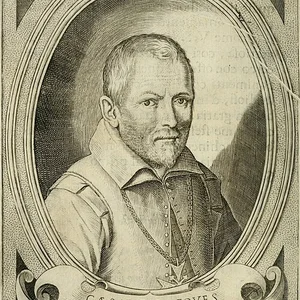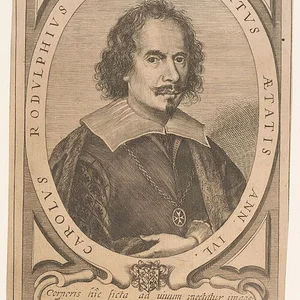

Carlo Ridolfi (1594-1658) was a Venetian painter and Italian art historian. He is best known for his *Meraviglie dell'Arte*, a biographical collection of Venetian painters and a major source for the history of Italian painting.
Carlo Ridolfi(1594 — 1658)
Carlo Ridolfi
république de Venise
7 min read
Frequently asked questions
Key Facts
- Born in 1594 in Lonigo (Veneto), died in 1658 in Venice
- Published the *Meraviglie dell'Arte* in 1648, a collection of biographies of Venetian painters
- A pupil of Palma il Giovane, he carried on the Venetian pictorial tradition
- His written work is an essential historiographical source on Renaissance painting in Venice
- Contributed to preserving the artistic legacy of Titian, Tintoretto, and Veronese
Works & Achievements
Ridolfi's historiographical masterpiece, published in two volumes in Venice. This biographical work on Venetian painters remains an irreplaceable primary source for the history of Venetian Renaissance and Baroque art.
The first major detailed biography of Tintoretto published separately, later incorporated into the *Maraviglie*. Ridolfi brings together firsthand accounts and precise descriptions of the master's works.
One of Ridolfi's painted works for the churches of the Veneto, in the tradition of the religious altarpiece inherited from Palma il Giovane. His painting bears witness to the enduring vitality of the grand Venetian style in the seventeenth century.
Ridolfi painted several portraits of Venetian nobles, a genre in high demand in the Serenissima. These works secured him a steady clientele and gave him access to the city's great private collections.
Anecdotes
Carlo Ridolfi was a pupil of Palma the Younger, one of the last great masters of sixteenth-century Venetian painting. This apprenticeship allowed him to come into direct contact with artists who had known Tintoretto or Veronese, receiving firsthand memories and anecdotes that would later enrich his biographies.
When he published *Le Maraviglie dell'Arte* in 1648, Ridolfi filled an enormous gap: no author had yet devoted a comprehensive study to the Venetian painters since Vasari's *Vite* (1568), which had largely overlooked the Venetian school. His two-volume work immediately became an indispensable reference for anyone seeking to understand Venetian painting.
Ridolfi gathered his information on Tintoretto by interviewing direct witnesses
including members of the painter
s own family. Thanks to him
we know that Tintoretto reportedly hung this motto in his studio:
The drawing of Michelangelo and the color of Titian" — an ambition that sums up an entire artistic program, and one that art history still recalls today.
Although trained as a painter, Ridolfi never achieved the fame of his Venetian masters. There is an irony of history here: the man who immortalized the glories of Venetian painting is himself almost forgotten as an artist, and survives in collective memory only as an art historian.
Ridolfi worked in Venice against a backdrop of the Republic's relative decline: the city had lost its commercial dominance to the Atlantic powers, yet it remained a cultural center of intense vitality. This awareness of a golden age now past doubtless explains his desire to preserve the memory of the great painters of the previous century before it disappeared entirely.
Primary Sources
A work dedicated to the memory of the great Venetian painters, describing their lives, works, and painting styles, with careful research into primary sources and the testimonies of their contemporaries.
Ridolfi portrays Tintoretto as a painter of prodigious energy, capable of working without rest and covering vast surfaces in a remarkably short time — a detail confirmed by the accounts of his contemporaries.
Ridolfi praises the magnificence of Veronese's decorative settings and the splendor of his colors, noting that the painter had a gift for depicting Venetian festivity and luxury with striking truthfulness and unrivaled harmony.
Ridolfi describes Titian as the prince of Venetian painting, whose exceptional longevity allowed his art to flourish across more than six decades, shaping every subsequent generation of painters.
Key Places
Carlo Ridolfi's birthplace, located in the Veneto region, inland. Ridolfi was born there in 1594 before moving to Venice for his artistic training.
A working-class and artisan district of Venice home to many painters' workshops. Ridolfi spent most of his career there, mixing with painters, engravers, and collectors.
It was in this workshop that Ridolfi completed his training as a painter. Palma the Younger (1548–1628) was at that time the official painter of the Venetian Republic, heir to Titian and Tintoretto.
Venice's great public library, founded in the 16th century, where Ridolfi consulted documents, art treatises, and archives while writing his biographies of painters.
A Venetian building entirely decorated by Tintoretto, which Ridolfi describes at length in his Maraviglie as the master's absolute masterpiece. Ridolfi studied the paintings there in meticulous detail in order to write his biography of Tintoretto.
Typical Objects

Ridolfi's everyday tool in his painting practice. He used traditional Venetian pigments — vermilion, lapis lazuli, terre verte, lead white — inherited from the techniques of his masters.

Instruments of his calling as an art historian. It was with these tools that Ridolfi wrote the meticulous biographies of Venetian painters that constitute his most enduring legacy.

Ridolfi gathered testimonies, anecdotes, and descriptions of artworks in working notebooks. These preparatory notes formed the indispensable documentary foundation of his 'Meraviglie dell'Arte'.

The primary support for Venetian oil painting since the sixteenth century. Ridolfi painted numerous altarpieces and religious scenes on canvas, destined for churches in Venice and the Veneto.

The illustrated editions of Giorgio Vasari's 'Vite' served as a model and reference for Ridolfi in structuring his own biographical work and defining its descriptive method.

The customary mode of transport in Venice, which Ridolfi used to travel from church to church in order to examine and describe the works of the masters whose lives he was writing.
School Curriculum
Vocabulary & Tags
Key Vocabulary
Daily Life
Morning
Ridolfi began his day early, as did most Venetian craftsmen and intellectuals. He devoted the first hours to reading and writing, making the most of the morning light to work on his biographies or on letters to collectors and art connoisseurs. The cool of the morning was conducive to concentration before the city stirred into life.
Afternoon
In the afternoon, Ridolfi visited churches, palaces, and convents to study the paintings he described in his *Maraviglie*. He questioned elders, members of artists' families, sacristans, and custodians who could offer him anecdotes or information about the history of the works. He kept his *taccuino* (notebook) to jot down what he saw and heard.
Evening
In the evenings, in his Venetian studio or lodgings, Ridolfi would sometimes meet with other intellectuals or artists for lively discussions on painting and the arts. He would write up his notes from the day, compare his sources, and draft pages of the *Maraviglie*. Venetian intellectual life in the seventeenth century often unfolded through these informal exchanges between men of letters and artists.
Food
The diet of a seventeenth-century Venetian artist-writer was built around the resources of the lagoon: fish (salt cod, sardines, eels), shellfish, vegetables from the Rialto market, corn polenta (introduced in the Veneto in the sixteenth century), and bread. Wine from the Colli Euganei or the broader Veneto region accompanied meals, often eaten simply in neighbourhood *osterie*.
Clothing
Ridolfi wore the clothing typical of a modestly circumstanced artist in Venice: a dark cloth doublet, a cloak (*tabarro*) to ward off the lagoon's damp, wool stockings, and thick-soled shoes suited to the uneven paving of the Venetian *calli*. On formal occasions or when calling on patrons, he would wear more carefully chosen garments in subdued colours such as black or grey.
Housing
Ridolfi lived and worked in lodgings typical of the Venetian urban fabric: an apartment in a pink brick building with low ceilings and one or two rooms serving as both studio and study. A window looking onto a canal or inner courtyard provided indirect light, ideal for painting. The ever-present humidity of the lagoon made winter heating essential: a stone fireplace (*camino*) dominated the main wall.
Historical Timeline
Period Vocabulary
Liens externes & ressources
Références
Œuvres
Le Maraviglie dell'Arte overo le vite degli illustri pittori veneti e dello stato
1648
Vita di Giacopo Robusti detto il Tintoretto
vers 1642
Portraits de patriciens vénitiens
vers 1620-1650