 flip
flipKaya Varuthathu (Plantain Chips in Coconut Oil)
Kaya Varuthathu (Plantain Chips in Coconut Oil)
Why this dish? These crispy chips keep for weeks in a jar: the snack one carries on a journey. Anna Mani traveled a great deal — from Madras to Bangalore, from London to Pune — and this kind of dry, simple, durable provision traditionally accompanies Keralites far from home.
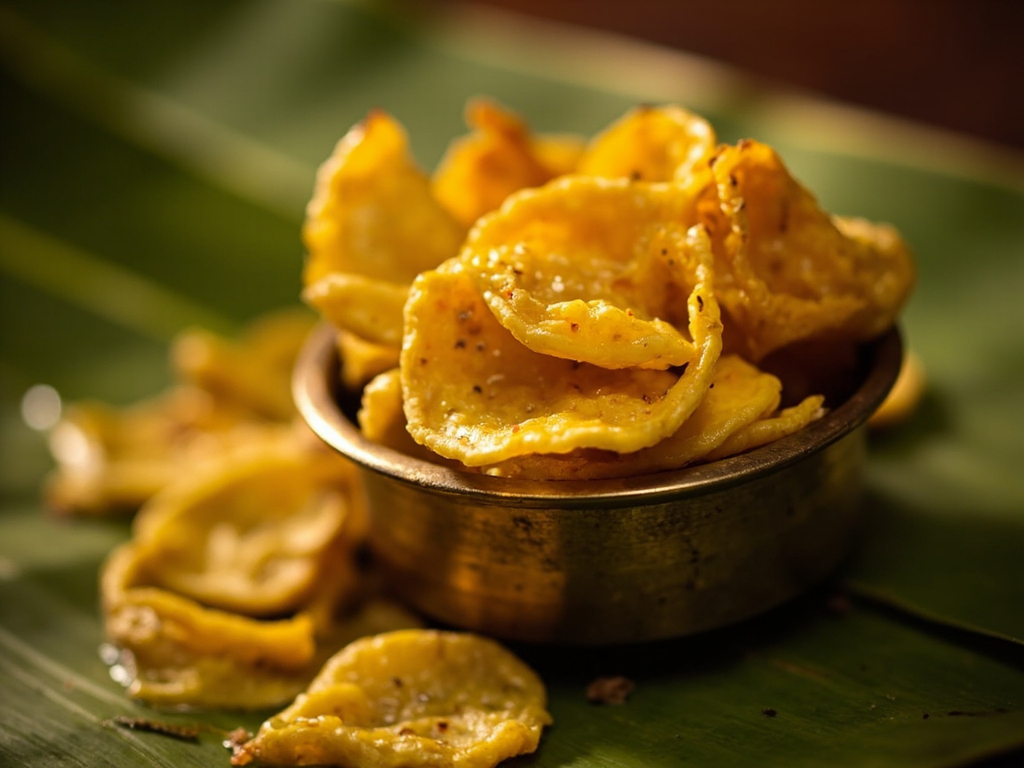
Thin slices of green plantain fried in coconut oil until brittle and golden, salted with salt water thrown in at the end of cooking. The quintessential Kerala snack, which keeps for a long time.
When you travel far — and I have taken many trains, many boats — you carry a cone of upperi. You need a plantain still green, firm, sliced thin over boiling coconut oil, blade against the skin. Only at the end do you throw a spoonful of salt water into the oil: it crackles, foams, and the salt fixes instantly on each slice. Drain well, let cool, store dry in a sealed jar. It keeps for weeks — useful, when you don't like depending on others for your meal.
- •Green plantains (nendran) — several (base)
- •Coconut oil — enough for frying (cooking)
- •Salt dissolved in a little water — one spoonful (seasoning)
- •Turmeric (optional) — a pinch (color)
Kaya Varuthathu (Plantain Chips in Coconut Oil)
Thin slices of green plantain fried in coconut oil until brittle and golden, salted with salt water thrown in at the end of cooking. The quintessential Kerala snack, which keeps for a long time.
Why this dish? These crispy chips keep for weeks in a jar: the snack one carries on a journey. Anna Mani traveled a great deal — from Madras to Bangalore, from London to Pune — and this kind of dry, simple, durable provision traditionally accompanies Keralites far from home.
When you travel far — and I have taken many trains, many boats — you carry a cone of upperi. You need a plantain still green, firm, sliced thin over boiling coconut oil, blade against the skin. Only at the end do you throw a spoonful of salt water into the oil: it crackles, foams, and the salt fixes instantly on each slice. Drain well, let cool, store dry in a sealed jar. It keeps for weeks — useful, when you don't like depending on others for your meal.
Ingredients (period version)
- Green plantains (nendran) — several (base)
- Coconut oil — enough for frying (cooking)
- Salt dissolved in a little water — one spoonful (seasoning)
- Turmeric (optional) — a pinch (color)
Ingredients
- Green plantains (nendran) — 3 large (base)
- Coconut oil — 750 ml (for frying) (cooking)
- Salt — 1 tsp (seasoning)
- Water — 2 tbsp (salt vehicle)
- Turmeric powder — 1 pinch (color)
Method
- Peel the green plantains (the skin comes off more easily after a small lengthwise slit).
- Heat coconut oil to 175°C in a deep pan.
- Slice the plantains into very thin rounds directly over the oil, using a mandoline or knife, in small batches.
- Fry, stirring, until the sizzling subsides and the chips are golden and firm.
- Mix the salt with water (and turmeric) and carefully splash it into the oil at the very end of cooking: watch for splatters.
- Drain on paper towels, cool completely before storing in an airtight jar.
How it was made : Upperi is traditionally made in a large uruli (bronze vessel) over a wood fire, with coconut oil. It is a staple of the Onam sadya but also a travel provision: dry, salty, it withstands heat and humidity far better than a cooked dish.
The contemporary twist : Serve in a paper cone street-food style, with a variant using cracked Kerala black pepper to evoke the Cardamom Hills.
Sources : K. T. Achaya, Indian Food: A Historical Companion, Oxford University Press, 1994 · Sabita Radhakrishna, Annapurni: Heritage Cuisine from Tamil Nadu, 2014
Anna Mani · Charactorium