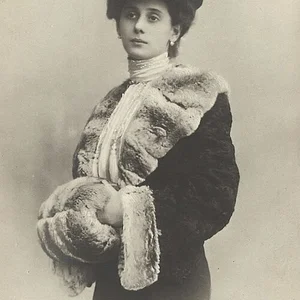

Anna Pavlova (1881-1931) was a Russian ballerina considered one of the greatest classical dancers in history. Trained at the Imperial Ballet School in Saint Petersburg, she conquered stages around the world and helped bring the art of classical ballet to an international audience.
Frequently asked questions
Famous Quotes
« "Everything I am, I owe to the art of dance."»
« "Success depends on effort."»
Key Facts
- 1881: Born in Saint Petersburg into a modest family
- 1899: Graduated from the Imperial Ballet School and joined the Mariinsky Ballet
- 1907: Premiered the solo The Dying Swan, choreographed by Michel Fokine, which became her signature work
- 1909: Participated in the early seasons of Serge Diaghilev's Ballets Russes in Paris
- 1931: Died in The Hague while on tour, leaving a lasting global legacy for classical ballet
Works & Achievements
A solo choreographed by Michel Fokine to music by Camille Saint-Saëns, this two-minute piece is Anna Pavlova's most iconic work. She performed it thousands of times, making it a universal symbol of fragility and fleeting beauty.
One of the great classical ballets in the Mariinsky repertoire, in which Pavlova distinguished herself early in her career. Her portrayal of Nikiya earned her recognition as a future star of Russian ballet.
In the title role of this 19th-century Romantic ballet, Pavlova showcased both her technical virtuosity and her dramatic talent. Her interpretation was acclaimed by international critics.
A white ballet by Fokine created for the Ballets Russes, in which Pavlova was among the performers during its early Paris premieres. This work embodied the new spirit of Russian ballet at the turn of the 20th century.
A comic and virtuosic ballet in which Pavlova demonstrated her ability to portray light-hearted and mischievous characters, revealing a different side of her technique from her usual dramatic roles.
The true work of her life, Pavlova led her own ballet company for nearly twenty years, touring across six continents. This mission to bring classical ballet to the entire world stands as her most enduring legacy.
Anecdotes
Anna Pavlova was so slender and light that her feet presented unusual technical challenges: her arches were particularly high and her toes very long. To dance with greater ease, she asked her shoemaker to reinforce the toe of her pointe shoes with stiff cardboard, thereby inventing a technique that influenced the manufacture of modern pointe shoes.
In 1905, choreographer Michel Fokine created for her a solo of barely two minutes, titled 'The Dying Swan', set to music by Saint-Saëns. This piece became Anna Pavlova's signature number, and she performed it thousands of times until the end of her career, making it the most iconic image in classical ballet worldwide.
Pavlova toured every continent with her own ballet company, performing in cities where classical ballet had never been seen before. In India, Australia, and Latin America, she introduced entire generations to classical dance. It is said that watching her performance in Lima inspired the future dancer Ana García to choose her vocation.
Anna Pavlova lived at Ivy House, a home beside a lake in Hampstead, London, where she kept swans. She had grown particularly fond of one of them, which she called Jack. According to those close to her, watching her swans helped her perfect the grace and carriage of the head she brought to her performances.
A few hours before dying of pneumonia in The Hague in January 1931, Pavlova reportedly asked for her swan costume to be prepared. Her last words, as recounted by those around her, were: 'Get my swan costume ready.' She died without ever having returned to Russia after her final departure in 1913.
Primary Sources
Since the age of eight, dancing has been my whole life. I have sacrificed everything to it — comfort, wealth, personal happiness.
I cannot stop dancing. If I stop, I will cease to live.
Pavlova had something unique: she could embody an emotion with such sincerity that the audience forgot they were watching technique — they saw a soul.
Miss Pavlova's 'Dying Swan' is not a dance; it is a poem in motion. One leaves the theatre shaken, as if one had witnessed something sacred.
The art of ballet must be universal. I want every child in the world to be able to see a ballet and understand what beauty means.
Key Places
It was at this elite institution that Pavlova trained from 1890 to 1899. Affiliated with the Mariinsky Theatre, the school was the crucible of Russian classical dance and instilled in her the technical rigor that defined her career.
Pavlova made her debut and triumphed on this prestigious stage, rising to the rank of prima ballerina assoluta. It was here that she premiered 'The Dying Swan' in 1905 and collaborated with Fokine and Petipa.
Pavlova's London residence from 1912, this lakeside home with its swans became her only stable haven. She set up a rehearsal studio there and spent her rare moments of rest between tours within its walls.
Pavlova performed at the Paris Opéra during the Ballets Russes seasons of 1909, contributing to the artistic revolution that transformed European ballet. Paris was one of the cities where she enjoyed her greatest triumphs.
During her many American tours, Pavlova performed at the Met and in cities across the United States, bringing classical ballet to American audiences who were often encountering it for the very first time.
Liens externes & ressources
Références
Œuvres
La Mort du cygne
1905
La Bayadère
1902
Giselle
vers 1903
Les Sylphides (Chopiniana)
1909
Coppélia
vers 1905
Tournée mondiale de sa compagnie (1913–1931)
1913-1931