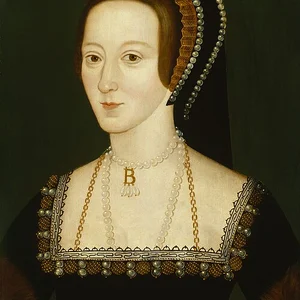

Queen of England from 1533 to 1536, Anne Boleyn was the second wife of Henry VIII. Her marriage required England's break with Rome, giving rise to the Church of England. Mother of Elizabeth I, she was accused of adultery and beheaded at the Tower of London.
Anne Boleyn(1507 — 1536)
Anne Boleyn
royaume d'Angleterre
8 min read
Frequently asked questions
Famous Quotes
« Good people, I am not come here to accuse any man, nor to speak of that whereof I am accused and for which I am to die. (scaffold speech, 19 May 1536)»
Key Facts
- c. 1501: birth of Anne Boleyn, likely in Norfolk, England
- 1533: secret marriage to Henry VIII and coronation as Queen of England
- September 1533: birth of the future Elizabeth I, daughter of Anne and Henry VIII
- 1534: Act of Supremacy — Henry VIII becomes Supreme Head of the Church of England
- 19 May 1536: accused of adultery and high treason, Anne Boleyn is beheaded at the Tower of London
Works & Achievements
Anne Boleyn's marriage to Henry VIII made a break with Rome inevitable, culminating in the Act of Supremacy of 1534. Although she was not the author of the founding texts, historians recognize her catalytic role in this major religious upheaval.
Anne Boleyn actively encouraged the circulation of reformist texts and the English-language Bible at court. Her influence helped pave the way for the official authorization of the 'Great Bible' in 1537.
As queen, Anne protected reformist scholars and preachers, funding scholarships and championing the ideas of Erasmus. She played a decisive role as a cultural patron at the Tudor court.
Though seen as a disappointment by Henry VIII, who had hoped for a son, the birth of Elizabeth proved to be Anne Boleyn's most lasting legacy. Her daughter reigned from 1558 to 1603 and made England a major Protestant power.
Anecdotes
Anne Boleyn was educated in France from the age of twelve — first at the court of Margaret of Austria in the Netherlands, then as a lady-in-waiting to Queen Claude of France. This upbringing gave her a refinement and cultural sophistication that drew notice when she returned to England around 1521: she introduced to Henry VIII's court the fashions and intellectual elegance of the Continent.
Henry VIII was so captivated by Anne Boleyn that he wrote her at least seventeen love letters between 1527 and 1528. Preserved today in the Vatican Secret Archives — most likely stolen by a papal agent — these letters reveal the depth of the king's passion: he begged Anne to grant him her favour and signed himself 'H. Rex, your entirely devoted servant.'
Her trial, which lasted barely a day on 15 May 1536, found her guilty of adultery with five men, including her own brother George Boleyn. The overwhelming majority of modern historians view these charges as fabricated by Thomas Cromwell to give the king grounds to be rid of her. She was beheaded on 19 May 1536 on Tower Green, a skilled swordsman having been brought from Calais as a mercy to ensure a swift death.
Anne Boleyn was known for her reformist convictions: she owned an English Bible and championed the ideas of Erasmus and Tyndale at court. Historians credit her with a decisive influence on Henry VIII's decision to authorise the distribution of the Bible in the vernacular in English churches — a measure enacted in 1537, after her death.
Primary Sources
"To my only mistress, reminding you of myself with the warmth of my heart, hoping that you too will remember me..." Henry VIII expressed his love and implored a favourable response to his marriage proposal.
Chapuys describes Anne Boleyn with hostility as "the concubine" and meticulously reports the court intrigues, Catherine of Aragon's reactions, and the manoeuvring surrounding the royal divorce.
Hall describes the coronation of Anne Boleyn in June 1533: "She was crowned at Westminster with great solemnity, wearing a robe of scarlet and ermine, her hair loose after the custom of the queens of England."
"The king, our sovereign lord, his heirs and successors, shall be taken, accepted, and reputed the only supreme head on earth of the Church of England." This founding text ratified the break with Rome made necessary by the marriage to Anne.
Key Places
The Boleyn family home in Kent, where Anne grew up. It was at this Tudor manor that the young Henry VIII came to court her during his determined pursuit of her affections.
Anne Boleyn was imprisoned in the Tower of London in May 1536 following her arrest. She was tried there and then beheaded on Tower Green on 19 May 1536; her remains rest in the Chapel of St Peter ad Vincula.
The principal palace of the Tudor court under Henry VIII, Greenwich witnessed both Anne's triumphs as queen and her eventual arrest. Her daughter Elizabeth I was born there on 7 September 1533.
It was at Westminster that Anne Boleyn was crowned Queen of England on 1 June 1533 by Archbishop Thomas Cranmer, in a lavish ceremony that formally sealed the religious break with Rome.
From 1514 to 1521, Anne lived in France as a lady-in-waiting to Queen Claude. This experience shaped her taste, culture, and elegance, giving her a considerable advantage when she returned to the English court.