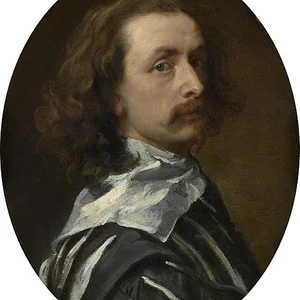

Anthony van Dyck (1599–1641) was a Flemish painter and engraver, a pupil of Rubens, who became one of the most celebrated portrait painters in seventeenth-century Europe. Appointed official painter to King Charles I of England, he left a lasting mark on the art of aristocratic portraiture.
Anthony van Dyck(1599 — 1641)
Anthony van Dyck
Pays-Bas espagnols
10 min read
Frequently asked questions
Key Facts
- Born in Antwerp in 1599, he entered Rubens's workshop around 1618
- A stay in Italy (1621–1627), where he studied the Venetian masters, particularly Titian
- Appointed court painter to Charles I of England in 1632, and knighted the same year
- He painted numerous portraits of the Stuart royal family that defined the official image of the English monarchy
- Died in London in 1641, leaving a body of work of more than 900 paintings
Works & Achievements
Now in the Louvre, this portrait shows Charles I in hunting dress — relaxed yet majestic. Van Dyck revolutionizes the royal portrait by replacing the stiff formality of traditional official likenesses with a natural, intimate atmosphere.
One of the most imposing equestrian portraits ever painted, it draws on the great examples of Titian and Rubens. Van Dyck constructs the image of an absolute monarch, master of both his horse and his subjects.
This group portrait of the King of England's five children is one of the masterpieces of the genre in the seventeenth century. It combines tenderness, formal elegance, and a keen eye for costume detail, establishing a benchmark for European portrait painting.
Van Dyck depicts himself holding a sunflower, a symbol of the painter turning toward the light of the royal sun — a metaphor for his devotion to Charles I. This self-portrait reveals both the artist's social ambition and his artistic self-awareness.
Painted in Genoa, this monumental portrait of a Genoese noblewoman is considered one of the pinnacles of Baroque portraiture. Its outdoor composition, the parasol held by a Black page, and the subject's commanding presence make it a pioneering work.
This altarpiece, housed in the church of Saint Paul in Antwerp, demonstrates Van Dyck's mastery of religious painting. It shows that, famous as he was for portraiture, the artist was equally accomplished in the grand sacred compositions inherited from Rubens.
A portrait of a wealthy Antwerp collector, painted when Van Dyck was barely twenty years old. This early work, remarkable for its psychological intensity, already announces his genius for capturing the inner life of his sitters.
Anecdotes
At only nineteen years old, Antoine van Dyck was admitted as a master painter to the prestigious Guild of Saint Luke in Antwerp in 1618, which allowed him to open his own studio. This title, usually earned after many years of apprenticeship, reflects the exceptional precocity of an artist whom Rubens himself called his finest pupil.
During his stay in Italy (1621–1627), Van Dyck kept a meticulous sketchbook — now held at the British Museum — in which he copied works by Italian masters such as Titian and Raphael. This notebook reveals a painter who learned by looking, seeking to understand the secret of Venetian color and weave it into his own style.
Charles I of England admired Van Dyck so greatly that he knighted him in 1632, presenting him with a gold medal and a precious chain. The king sat for his official painter on numerous occasions: Van Dyck depicted Charles I on horseback, out hunting, and in armor, thereby crafting the image of a powerful and refined monarch for audiences across all of Europe.
Van Dyck had a remarkably effective technique for flattering his sitters: he painted hands with aristocratic elegance and subtly elongated figures to give them an ideal bearing. Charles I, who stood only five feet four inches tall, appears in his portraits as an imposing and majestic sovereign.
Van Dyck died at Blackfriars (London) on 9 December 1641, at only forty-two years of age, just a few months before the outbreak of the English Civil War. He was buried in St Paul's Cathedral in London. His untimely death deprived England of its most brilliant portraitist at a crucial moment in its political history.
Primary Sources
This notebook, held at the British Museum, contains hundreds of sketches and copies made by Van Dyck during his stay in Italy between 1621 and 1627. He recorded works by Titian, Raphael, and Veronese, and sketched portraits of the Italian collectors he encountered.
Bellori devotes a detailed entry to Van Dyck, describing his apprenticeship under Rubens, his journey to Italy, and his manner of painting: “He had a way of conveying nobility and grace that no other Flemish painter had achieved with such naturalness.”
The official document, signed in 1632, grants “our well-beloved servant Anthonie van Dyck” the title of Principal Painter in Ordinary, with an annual pension of two hundred pounds sterling and the right to lodge in the Palace of Blackfriars.
De Piles notes that Van Dyck “had the gift of capturing the likeness of his sitters in just a few sessions” and that he “never asked for more than three sittings to finish a head portrait, for he had no wish to tire the great lords he painted.”
Rubens writes of his young pupil: “Van Dyck is the finest of my apprentices; he already possesses a sure hand and a sense of colour that many masters will never attain. I fear he may surpass me one day.”
Key Places
Van Dyck's birthplace, Antwerp was in the 17th century one of Europe's great artistic centers. It was there that he entered Rubens's studio and gained his first international renown.
The city where Van Dyck spent extended periods during his Italian journey (1621–1627), painting the great aristocratic families of Genoa (Balbi, Grimaldi, Spinola). These full-length portraits would inspire European aristocracy for more than a century.
Van Dyck stayed in Rome, where he studied Antiquity and the great masters of the Renaissance. There he met contemporary artists and refined his command of monumental composition.
After his return from Italy, Van Dyck worked in Brussels for Archduchess Isabella, governor of the Spanish Netherlands, broadening his aristocratic clientele before moving to London.
The principal residence of Charles I, Van Dyck worked there regularly and produced his royal portraits there. The palace housed one of the largest art collections in Europe in the 17th century.
Van Dyck lived and set up his studio there from 1632, enjoying a house provided by Charles I. He died there on 9 December 1641 and was subsequently buried at the nearby St Paul's Cathedral.
Typical Objects

An essential tool for Van Dyck, his palette was renowned for the richness of its reds, deep blacks, and luminous whites. He favored costly pigments such as lapis lazuli and madder lake to achieve the characteristic brilliance of the fabrics in his paintings.

Van Dyck used sketchbooks to record his observations and copy the Italian masters. His famous Italian travel sketchbook, held at the British Museum, bears witness to his method of learning through imitation and the careful study of past works.

Van Dyck's portraits made famous the large white lace collars worn by the Baroque aristocracy. This style of collar is now known worldwide as the "Van Dyck collar," so closely is it associated with his work.

In 1632, Charles I presented Van Dyck with a gold chain and medal upon his knighthood — a tangible mark of royal favour that the painter wore at court ceremonies and which can sometimes be seen in his self-portraits.

Many aristocratic sitters posed in armour, a symbol of military power. Van Dyck excelled at rendering polished metal and its reflections, giving these portraits a heroic dimension while revealing the personality of his subjects.

For facial details and the sheen of silks, Van Dyck used very fine brushes whose mastery was the secret behind his light touch and the transparency of his glazes — a technique inherited from the Venetian masters.
School Curriculum
Vocabulary & Tags
Key Vocabulary
Daily Life
Morning
Van Dyck began his day early, preparing his pigments and canvases with the help of his studio assistants. Nobles and courtiers would come to sit in the morning, when the natural light streaming through the large windows of his Blackfriars studio was most favorable for painting faces and fabrics.
Afternoon
The afternoon was devoted to longer sittings and background work: picture backgrounds, costumes, and settings. Van Dyck frequently delegated the painting of clothing and hands to his assistants, reserving the faces for himself. He also received commissions, negotiated prices, and corresponded with his patrons abroad.
Evening
Evenings brought Van Dyck into the fashionable circles of the English court: banquets, concerts, and receptions to which he was invited as the king's favorite artist. He carefully cultivated these social connections, which were essential for securing new commissions among the English and European aristocracy.
Food
As a well-paid court artist, Van Dyck had access to abundant and varied food: roasted meats, fish, pastries, and fine wines. During his time in Italy, he had developed a taste for the Mediterranean style — oils, vegetables, and fruits — which contrasted with the heavier cuisine of Flanders.
Clothing
Van Dyck dressed with elegance and refinement, in keeping with his aristocratic sitters: velvet or silk doublet, wide white lace collar, cape over the shoulders. At official ceremonies he wore the gold chain presented to him by Charles I, a visible mark of his status as an ennobled and recognized painter at court.
Housing
In London, Van Dyck lived in a fine house at Blackfriars, provided by Charles I, fitted with a spacious studio lit by tall windows. In Antwerp he had occupied a well-appointed studio in the city itself. His residences reflected his social success: refined furnishings, collections of prints and master drawings, and a library.
Historical Timeline
Period Vocabulary
Liens externes & ressources
Références
Œuvres
Charles Ier à la chasse
vers 1635
Portrait équestre de Charles Ier avec M. de Saint-Antoine
1633
Autoportrait au tournesol
vers 1632-1633
Portrait de la Marchesa Elena Grimaldi Cattaneo
1623
Portrait de Cornelis van der Geest
vers 1620