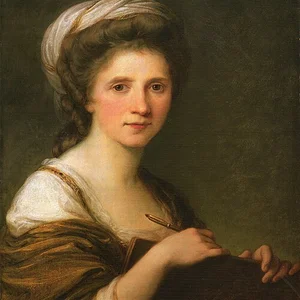

French painter and miniaturist of the 18th century, she was one of only two women admitted to the Académie royale de peinture in 1783. Official portraitist to the Mesdames de France, she rivaled Élisabeth Vigée Le Brun and campaigned for women's access to artistic institutions.
Adélaïde Labille-Guiard(1749 — 1803)
Adélaïde Labille-Guiard
France
9 min read
Frequently asked questions
Key Facts
- 1749: born in Paris
- 1769: trained under François-Élie Vincent, then under his son François-André Vincent
- 1783: admitted to the Académie royale de peinture et de sculpture on the same day as Élisabeth Vigée Le Brun
- 1787: presentation of the painting “Self-Portrait with Two Pupils” at the Salon, a masterpiece asserting women's right to transmit artistic knowledge
- 1800: died in Paris
Works & Achievements
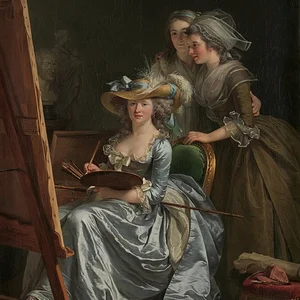
An iconic masterpiece held at the Metropolitan Museum of Art in New York, this large painting shows the artist at work surrounded by two female disciples. It is at once a professional self-portrait and a manifesto on women's right to teach and practice the fine arts.
An official portrait of the eldest daughter of Louis XV, held at the Palace of Versailles. Commissioned as part of her role as portraitist to the Mesdames, it showcases her command of the conventions of royal state portraiture.
A portrait of the third daughter of Louis XV, a pendant to the portrait of Madame Adélaïde, also at Versailles. These two canvases rank among the most significant commissions of her career and bear witness to her favor with the royal family.
Her reception piece presented to the Académie royale to secure her admission. This portrait of a respected academician allowed her to demonstrate her mastery of the genre and persuade her peers to accept her into their ranks.
A portrait of the lawyer and future revolutionary leader Maximilien de Robespierre, painted at the dawn of the Revolution. This unexpected commission speaks to Labille-Guiard's ability to navigate the political fault lines of her time.
An intimate portrait of her companion and future husband, a respected academic painter. This canvas reveals a more personal side of her art, free from the constraints of official commissions.
Anecdotes
On May 31, 1783, Adélaïde Labille-Guiard and Élisabeth Vigée Le Brun were admitted on the same day to the Royal Academy of Painting and Sculpture — an unprecedented event. Their jealous rivals whispered that one owed her place to the king and the other to the queen, but their impressive works put these rumors to rest: each had submitted several paintings of undeniable quality.
In 1785, Labille-Guiard exhibited at the Salon her celebrated self-portrait flanked by two students, Marie-Gabrielle Capet and Mlle Carreaux de Rosemond. This large-format painting — the dimensions of a formal state portrait — was as much a political statement as an artistic one: it publicly demonstrated that women could not only paint, but also teach and pass on their skills to others.
She fought throughout her career to abolish the rule limiting the number of women admitted to the Royal Academy to four. In 1790, she submitted a formal petition to the academicians, arguing that the exclusion of women betrayed the ideals of the Enlightenment. She never lived to see this limit abolished, but she paved the way for the generations that followed.
During the Revolution, Labille-Guiard skillfully repositioned herself. She had painted the Mesdames de France (daughters of Louis XV) and members of the court, but she had certain canvases altered or retitled to remove overly royalist references. She even painted a portrait of Robespierre in 1791, displaying a remarkable political flexibility for a woman who had once been an official portraitist of the monarchy.
Unlike Vigée Le Brun, who emigrated as early as 1789, Labille-Guiard chose to remain in France throughout the Revolution. She trained some twelve women artists in her studio, defying the prejudices of an era that considered it indecent for a male teacher to instruct young women in drawing from life. Her home became a true center for the passing on of art by and for women.
Primary Sources
This day, 31 May 1783, the Company has received among its members Madame Labille, wife of Sieur Guiard, upon the presentation of her works, and notably a portrait of M. Pajou, sculptor to the king.
Women artists, admitted in numbers so restricted that they seem merely tolerated rather than welcomed, beseech the Company to consider that genius has no sex, and that the Enlightenment of this century commands that the doors of the temple of the arts be opened more widely.
No. 132. Portrait of Madame Labille-Guiard, Artist, with Two of Her Pupils, Mesdames Marie-Gabrielle Capet and Carreaux de Rosemond. Belongs to the author.
Mme Labille-Guiard began today the second sitting for my portrait. Her dedication and talent are beyond anything words can express; she brings to her works a truthfulness and a grace that few artists can boast of attaining.
Our mistress taught us not only the craft of painting, but also how to hold one's place in the world of the arts, to respond to commissions, and to defend one's price and dignity before patrons.
Key Places
She was born and raised on the rue Saint-Honoré, a busy commercial and fashionable thoroughfare in eighteenth-century Paris. Her father ran a haberdashery there, a middle-class setting that gave her access to a thorough artistic education.
The biennial Salon, the official showcase of the Académie royale, was held in the Salon Carré of the Louvre. Labille-Guiard exhibited there regularly from 1774 onwards, including her celebrated Self-Portrait with Two Pupils in 1785.
She was appointed official portraitist to the Mesdames de France and traveled to Versailles for their sittings. Her portraits of Mesdames Adélaïde and Victoire, painted between 1787 and 1788, are still held there today.
It was in the studio of the painter Vincent the Elder that she learned the fundamentals of oil painting and portraiture. This workshop was also where she met her future husband, François-André Vincent, the master's son.
At the height of her career, she established her own studio where she received models and patrons, and trained around a dozen women artists. This space embodied her professional independence and her commitment to the education of women.
Typical Objects

Labille-Guiard began her career as a pastellist, mastering the sticks of pigment bound with gum arabic. Pastel allowed her to capture the softness of skin and the sheen of silks with a speed no other medium could match at the time.

She honed her early skills painting miniatures on ivory or vellum — small, intimate portraits worn as lockets. This training gave her a precision of detail that she retained throughout her life in her large-scale oil works.

Her oil palette, stocked with fine colors ground by her students, was the central tool of her sitting sessions. She used sable brushes for the delicate glazes of flesh tones and broader brushes for the neutral backgrounds of her formal portraits.

Her monumental paintings — such as the Self-Portrait with Two Pupils (210 × 151 cm) — required a sturdy adjustable easel. This piece of furniture held pride of place in her Parisian studio, a visible symbol of her artistic ambition.

Models would bring or borrow silk gowns, lace, and jewelry for the sessions. Labille-Guiard had to coordinate these accessories with the lighting in her studio, choosing draperies that would showcase her mastery of shimmering fabrics.

Before undertaking a formal portrait, she would produce pencil or red chalk studies to frame the composition and settle the pose. These sketchbooks bear witness to her rigorous method, inherited from academic training.
School Curriculum
Vocabulary & Tags
Key Vocabulary
Daily Life
Morning
Labille-Guiard rose early to make the most of the natural north light, essential for rendering flesh tones. Her students arrived in the morning to grind pigments, prepare palettes, and stretch canvases. She devoted these first hours to the delicate glazes that required the freshest eye.
Afternoon
Afternoons were reserved for posing sessions with patrons, often members of the nobility or the upper bourgeoisie. She directed the light, arranged drapery, and kept up conversation to animate her models' expressions. Between sessions, her students observed, copied, and received her corrections.
Evening
Evenings were frequently spent at literary and social salons, where she cultivated her network of potential patrons. She discussed aesthetics with philosophers, writers, and collectors, establishing herself as an intellectual as much as a craftswoman. On Salon days, she spent hours observing the public's reactions and defending her choices to the critics.
Food
Like any prosperous Parisian bourgeoise, she ate two main meals a day. The midday dinner, served early, included soup, roasted meats, vegetables, and sweet desserts. The evening supper, taken after work or on leaving a salon, was lighter: cold poultry, cheeses, and seasonal fruit.
Clothing
For work, she wore a simple linen or wool dress, often protected by a painter's apron. To receive patrons and social visitors in her studio, she dressed in silk or taffeta gowns in muted colors, adorned with lace fichus. Her 1785 self-portrait shows her in an elegant working dress with a large feathered hat — an outfit both practical and presentable.
Housing
She occupied a spacious studio-apartment, in which the large north-facing room served as both workspace and reception room. The walls were covered with works in progress, sketches, and reference materials. She had one or two private rooms, more modestly furnished, separated from the professional space shared with her students.
Historical Timeline
Period Vocabulary
Liens externes & ressources
Références
Œuvres
Portrait de Madame Adélaïde de France
1787
Portrait de Madame Victoire de France
1788
Portrait du sculpteur Augustin Pajou
1782
Portrait de Robespierre
1791
Portrait du peintre François-André Vincent
vers 1795