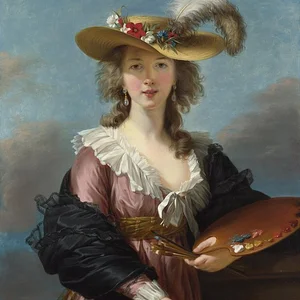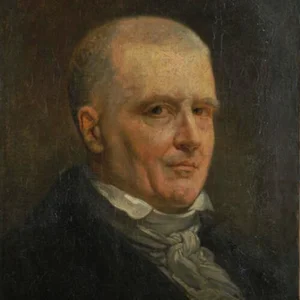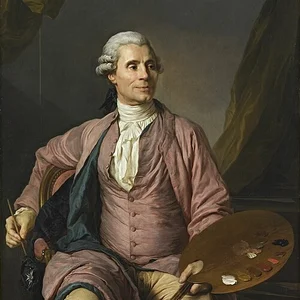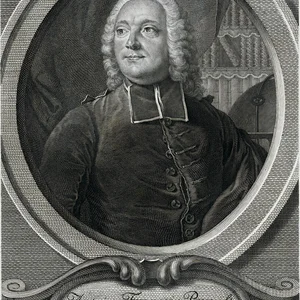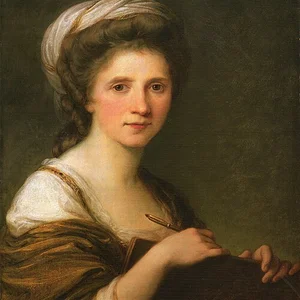

Swiss painter, a major figure of European Neoclassicism. A celebrated portraitist and history painter, she was one of only two women among the founding members of the Royal Academy of Arts in London in 1768.
Angelica Kauffmann(1741 — 1807)
Angelica Kauffmann
Suisse, Trois Ligues
5 min read
Frequently asked questions
Key Facts
- Born in 1741 in Chur (Coire), Switzerland, and trained in painting from a very young age
- Made her name in Rome in the 1760s, at the heart of the Neoclassical movement
- In 1768, became one of only two women founding members of the Royal Academy of Arts in London
- Known for her portraits and her scenes of history and mythology inspired by Antiquity
- Died in 1807 in Rome, celebrated throughout Europe
Works & Achievements
Portrait of the famous English actor, painted in Naples, which helped launch her reputation with the British public.
A grand history scene with an antique moral, exemplary of Neoclassicism and of Kauffmann's ambition as a history painter.
An allegory of her choice of vocation, which became one of her most emblematic works.
Medallions and decorative panels created in collaboration with the architect Robert Adam, spreading Neoclassical taste.
Portrait of the writer made in Rome, a testament to their friendship and to Enlightenment culture.
A sensitive mythological subject, illustrating her mastery of history painting and of Neoclassical emotion.
Anecdotes
In 1768, Angelica Kauffmann was one of only two women (alongside Mary Moser) among the 36 founding members of the Royal Academy of Arts in London. For more than a century, no other woman would be elected a full member of the institution.
In Johann Zoffany's famous group portrait of the academicians studying a nude model (1771-1772), Kauffmann and Moser, as women, were not allowed to attend the session: they appear only as portraits hanging on the wall, because the standards of decency of the time forbade them from studying the living male nude.
A child prodigy, Angelica spoke several languages fluently and long hesitated between a career as a singer and one as a painter. She illustrated this dilemma in an allegorical work in which she portrays herself torn between Music and Painting.
Much in demand, she painted the portraits of many celebrities of her time, including the writer Goethe, whom she met in Rome and with whom she became friends. Goethe admired her talent and her learning.
Her first marriage turned into a scandal: an adventurer passed himself off as the Swedish Count of Horn and married her in 1767; he was later found to be an impostor who was already married, which forced a costly separation.
Primary Sources
The portraits of Angelica Kauffmann and Mary Moser hang on the wall of the room, as the two women could not be present among the men studying the nude model.
An allegorical self-portrait in which the artist depicts herself between two figures personifying Music and Painting, illustrating the choice of vocation she faced in her youth.
Goethe recalls his Roman encounters with Angelica Kauffmann, praising her talent, sensitivity, and broad culture.
A register in which the artist recorded her paintings, their patrons, and their prices, attesting to the professional management of her studio.
Key Places
Swiss town where Angelica Kauffmann was born in 1741, into a family of painters.
Where the young artist studied the masters and was admitted to the Accademia del Disegno in 1762.
Where she achieved fame as a portraitist and became a founding member of the Royal Academy in 1768.
Capital of Neoclassicism, where she settled in 1782; her studio became a cosmopolitan artistic hub. She died there in 1807.
Typical Objects

Wooden board on which the artist laid out and mixed her pigments. A symbol of her craft, it appears in several of her self-portraits.

Fine brushes used for the delicate details of faces and Neoclassical drapery. Essential tools of the portrait painter.

Wooden support holding the canvas upright during work. The centrepiece of the studio where she received her patrons.

Ground raw materials (earths, minerals, lake) mixed with oil to obtain the various hues. Ultramarine blue, drawn from lapis lazuli, remained expensive.

A collection of preparatory drawings after the antique, after models and of compositions. Indispensable for the Neoclassical history painter.

Albums reproducing Greco-Roman statues, bas-reliefs and vases, which inspired the subjects and poses of Neoclassicism.
School Curriculum
Vocabulary & Tags
Key Vocabulary
Daily Life
Morning
Angelica started early in her studio, making the most of the daylight that is essential to a painter. She prepared her colors and worked on preparatory drawings before her sitters arrived.
Afternoon
The afternoon was devoted to sitting sessions with her patrons, often aristocrats and travelers on the Grand Tour. She produced portraits and large history paintings commissioned from all across Europe.
Evening
In the evening, her Roman salon welcomed artists, writers, and scholars such as Goethe. There, people conversed about ancient art, literature, and music, in the spirit of the Enlightenment.
Food
Like the polite society of her time, she enjoyed refined cuisine combining local Italian produce, bread, meats, fruit, and wine. Coffee and chocolate, fashionable in the 18th century, accompanied her receptions.
Clothing
She wore the elegant gowns of the late 18th century, made of silk and muslin, whose lines were gradually inspired by classical antiquity. To paint, she protected her clothing with an apron or a smock.
Housing
In Rome, she lived in a spacious residence housing her studio and her collection of artworks and antiquities. The house served at once as a workplace, a gallery, and a fashionable salon.
Historical Timeline
Period Vocabulary
Liens externes & ressources
Références
Œuvres
Portrait de David Garrick
1764
Cornelia, mère des Gracques, présentant ses enfants comme ses trésors
vers 1785
Autoportrait hésitant entre la Musique et la Peinture
1794
Décors et peintures pour Somerset House et des intérieurs anglais
années 1770
Portrait de Johann Wolfgang von Goethe
1787