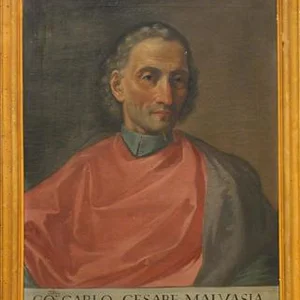

Carlo Cesare Malvasia (1616-1693) was a Bolognese Italian art historian and writer. He is the author of the *Felsina pittrice*, a major work devoted to the painters of the Bolognese school, which stands as a fundamental historiographical source for Italian Baroque art.
Carlo Cesare Malvasia(1616 — 1693)
Carlo Cesare Malvasia
Italie
8 min read
Frequently asked questions
Key Facts
- Born in 1616 in Bologna, into a noble Italian family
- Published the *Felsina pittrice* in 1678, a biographical compendium on Bolognese painters
- His work follows in the tradition of Vasari's *Lives*, with a focus on the local school
- Championed the superiority of the Bolognese school over the Florentine and Roman schools
- Died in 1693 in Bologna, leaving behind a landmark reference work in art historiography
Works & Achievements
Malvasia's masterpiece in two volumes, devoted to the painters of the Bolognese school from its origins through the seventeenth century. A foundational work in the historiography of Baroque art, it remains an indispensable primary source for art historians, consulted and reprinted to this day.
A practical and erudite guide to the paintings, sculptures, and architecture of Bologna, intended for cultured travelers. It complements the Felsina pittrice by precisely locating works in the city's churches, palaces, and collections.
A collection of notes and biographical drafts accumulated over years of research among artists and their associates, forming the raw material for the Felsina pittrice. Partially preserved at the University Library of Bologna.
A vast body of letters exchanged with Italian artists, collectors, and scholars, illuminating Malvasia's research methods and aesthetic positions. These letters establish him as a forerunner of modern art criticism.
Anecdotes
Malvasia had a privileged relationship with the painter Guercino, whose famous *Libro dei conti* he was able to consult — a detailed account book recording every commission received, along with the names of patrons and sums paid. Thanks to this exceptional access, he reconstructed the master's entire career with a documentary precision unmatched for the period.
The *Felsina pittrice* was in part a polemical response to the views championed by Giovanni Pietro Bellori, whose *Vite* of modern artists had been published in 1672. Bellori favored Roman artists and their adherence to antique models; Malvasia, as a proud Bolognese, vigorously defended his fellow citizens, asserting that the Carracci and Guido Reni equaled — if not surpassed — the Roman masters.
Malvasia conducted genuine oral investigations when writing his biographies: he would meet with aging students, relatives, and heirs of deceased painters to gather first-hand anecdotes and testimonies. This method, akin to journalism, allowed him to record details about life in Bolognese workshops that would otherwise never have been set down in writing.
As a canon at Bologna's cathedral of San Pietro, Malvasia enjoyed a stable income that allowed him to devote himself to his research without depending on a demanding patron. This financial independence — extremely rare for a seventeenth-century scholar — partly explains the scope and freedom of tone of the *Felsina pittrice*, which does not shy away from criticizing some of the biggest names in art.
Primary Sources
Tra i pittori che han fatto chiara e famosa la scuola bolognese, nissuno forse ha avuto più universale grido e stima di Lodovico Carracci, il quale, unito co' cugini Agostino et Annibale, fondò quella famosa Accademia degli Incamminati.
Guida per li forestieri curiosi di vedere le pitture, sculture, et architetture della città di Bologna, con gli autori e luoghi dove si trovano, opera utilissima a chi vuol vedere questa nobilissima città.
Registrazione fedele delle commissioni ricevute dal Barbieri detto il Guercino, con i nomi dei committenti, le somme pagate e i soggetti delle opere eseguite dal maestro dal 1629 al 1666.
Non posso tacere come i pittori bolognesi, e in particolare i Carracci, abbiano saputo unire la diligenza del disegno con la forza del colorire, in modo da non cedere a nessuna altra scuola d'Italia.
Key Places
Malvasia's birthplace and the setting for his entire life and work. It was here that he was born, studied at the university, served as a canon, and wrote the *Felsina pittrice*, his masterpiece devoted to the painters of a city that was one of the major centers of Italian Baroque painting.
The site where Malvasia exercised his duties as a canon, a position that provided him with a stable income and social standing. This ecclesiastical post allowed him to pursue his historical research in complete financial independence, without having to court a patron.
Founded by the Carracci brothers around 1582, this academy lies at the heart of the *Felsina pittrice*. Drawing on eyewitness accounts and documents, Malvasia reconstructed its history and groundbreaking teaching methods, enshrining it as the legendary birthplace of Bolognese Baroque painting.
The birthplace of Guercino, which Malvasia visited to gather information about the master and consult his personal archives. These visits were decisive in ensuring the documentary quality of the biography of Guercino in the *Felsina pittrice*.
The artistic capital of Baroque Italy, where many of the painters described by Malvasia were active — most notably the Carracci, who decorated the Farnese Gallery there. Rome was also the stronghold of his rival Bellori, giving the polemic between the two men a geographical dimension as much as an aesthetic one.
Typical Objects

Malvasia wrote his biographies with a quill on loose sheets that he endlessly corrected and rearranged. His original manuscripts, partly preserved at the University Library of Bologna, bear the traces of numerous crossings-out and additions that reveal his working method.

This account book kept by the painter Guercino, which Malvasia was able to consult directly thanks to their friendship, is one of the most valuable primary sources he drew upon. In it, Guercino recorded the prices and patrons of hundreds of paintings, offering a unique window onto the Baroque art market.

Malvasia collected engravings reproducing the works of Bolognese painters, which he used to document and compare compositions. Prints after the Carracci or Guido Reni circulated throughout learned Europe and helped spread the reputation of the Bolognese school.

Malvasia gathered numerous original drawings by Bolognese painters, which still constitute a precious collection today. In the *Felsina pittrice* he describes how certain artists prepared their compositions through studies on paper, stressing the importance of *disegno* in the Carracci's teaching.

As a canon of the cathedral of San Pietro, Malvasia wore a black cassock, white surplice, and violet mozzetta. This ecclesiastical status opened the doors of private collections, convents, and palaces where the works he described were kept.

Correspondence was the primary network for the circulation of knowledge in the seventeenth century. Malvasia exchanged letters with collectors, artists, and Italian scholars to gather testimonies, corrections, and unpublished information, making him a pioneer of scholarly networking.
School Curriculum
Vocabulary & Tags
Key Vocabulary
Daily Life
Morning
Malvasia rose early to attend religious services as a canon of the cathedral of San Pietro. After morning Mass, he devoted the first hours of the day to reading and annotating manuscripts in his personal library, which was stocked with art treatises, collections of prints, and letters from artists.
Afternoon
In the afternoon, he visited the studios of Bolognese painters, church sacristies, or the private collections of the local nobility to examine and describe works on site. He conducted genuine oral inquiries with elderly pupils and the heirs of artists, gathering anecdotes and first-hand accounts.
Evening
In the evening, Malvasia wrote up his notes and biographies by candlelight, endlessly revising and enriching his texts. He attended the meetings of Bologna's literary academies, where he mingled with the city's intellectual elite and debated questions of taste and aesthetics.
Food
As a member of the secular clergy from a noble family, Malvasia enjoyed a comfortable diet: roasted meats, fresh pasta, legumes, and local cheeses made up the everyday Bolognese table. On the days of abstinence prescribed by the Church, he made do with fish, eggs, and seasonal vegetables.
Clothing
Malvasia wore the canonical habit: a long black cassock topped with a white rochet and a violet mozzetta for liturgical services. In his private life as a scholar, he dressed soberly but well, in wool or light silk, in keeping with his noble rank and the decorum of his age.
Housing
Malvasia lived in canonical lodgings adjoining the cathedral, but also owned the family palazzo in the city. His home housed a well-stocked library and collections of drawings and prints accumulated over the years, and served as an informal gathering place for Bolognese scholars and artists.
Historical Timeline
Period Vocabulary
Liens externes & ressources
Références
Œuvres
Felsina pittrice, vite de' pittori bolognesi
1678
Vite de' pittori bolognesi (manuscrits préparatoires)
vers 1660–1675
Correspondance érudite
1640–1693