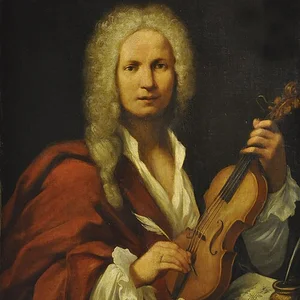

An 18th-century Venetian composer and violinist, Vivaldi is one of the major figures of Baroque music. He is best known for his violin concertos, particularly The Four Seasons, which remain among the most performed works in the classical repertoire.
Frequently asked questions
Key Facts
- 1678: Born in Venice on March 4
- 1703: Debut as a violinist and beginning of his career as a composer
- 1711: Publication of his concertos Op. 3 'L'Estro Armonico', which brought him fame across Europe
- 1725: Composition of The Four Seasons, four violin concertos each depicting one season of the year
- 1741: Death in Vienna on July 28
Works & Achievements
Four violin concertos illustrating each season, accompanied by descriptive sonnets. Vivaldi's most famous work and one of the most performed compositions in the history of music.
A collection of twelve concertos published in Amsterdam that secured Vivaldi's international fame. Bach himself transcribed several of them for keyboard.
A sacred music work composed for the singers of the Pietà. This Gloria remains one of the most popular pieces in the Baroque choral repertoire.
A collection of twelve concertos, the first four of which form The Four Seasons. The title evokes the challenge of reconciling harmonic structure with musical invention.
An opera in three acts inspired by Ariosto's epic poem. One of Vivaldi's most accomplished operas, rediscovered and restaged in the 20th century.
A sacred work for contralto and string orchestra of remarkable emotional intensity. Composed for a church in Brescia.
A collection of twelve violin concertos dedicated to a Venetian nobleman. This cycle confirmed Vivaldi's talent in the art of the solo concerto.
Anecdotes
Vivaldi was ordained a priest in 1703, which earned him the nickname "il Prete Rosso" (the Red Priest) due to his flaming red hair. However, he quickly stopped celebrating Mass, citing chest tightness episodes, most likely asthma, which prevented him from standing for long periods at the altar.
Vivaldi worked for nearly forty years at the Ospedale della Pietà, a Venetian orphanage for young girls. This institution was famous throughout Europe for the quality of its all-female orchestra, and visitors traveled from great distances to attend its concerts. Vivaldi composed a large portion of his concertos and sacred works there.
The composer was a worker of legendary speed. He himself boasted that he could compose a concerto faster than a copyist could transcribe it. He is credited with more than 500 concertos, which led composer Igor Stravinsky, much later, to quip that he had "written the same concerto 500 times" — a harsh and unfair judgment.
Vivaldi died in Vienna on July 28, 1741, in near-total poverty. He was buried in a simple hospital cemetery, with no ceremony. His music fell into almost complete obscurity for nearly two centuries, before being rediscovered in the 1920s thanks to Italian musicologist Alberto Gentili, who tracked down a substantial manuscript collection in Turin.
Vivaldi maintained a close professional and personal relationship with the contralto Anna Girò, who sang the lead roles in his operas. This closeness gave rise to rumors and criticism, most notably from Cardinal Ruffo, who barred Vivaldi from entering Ferrara in 1737 on account of this association, deemed scandalous for a priest.
Primary Sources
For twenty-five years I have no longer said Mass, and I shall never say it again, not by prohibition, but by my own choice, because of an ailment that has burdened me since birth. Ordained as a priest, I said Mass for one year, then gave it up, having had to leave the altar three times without completing it because of my ailment.
The transcendent music here is that of the hospitals. There are four of them, all composed of illegitimate or orphaned girls. They are raised at the expense of the State and trained solely to excel in music. They sing like angels and play the violin, flute, organ, oboe, and cello.
The four concertos that open this collection, being already known to Your Most Illustrious Grace, I thought it fitting to include the explanatory sonnets, so that the reader may understand the sentiments that the music seeks to express.
The Very Reverend Antonio Vivaldi, secular priest, aged sixty years, died of an internal inflammation, at the lodgings of the widow of the saddler Wahler. Buried in the hospital cemetery.
Key Places
Orphanage for young girls where Vivaldi taught violin and composed for nearly forty years. The Pietà's female orchestra gained European fame thanks to him.
Venetian opera house of which Vivaldi was the impresario and where he premiered many operas. It was one of the most active venues in Venice in the 18th century.
Parish church where Vivaldi was baptized on 6 May 1678. It still holds the records of his baptism today.
City where Vivaldi stayed from 1718 to 1720 in the service of Prince Philip of Hesse-Darmstadt, composing several operas and cantatas.
Vivaldi's final destination, where he traveled in 1740 hoping to find an imperial patron. He died there in poverty on 28 July 1741.
Typical Objects

Vivaldi's principal instrument, recognized as a virtuoso throughout Europe. He composed and performed his own concertos, pushing the technical limits of the instrument.

Vivaldi wrote his compositions at a remarkable speed, often with a quill pen on ruled paper. Hundreds of his manuscripts were discovered in Turin in the 20th century.

An indispensable accessory for musicians and clergymen of the 18th century. Vivaldi, a red-haired priest, wore it during his public appearances in keeping with the conventions of the time.

A prayer book that Vivaldi, as an ordained priest, was expected to use daily, although he quickly neglected his priestly duties.

A ubiquitous instrument in Baroque music, used for the basso continuo in Vivaldi's concertos and operas. It also served for composition and rehearsals.

Vivaldi composed nearly fifty operas. The librettos, small printed booklets, were distributed to the audience and contained the sung text as well as the dedication to the patron.
School Curriculum
Vocabulary & Tags
Key Vocabulary
Daily Life
Morning
Vivaldi rose early to work on his compositions, often at dawn. As a priest, he should have recited the morning office, but he had largely given it up. He would go to the Pietà to conduct rehearsals with the all-female orchestra.
Afternoon
The afternoon was devoted to violin lessons with the residents of the Pietà, followed by matters related to his opera productions. Vivaldi negotiated with singers, librettists, and theater directors, managing his career with a sharp business sense.
Evening
Evenings were often occupied by opera performances at the Teatro Sant'Angelo or concerts at the Pietà, which attracted an international audience. After the shows, Vivaldi would sometimes continue composing late into the night.
Food
Venetian cuisine in the 18th century was built around fish from the lagoon, rice, polenta, vegetables from the mainland, and bread. Wine was the common drink. Coffee, which had arrived in Venice the previous century, had become very popular in the city's many cafés.
Clothing
Vivaldi wore the black cassock of a secular priest in his ecclesiastical functions. For performances and social life, he adopted 18th-century fashionable dress: an embroidered coat, waistcoat, breeches, silk stockings, and a powdered wig, in keeping with Venetian social conventions.
Housing
Vivaldi spent much of his life in Venice, in the neighborhood near the Pietà, on the Riva degli Schiavoni. He lived in modest lodgings, though his income could vary considerably depending on the success of his operas and the patronage he received.
Historical Timeline
Period Vocabulary
Visual Style
Un style visuel inspiré du baroque vénitien : lumières dorées, dorures, brocarts cramoisis et l'atmosphère lumineuse des vedute de Canaletto, entre canaux scintillants et intérieurs d'église somptueux.
Sound Ambience
L'univers sonore de Vivaldi mêle les eaux vénitiennes, les cloches des églises, le bourdonnement des répétitions à la Pietà et l'effervescence des théâtres d'opéra du XVIIIe siècle.