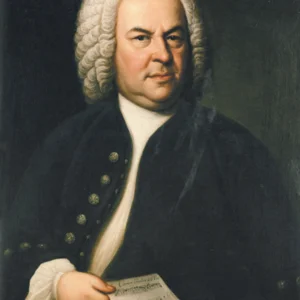

German composer and organist (1685–1750), Johann Sebastian Bach is one of the greatest figures of Baroque music. A master of fugue and polyphony, he composed over a thousand works combining mathematical rigor with spiritual depth, decisively influencing the history of Western music.
Johann Sebastian Bach(1685 — 1750)
Johann Sebastian Bach
Saint-Empire romain germanique, duché de Saxe-Eisenach
8 min read
Frequently asked questions
Key Facts
- 1703: Began his career as an organist in Thuringia (Germany)
- 1708–1717: Court Kapellmeister in Weimar, a period of intense composition including the Toccatas and Fugues for organ
- 1717–1723: Director of the princely chapel in Köthen, composition of the Brandenburg Concertos and the Cello Suites
- 1723–1750: Cantor at St. Thomas Church in Leipzig, composition of his major sacred works (Passions, Mass in B minor, Goldberg Variations)
- 1747: Visit to Frederick II of Prussia, composition of the Musical Offering
Works & Achievements
Six concertos for chamber orchestra dedicated to the Margrave of Brandenburg, considered absolute masterpieces of Baroque music and instrumental ensemble writing.
A major vocal and orchestral work depicting the story of the Passion of Christ according to the Gospel of Matthew. Rediscovered by Mendelssohn in 1829, it marked the renaissance of Bach's work.
Two collections of 24 preludes and fugues each, exploring all major and minor keys. A foundational pedagogical work, it remains to this day the bible of every classical pianist.
Six suites for unaccompanied cello, exploring the full expressive and technical richness of the instrument. Rediscovered by Pablo Casals in the 20th century, they are now among the most performed works in the repertoire.
A monumental choral work for soloists, choir and orchestra, considered one of the greatest religious compositions in the history of Western music.
A collection of fugues and counterpoints built on a single theme, left unfinished at Bach's death. A true artistic testament, it illustrates his absolute mastery of polyphony.
A set of contrapuntal pieces built on a theme proposed by Frederick II of Prussia, dedicated to the king. A testament to Bach's intellectual virtuosity in the twilight of his life.
Anecdotes
At the age of ten, Bach was orphaned and went to live with his elder brother Johann Christoph. Passionate about music, he secretly copied, by moonlight, a notebook of scores that his brother had forbidden him to touch. When Johann Christoph discovered the copy, he confiscated it — but Bach had already memorized everything.
In 1705, Bach walked approximately 400 kilometers from Arnstadt to Lübeck to hear the famous organist Dietrich Buxtehude play. He was supposed to stay four weeks but lingered for four months, captivated by the master's genius, which earned him a severe reprimand from his employers upon his return.
Bach had an extraordinarily large family: he had twenty children from two successive marriages, several of whom became renowned composers themselves. He also ran a true family musical enterprise, training his sons and nephews in his own home as if it were a private school.
In Leipzig, Bach regularly quarreled with the municipal authorities, who denied him the means necessary to provide quality music at St. Thomas Church. In a letter from 1730 addressed to his friend Georg Erdmann, he bitterly complained about his working conditions and even considered seeking another position.
Toward the end of his life, Bach lost his sight almost entirely due to serious eye problems. He underwent surgery twice by the same traveling surgeon — John Taylor — who had also operated on Handel. Both operations were failures, and Bach died a few months after the second procedure, in July 1750.
Primary Sources
I find myself in a situation where my salary is very insufficient and where the authorities are not very accommodating toward music. I am therefore compelled, with God's help, to seek my fortune elsewhere.
Mr. Bach was summoned to explain why he had introduced into the chorale many strange notes that caused confusion in the congregation.
He mastered his instrument to a degree that no other has ever reached, and perhaps never will. He saw in composition the means of expressing the deepest truths of the human soul.
Said Mr. Johann Sebastian Bach shall provide musical and vocal instruction to the pupils of St. Thomas's School, compose and direct music for the city's principal churches on Sundays and feast days.
I take the very humble liberty of dedicating to Your Royal Majesty this theme which Your Majesty itself deigned to propose to me, and of having joined to it the development that pertains thereto.
Key Places
Bach's birthplace and cradle of the Bach family, who had been musicians there for several generations. The birthplace is today a museum dedicated to the composer.
Bach's principal workplace during the last 27 years of his life. He directed the choir there, created his great Passions there, and was buried there. His tomb remains there to this day.
Residence of Prince Leopold, where Bach served as Kapellmeister from 1717 to 1723. It was there that he composed the Brandenburg Concertos and the Orchestral Suites.
The city where Dietrich Buxtehude held his post, whom Bach admired so greatly that he walked 400 km to hear him. This encounter profoundly influenced his organ writing style.
Palace of Frederick II of Prussia, which Bach visited in 1747. The king presented him with a musical theme upon which Bach improvised brilliantly, giving rise to the Musical Offering.
Typical Objects

Bach was considered during his lifetime to be the greatest organist in Germany. He would spend hours at the organ, composing, improvising, and personally testing the instruments in new churches.

A delicate and expressive keyboard instrument that Bach used to compose and teach at home. He owned several of them in his house in Leipzig.

Bach copied and composed his scores by hand with a goose quill, on hand-ruled paper. His musical calligraphy was both precise and distinctive.

Bach personally notated all his compositions, often in several corrected versions. Thousands of pages of his manuscripts have been preserved and are today listed as UNESCO World Heritage.

Like any man of his standing in the 18th century, Bach wore a powdered wig at official ceremonies, at church or at court, as a sign of social respectability.

Bach was deeply rooted in the Lutheran Protestant tradition. Chorale books, collections of religious hymns, formed the foundation of his weekly liturgical work.
School Curriculum
Vocabulary & Tags
Key Vocabulary
Tags
Mouvement
Daily Life
Morning
Bach rose early, often before dawn, to prepare the music for the morning religious service. In Leipzig, he had to ensure that the choristers of the St. Thomas School were ready for the daily mass. He supervised rehearsals from 7 o'clock onwards.
Afternoon
The afternoon was devoted to composition, teaching private pupils, and training his own children in music. Bach also received professional musicians at the Collegium Musicum, an amateur ensemble he directed at the Zimmermann coffee house in Leipzig.
Evening
Evenings were often musical: family rehearsals, score readings, or composition by candlelight. Bach lived surrounded by his many children and pupils in a house at the St. Thomas School; evening meals brought the whole household together around singing and conversation.
Food
Bach lived in the manner of an 18th-century Lutheran burgher: dark bread, soups, vegetables, salted meats, river fish, and wheat beer, a common drink at every German table. On feast days, the table was more generous with roasts and pastries.
Clothing
Bach wore dark woollen cloth garments, a long buttoned coat, a white linen jabot shirt, and a powdered wig for official occasions. Outside of ceremonies, he dressed in a practical and sober manner, befitting a respected schoolmaster.
Housing
In Leipzig, Bach lived in a tied apartment within the St. Thomas School, a medieval building adjoining the church. The lodgings, though spacious, were constantly animated by his twenty children, his boarding pupils, and visiting musicians.
Historical Timeline
Period Vocabulary
Visual Style
L'esthétique visuelle de l'univers de Bach mêle la sobriété austère des intérieurs luthériens, les ors des grandes orgues baroques et la lumière chaude des bougies éclairant les partitions manuscrites.
Sound Ambience
L'univers sonore de Bach se déroule entre la grande église luthérienne de Leipzig et sa maison familiale animée : orgues, claviers, voix d'enfants en répétition, et le silence studieux de la composition nocturne.