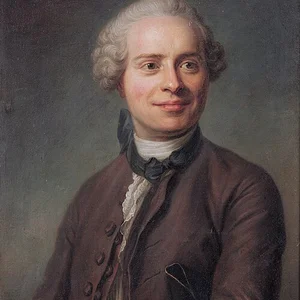

A mathematician and philosopher of the Enlightenment, he co-edited the great Encyclopédie with Diderot and wrote its famous Preliminary Discourse. He formulated the mechanical principle that bears his name and embodied the encyclopédiste ideal of bringing together all human knowledge.
Jean le Rond d'Alembert(1717 — 1783)
Jean Le Rond d'Alembert
royaume de France
9 min read
Frequently asked questions
Famous Quotes
« The universe, for one who could embrace it from a single point of view, would be, if we may say so, one single fact and one great truth.»
« The love of truth, when separated from the love of good, is nothing but one passion more.»
Key Facts
- 1717: Born in Paris as the illegitimate son of Madame de Tencin, abandoned on the steps of the church of Saint-Jean-le-Rond
- 1743: Publication of the Treatise on Dynamics, which formulates d'Alembert's principle in mechanics
- 1751: Co-edited with Diderot the first volume of the Encyclopédie and wrote the Preliminary Discourse
- 1754: Elected to the Académie française, of which he became perpetual secretary in 1772
- 1783: Died in Paris, leaving behind a major body of work at the crossroads of science and philosophy
Works & Achievements
A foundational work of modern mechanics, this treatise establishes d'Alembert's principle, which reduces any problem in dynamics to one of static equilibrium, thereby revolutionizing mathematical physics.
The introductory text of the Encyclopédie, which became one of the most celebrated manifestos of the Enlightenment. In it, d'Alembert maps out all human knowledge in encyclopedic form, drawing on the ideas of Bacon and Locke.
A memoir awarded by the Berlin Academy in which d'Alembert applies differential calculus to provide a scientific explanation of trade winds and the circulation of Earth's atmosphere.
A work in which d'Alembert popularizes and systematizes the harmonic theory of the composer Rameau, showcasing his gifts as a scientific educator well beyond the field of mathematics alone.
A collection of essays blending reflections on literature, philosophy, and history, which illustrates d'Alembert's intellectual versatility and his vision of the encyclopedist ideal — uniting all disciplines under one roof.
A philosophical pamphlet in which d'Alembert analyzes the expulsion of the Society of Jesus — seen by the philosophes as a symbol of the retreat of obscurantism and the triumph of reason.
Anecdotes
Jean le Rond d'Alembert owes his first name to the place where he was abandoned at birth: the steps of the church of Saint-Jean-le-Rond in Paris. The illegitimate son of the writer Mme de Tencin and the Chevalier Destouches-Canon, he was taken in by a humble glazier's wife, Mme Rousseau, whom he considered his true mother for the rest of his life — refusing to reunite with his biological mother even when she eventually made herself known.
When Frederick II of Prussia offered him the presidency of the Berlin Academy with a generous salary, d'Alembert politely declined. A few years later, Catherine II of Russia offered him 100,000 livres to educate her son, the future tsar — he turned that down as well, preferring his freedom and his Parisian life to any court in Europe.
D'Alembert was a true mathematical prodigy: admitted to the Académie des sciences at just 24, he published his groundbreaking Treatise on Dynamics in 1743 at the age of 26. The work, which sets out the mechanical principle now known by his name, astonished his contemporaries with its rigor and originality.
For twenty years, d'Alembert lived in an apartment directly across from that of Julie de Lespinasse, the celebrated hostess of a famous Parisian salon. Their deep friendship shaped the entire second half of his life; when Julie died in 1776, he was inconsolable and never truly recovered.
In his early years, d'Alembert lived on so little that he shared meals at the table of his foster mother, Mme Rousseau. It was only in his forties, thanks to royal and academic pensions, that he attained a measure of comfort — which he always kept modest, rejecting ostentation and the favors of the powerful.
Primary Sources
The learned world has at last come to recognize that human knowledge is so interconnected that it is often impossible to deepen one branch of it without the help of several others. This tree of human knowledge, whose map we have attempted to draw, is not the work of a single man, but of all the ages.
In any system of bodies set in motion by forces of any kind, the motions actually taken by the bodies can be regarded as compounded of two systems of motions — one that the bodies would have taken had nothing opposed them, and another that produces the equilibrium of the system.
The general solution to the problem of winds requires that we consider simultaneously the rotation of the Earth and the unequal action of solar heat on different parts of the globe; therein lies the common origin of trade winds and monsoons.
Music is founded on determined mathematical relationships, but it is the ear alone that must judge their effect and beauty; theory can only assist the ear, and can never replace it.
I am firmly convinced that philosophy can make solid progress only by enlightening people about their true interests and by gradually dismantling the prejudices that have kept them in chains for so many centuries.
Key Places
A small church, now demolished, that stood against the walls of Notre-Dame de Paris. D'Alembert was abandoned on its steps at birth in 1717, and it gave him his first name.
The literary salon d'Alembert frequented most, first on the rue Saint-Dominique and later on the rue de Bellechasse, where he gathered every evening with philosophers, scientists, and men of letters in an atmosphere of free discussion.
The institution where d'Alembert was elected in 1754 and became Perpetual Secretary in 1772, gradually turning his reception speeches into genuine philosophical platforms.
A famous café in the Palais-Royal district and a meeting place for philosophers and chess players, where d'Alembert and Diderot debated and worked together on the Encyclopédie.
The scientific institution d'Alembert joined as a member in 1741, where he presented the mathematics and physics papers that secured his reputation throughout learned Europe.
Typical Objects

The philosopher's daily working tools, with which he wrote his encyclopedic articles, scientific memoirs, and extensive correspondence with scholars and princes across Europe.

The seventeen volumes of text and eleven volumes of plates of the Encyclopédie, for which d'Alembert wrote the Preliminary Discourse and hundreds of articles devoted to mathematics, physics, and music.

Compass, graduated ruler, and set square — essential tools for d'Alembert's mathematical work, as he frequently illustrated his proofs with precise diagrams and geometric constructions.

The instrument typical of 18th-century drawing rooms that d'Alembert encountered daily, and upon which he based the theoretical reflections published in his Elements of Music According to the Principles of Rameau.

The sole source of artificial light for the scholar's long nights of work; ubiquitous in Parisian studies before gas lighting, it symbolizes the nocturnal labors of Enlightenment philosophers.

The periodicals of the era — the Mercure de France, the Journal des savants — which philosophers read avidly and to which they contributed in order to spread the new ideas of the Enlightenment across Europe.

Hundreds of letters exchanged with Voltaire, Frederick II, Catherine II, and other philosophers, forming the intellectual network of the European Enlightenment and a precious record of the scholarly life of the century.
School Curriculum
Vocabulary & Tags
Key Vocabulary
Daily Life
Morning
D'Alembert rose early and devoted his mornings to mathematical and scientific work, which he considered the time when the mind was sharpest. He would write his memoirs, solve problems, and handle the most technical parts of his correspondence, in the quiet of his Parisian apartment.
Afternoon
His afternoons were divided between sessions at the Académie des sciences, where he presented his work, and meetings with Diderot and other collaborators to make progress on the volumes of the Encyclopédie. He sometimes visited the royal library for his research.
Evening
D'Alembert's evenings were spent almost invariably in the Parisian salons, especially that of Julie de Lespinasse, where he debated philosophy, science, and literature with the intellectual elite. He often walked home late at night, beneath the lanterns lining the streets of Paris.
Food
Like many modest Parisians in his younger years, d'Alembert ate simply: soup, bread, seasonal vegetables, cheese. Even after achieving a degree of comfort, he kept his plain eating habits and never developed a taste for the refined gastronomy of lavish dinner parties.
Clothing
D'Alembert wore the typical bourgeois dress of an eighteenth-century man of letters: a dark cloth coat, knee breeches, silk stockings, a buttoned waistcoat, a shirt with a lace jabot, and a powdered wig. For academic sessions and salon gatherings, he took greater care with his appearance, though he never approached the extravagance of courtiers.
Housing
D'Alembert lived for many years with his foster mother, Madame Rousseau, in a modest lodging in the Saint-Michel quarter, refusing to leave her despite his growing fame. Only after her death did he move into an apartment on the rue Saint-Martin — simple and tidy, its walls hidden behind books and manuscripts.
Historical Timeline
Period Vocabulary
Visual Style
Le style visuel de d'Alembert s'inscrit dans l'esthétique sobre et lumineuse des portraits de philosophes du XVIIIe siècle français, entre cabinet de travail encombré de livres et élégance feutrée des salons des Lumières.
Sound Ambience
L'ambiance sonore de d'Alembert mêle le calme studieux de son cabinet de travail — grattement de plume, feuilletage de volumes — au bourdonnement vivant des salons parisiens où les philosophes débattent au son du clavecin et des cloches de la ville.