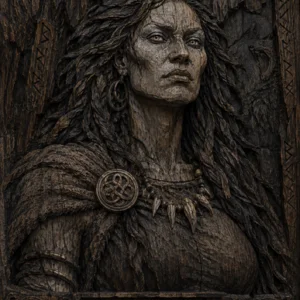

The Banshee is a female spirit from medieval Irish folklore whose nocturnal wailing announces the imminent death of a member of a native Irish family. Her Gaelic name, Bean Sídhe, means "woman of the fairy mounds".
Banshee
The Wailer
Irlande
7 min read
Frequently asked questions
Key Facts
- The Banshee appears in medieval Irish texts as early as the 8th century as the guardian spirit of certain noble families.
- She is associated with the great Irish families of pure Gaelic lineage, particularly those whose names begin with Ó or Mac.
- She appears in three forms: a young woman, a matron, or an old hag (the Cailleach), depending on the region of Ireland.
- Her lamentations (keening) are described as a mix of moaning, funeral chanting, and piercing cries.
- The tradition of keening — a real form of female funeral singing — is deeply intertwined with the mythological figure of the Banshee.
Works & Achievements
One of the earliest literary appearances of a figure foreshadowing the Banshee, featuring a description of a woman prophesying the death of an Irish king through her lamenting cries.
The oldest surviving Irish manuscript, it contains foundational mythological tales including descriptions of weeping supernatural female figures from the world of the Tuatha Dé Danann.
A monumental compilation of medieval Irish chronicles recording several events associated with supernatural omens, including Banshee lamentations before the deaths of great kings.
The first systematic and scholarly collection of Irish oral traditions about fairy beings, including detailed accounts of the Banshee as they were still alive in living memory at the start of the 19th century.
A landmark academic study offering an exhaustive analysis of medieval and modern sources on the Banshee, establishing her central place in Irish culture across more than fifteen centuries.
Anecdotes
The Gaelic name Bean Sídhe, meaning 'woman of the fairy mounds,' refers to a supernatural being intimately connected to the great Irish families of Celtic origin. According to tradition, only families bearing surnames beginning with Ó or Mac could hear her cries, making her wail a sign reserved for the Gaelic aristocracy.
Medieval Irish chronicles mention the Banshee as early as the 8th century in the Leabhar Gabhála Éireann. It describes spirit-women associated with the Tuatha Dé Danann, the pre-Christian Celtic deities, who wept for heroes fallen in battle.
The Banshee could appear in several forms: sometimes as a gaunt old woman with eyes red from endless weeping, sometimes as a beautiful young woman with silver hair. This duality reflects the Celtic conception of death as a passage between two states — neither wholly terrifying nor benevolent.
The O'Brien family, descendants of King Brian Boru — who died at the Battle of Clontarf in 1014 — were said to have their own dedicated Banshee, known as Aibell. This protective and mourning figure illustrates how the Banshee could also be seen as a faithful guardian of a bloodline.
Contrary to popular belief, the Banshee is not a cause of death but a herald of it. In some 12th-century accounts, several Banshees weeping together signaled the death of a great king or saint, amplifying the scale of collective grief.
Primary Sources
The tales of the Tuatha Dé Danann describe divine women whose prophetic weeping is associated with burial mounds and sacred hills, messengers between the world of the living and the realm of the dead.
Before the death of King Conaire Mór, a long-haired woman in multicolored garments appears weeping before the hostel — an ill omen that medieval annalists would explicitly associate with the figure of the Bean Sídhe.
At the death of Brian Boru at Clontarf, the chroniclers report that supernatural lamentations were heard in the night, attributed by the people to Aibell, the Banshee protector of the O'Brien clan.
The women of the Tuatha Dé Danann raise ritual cries (keening) over the dead on the battlefield, a practice rooted in the same mythological substrate as that of the Banshee.
Key Places
A sacred hill associated with Aibell, the Banshee protectress of the O'Brien clan. Legend holds that her spirit dwelled here and wailed to foretell the death of Brian Boru in 1014.
A Neolithic passage tomb later reinterpreted by the Celts as an entrance to the Sídhe, the underground realm of fairy beings. Such sites form the mythological territory of the Banshee.
The symbolic seat of Ireland's High Kings and a focal point of Gaelic mythological tradition, where — according to medieval belief — the boundary between the world of the living and the fairy realm grew thin.
The banks of the Shannon are linked in folklore to apparitions of the Banshee washing burial shrouds — the Irish counterpart of the Night Washerwoman figure found in other Celtic traditions.
A rural region of Ireland that remained Irish-speaking for generations and where Banshee lore survived with the greatest vitality, passed down orally from one generation to the next.
Typical Objects

The Banshee is often depicted combing her long white or silver hair. Finding such a comb left behind was considered a bad omen in Irish folklore.

The traditional garment of the Banshee in medieval accounts is a long grey or pale green cloak, the color of the in-between world separating life and death in Celtic cosmology.

In some versions, the Banshee washes shrouds or bloodied garments in a stream, announcing through this ritual act that death is near.

Associated with medieval Irish funeral processions, the white torch sometimes accompanies the Banshee during her nocturnal appearances, lighting the way to the world of the dead.

In some older tales, the Banshee offers a drinking cup to those whose death she foretells, a symbolic gesture representing the passage into the afterlife.

The Neolithic burial mounds reinterpreted as dwellings of fairy beings are inseparable from the Banshee, who emerges from them at night to carry out her role as herald of death.
School Curriculum
Vocabulary & Tags
Key Vocabulary
Tags
Daily Life
Morning
The Banshee has no daytime life in the conventional sense: she belongs to the world of the sídhe, invisible to mortals until death draws near. She lies hidden in the hollows of hills or beneath the waters of sacred springs, waiting for the signal that will call her to act.
Afternoon
According to medieval Irish belief, the Banshee silently watches the world of the living, bound to a particular bloodline whose fates she keeps vigil over. She may appear fleetingly as a shadow or a distant figure glimpsed through the mist.
Evening
It is at dusk and in the night that the Banshee fully manifests: she sits upon a stone or at the edge of a stream, combs her long hair, and begins the keening — the Irish funeral lament — a signal that death has come to the door of a member of the family she watches over.
Food
As a supernatural being, the Banshee does not feed as mortals do. Some accounts suggest she sustains herself on the tears shed for the dead and the emotion of collective grief, giving her an existence paradoxically nourished by human suffering.
Clothing
The Banshee wears a long cloak (brat) of grey or pale green — the color of the in-between world in Celtic cosmology. Her garments are often described as damp with dew or mist, and her white or silver hair flows freely, like that of a woman in mourning.
Housing
She dwells in the sídhe — the burial mounds and earthen barrows that medieval Irish people perceived as gateways to the underground realm of fairy beings. These sites, often thousands-of-years-old Neolithic monuments, were feared and avoided at night by rural communities.
Historical Timeline
Period Vocabulary
Visual Style
Illustration médiévale irlandaise : figure féminine fantomatique aux cheveux argentés sur une lande brumeuse sous la lune, palette froide et terreuse avec des accents bleu-argent, style enluminure insulaire.
Sound Ambience
Paysage sonore nocturne de l'Irlande médiévale rurale : lamentations féminines poussées (keening), vent sur les landes, cours d'eau, chouettes et silence des tertres funéraires.
Liens externes & ressources
Références
Œuvres
Togail Bruidne Dá Derga
Xe–XIe siècle
Leabhar na hUidhre (Livre de la Vache Brune)
vers 1100
Annales des Quatre Maîtres
1632–1636
Fairy Legends and Traditions of the South of Ireland, T. Crofton Croker
1825
The Banshee: The Irish Death Messenger, Patricia Lysaght
1986