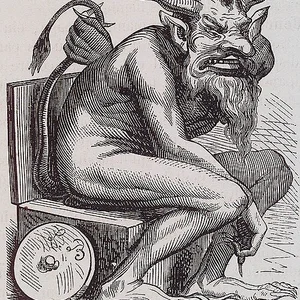

Belphegor is a demon from Hebrew and medieval Christian traditions, associated with the deadly sin of sloth. Considered one of the seven princes of Hell, he tempts humans with promises of wealth and ingenious inventions. His name derives from Baal-Peor, a Moabite deity mentioned in the Bible.
Belphegor
Belphegor
8 min read
Frequently asked questions
Key Facts
- His name derives from Baal-Peor, a Canaanite deity mentioned in Numbers (25:3) of the Hebrew Bible
- Listed among the seven princes of Hell corresponding to the seven deadly sins in medieval demonology
- Described in Collin de Plancy's 'Dictionnaire Infernal' (1818) as a tempter through sloth and inventions
- Associated with the deadly sin of sloth (acedia) in medieval Christian tradition
- Mentioned in several grimoires and demonological treatises of the 16th and 17th centuries
Works & Achievements
A foundational text mentioning the cult of Baal-Peor and its disastrous consequences for the people of Israel. The primary source for the name and origins of Belphegor in religious tradition.
A satirical novella in which an archdemon is sent on an observation mission to Earth. A landmark text that established Belphegor as a figure in European Renaissance literature.
A demonology treatise cataloguing demons and their attributes. One of the earliest works to attempt a critical, rationalized approach to medieval demonological beliefs.
A treatise by Bishop Binsfeld establishing the list of seven princes of Hell associated with the deadly sins. This is the text in which Belphegor is officially linked to sloth.
An encyclopedia of demonology synthesizing medieval and early modern traditions. Louis Breton's famous illustration of Belphegor in this volume forged the grotesque image of the demon that endures to this day.
Anecdotes
The name Belphegor comes from Baal-Peor, a Moabite deity mentioned in the Bible (Numbers 25). The Israelites who bowed down before this idol were struck by a great calamity, and this episode turned Baal-Peor into a cautionary figure in the Hebrew tradition, which gradually transformed him into a demon.
According to Christian medieval demonology, each of the seven deadly sins was ruled by a prince of Hell. Pierre Binsfeld, auxiliary bishop of Trier, established a precise classification in 1589: Belphegor was thus officially associated with sloth (acedia), the sin of avoiding spiritual and moral effort.
A widespread medieval legend held that Belphegor had been sent to Earth by Satan to verify whether marriage truly made men happy — as some demons in Hell claimed. After observing human couples, he fled back to Hell in a hurry, convinced that the institution of marriage was already a sufficient form of torment in itself.
Belphegor is one of the rare demons to whom demonological tradition attributes the talents of an inventor. He was said to be capable of suggesting ingenious discoveries and easy riches to men — but only to corrupt them through the temptation of sloth and effortless gain.
In the famous Dictionnaire Infernal by Collin de Plancy (1818), illustrator Louis Breton depicted Belphegor seated on a toilet, mouth agape and wearing a dazed expression. This grotesque image, which became iconic, captures both the idea of sloth and the medieval contempt for diabolical seductions, presented as utterly ridiculous.
Primary Sources
Israel joined himself to Baal-Peor. The anger of the Lord was kindled against Israel. The Lord said to Moses: Take all the chiefs of the people, and hang them before the Lord.
Pluto, having summoned all the princes of Hell into council, learned that the souls of damned men attributed their misfortune to the women they had married. It was decided to send a devil to Earth to verify this claim.
Belphegor is the prince who governs the vice of sloth, for it is through him that the enemy of mankind drives souls to shun spiritual labor and surrender to the corruption of idleness.
Belphegor is a demon whom the Moabites worshipped in the form of a young woman. Other authors have claimed that he appeared in obscene forms, and that he seduced men with riches and ingenious inventions.
Demons seek to deceive men through flattery and the promise of earthly goods, in order to turn the soul away from divine contemplation and plunge it into torpor and indifference.
Key Places
A place of worship for Baal-Peor mentioned in the Bible (Numbers 23–25). It was on this mountain overlooking the plain of Moab that the rituals took place which gave the future demon his name.
Center of the Hebrew tradition and biblical monotheism, against which the cult of Baal-Peor was seen as a serious act of betrayal. The texts condemning this cult were compiled and transmitted here.
Home city of Peter Binsfeld, the bishop who in 1589 codified the correspondence between Belphegor and the sin of sloth. Trier was also the scene of major witchcraft trials at the end of the 16th century.
Birthplace of Machiavelli, where around 1515 the satirical novella Belfagor arcidiavolo was written, popularizing the figure of a spy demon sent to Earth to observe human marriage.
Typical Objects

A book of black magic containing invocations and pacts with demons. According to medieval demonologists, Belphegor inspired men with formulas to obtain wealth and inventions without labor.

Belphegor is associated with the promise of easy riches, offered without effort to corrupt men through the combined temptation of sloth and greed.

According to tradition, Belphegor seduced inventors by whispering to them mechanisms or discoveries supposedly capable of bringing fortune without work, thereby corrupting the human mind through vanity.

A statue or effigy of the Moabite deity from which Belphegor takes his name. In the Bible, its cult is associated with the debauchery and apostasy of the Israelites in the land of Moab.

A geometric symbol used in medieval magic ceremonies to summon or ward off demons. Grimoires describe specific pentacles associated with Belphegor.

A magical object through which demons were believed to show men false visions of wealth and success, in order to turn them away from virtuous work.
School Curriculum
Vocabulary & Tags
Key Vocabulary
Tags
Daily Life
Morning
According to medieval demonological texts, Belphegor exerts his influence at the break of day, when men must choose between virtuous work and idleness. He is said to whisper into the ears of craftsmen and scholars ideas for ingenious machines promising wealth without effort.
Afternoon
Medieval tradition describes Belphegor as particularly active during the afternoon hours, that time when fatigue can make men receptive to the temptation of sloth. He slips into the minds of merchants and inventors, offering them easy, illusory gains.
Evening
At dusk, the hour of offices and prayer, Belphegor redoubles his efforts to distract the faithful from their spiritual duties. Demonologists describe him wandering through taverns and poorly shuttered homes, seeking souls willing to trade their virtue for false promises of happiness.
Food
As a demonic figure, Belphegor has no dietary needs of his own. Yet iconographic tradition associates him with excess and the easy pleasures of the table, symbols of moral laziness and the rejection of Christian austerities.
Clothing
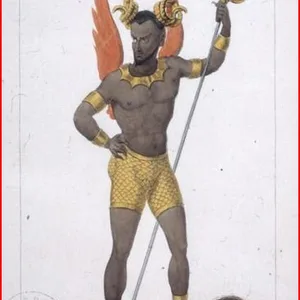
Medieval iconography generally depicts demons as naked or covered in dark animal furs, signifying their bestial nature as opposed to human dignity. Belphegor sometimes appears draped in rags of purple — the color of false kings and deceptive wealth.
Housing
According to Christian medieval cosmology, Belphegor resides in Hell, in a circle reserved for demons governing the vices. In Hebrew texts he is sometimes associated with the cave sanctuaries of Mount Peor, and in Christian tradition with abandoned places conducive to stagnation and idleness.
Historical Timeline
Period Vocabulary
Visual Style
Style enluminure gothique médiévale tardive, avec une palette sombre aux tons de pourpre, d'ocre brûlé et de noir de fumée, évoquant les représentations démonologiques des manuscrits du XVe siècle.
Sound Ambience
Une atmosphère de scriptorium médiéval nocturne mêlée à des résonances souterraines, évoquant à la fois l'origine biblique de Belphégor et le monde des démonologues chrétiens du Moyen Âge.
Liens externes & ressources
Références
Œuvres
Livre des Nombres, chapitre 25 (Bible hébraïque)
VIIIe–Ve siècle avant J.-C.
Belfagor arcidiavolo, Niccolò Machiavel
Rédigé vers 1515, publié en 1549
De Praestigiis Daemonum, Jean Wier
1563
Tractatus de confessionibus maleficorum et sagarum, Pierre Binsfeld
1589
Dictionnaire Infernal, Jacques Collin de Plancy
1818 (édition illustrée : 1863)