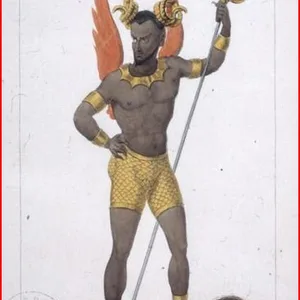

Astaroth is a grand duke of Hell from medieval demonology, considered a corrupted form of the Phoenician goddess Astarte. Described in the Goetia as riding a dragon and holding a serpent, he embodies vanity and sloth. His name illustrates the process by which medieval Christian theology demonized the deities of ancient religions.
Astaroth
Astaroth
9 min read
Frequently asked questions
Key Facts
- Mentioned in the Goetia (16th century) as one of Solomon's 72 demons, he holds the rank of grand duke of Hell
- His name and figure derive from Astarte, the great Phoenician and Babylonian goddess associated with fertility and war
- The Goetia describes him riding an infernal dragon and holding a serpent in his left hand
- He is associated with the sins of vanity and sloth in medieval demon classification
- His existence illustrates how the gods of ancient polytheistic religions were reinterpreted as demons in the medieval Christian tradition
Works & Achievements
The first systematic list of demons, appended to his De Praestigiis Daemonum. Weyer describes Astaroth as a grand duke who teaches the liberal arts and reveals secrets of the past and future — a foundational text of modern demonology.
A grimoire describing 72 demons with their seals, ranks, and powers. Astaroth appears as the twenty-ninth spirit, a grand duke commanding forty legions; this text remains the canonical reference of Western occultism.
The "Hammer of Witches," an inquisitorial manual describing demonic pacts and the methods used to detect them. It helped place high-ranking demons such as Astaroth at the center of European witchcraft trials.
A treatise by the French jurist defending the reality of diabolical pacts against Weyer's skepticism. Bodin establishes a hierarchy of demonic powers, helping to cement Astaroth's status in learned culture.
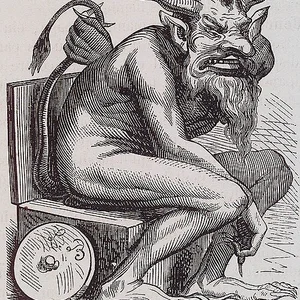
An illustrated encyclopedia of demons and supernatural beings. The engraving of Astaroth by Louis Le Breton (1863 edition) became the definitive image of the figure for the following two centuries, shaping both Romantic and popular imagination.
Anecdotes
The name "Astaroth" is a Hebrew distortion of the name of the Phoenician goddess Astarte (Ashtaroth in the Bible). In 1 Kings 11:5, King Solomon is condemned for worshipping "Ashtoreth, the goddess of the Sidonians." This semantic shift illustrates how a goddess venerated by millions was gradually transformed into a demon by Christian and Jewish theology.
In the Goetia — compiled around the 17th century but heir to a long medieval tradition — Astaroth is described as a "grand duke" commanding forty legions of demons. He is depicted riding an infernal dragon and holding a serpent in his left hand. His stench is so terrible that grimoires advise magicians to hold a silver ring before their nose to protect themselves from his breath.
Johann Weyer, a Flemish humanist physician, published the Pseudomonarchia Daemonum in 1563, the first systematic catalogue of demons. In it, he claimed to have debunked witchcraft, arguing that people accused of demonic pacts were simply ill. Paradoxically, his work helped spread descriptions of Astaroth across learned Europe, fueling the very witch trials he sought to criticize.
The theologian and inquisitor Heinrich Kramer, author of the Malleus Maleficarum (1486), emphasized the ability of demons like Astaroth to deceive human senses and disguise themselves in seductive forms. This treatise, used by inquisitorial courts, illustrates how fear of the devil and his lieutenants had devastating consequences for thousands of men and women accused of witchcraft.
Religious historian Peter Brown has shown that the "demonization" of ancient gods is a documented process dating back to the 4th and 5th centuries: Augustine of Hippo asserts in The City of God that the gods of the Gentiles are in reality demons. Astaroth is a paradigmatic example of this mechanism: from a great goddess of fertility, she became one of the most feared princes of darkness in medieval demonological literature.
Primary Sources
Astaroth, magnus dux, procedit in forma angeli, foetidus nimis, equitat super draconem infernali, gestat in manu dextra serpentem. Docet libenter de rebus praeteritis, praesentibus et futuris, et de omni re arcana.
Astaroth is a great and a strong duke, and he cometh forth in the likeness of a foul angel, sitting upon an infernal dragon, and carrying in his right hand a viper.
For Solomon went after Ashtoreth the goddess of the Zidonians, and after Milcom the abomination of the Ammonites. And Solomon did evil in the sight of the LORD.
The demons are called gods by the Gentiles, yet they are nothing but evil spirits who seek to turn men away from the true God through deceitful rites and displays of power.
The higher demons, such as those who govern the infernal legions, possess knowledge of past and future things and can impart to sorcerers unlawful knowledge contrary to divine law.
Key Places
A great Phoenician city and major center of the cult of Astarte, of whom Astaroth is the demonized version. The title 'deity of the Sidonians' (1 Kings 11:5) historically anchors this figure to this geography.
Another great Phoenician metropolis where the temple of Astarte was one of the most important in the ancient Mediterranean world. Herodotus describes its sanctuary as thousands of years old.
The city where Johann Weyer, physician to William of Jülich, was based when he wrote the Pseudomonarchia Daemonum in 1563 — a foundational work in spreading the description of Astaroth throughout learned Europe.
Site of the famous 1634 possession case, in which Astaroth was named among the demons said to have possessed the Ursuline nuns. The trial and execution of Father Grandier made it an emblematic episode of the witch hunts.
The institution that officially condemned necromancy and demonic magic in 1398, helping to forge the legal and theological framework that made figures like Astaroth into real threats in the eyes of medieval society.
Typical Objects

A magical text compiled in the 17th century containing the descriptions and seals of 72 demons, including Astaroth. Magicians were said to use these seals to summon and compel demons to answer their questions.

Astaroth's mount according to the Goetia, a symbol of subterranean power and transgression. The image of Astaroth riding a dragon places him within the medieval diabolical iconography inherited from the Book of Revelation.

According to medieval grimoires, Astaroth holds a serpent in his hand — a direct echo of the biblical serpent from Genesis, associated with temptation and the Fall, reinforcing his deceitful nature.

Grimoires advise the necromancer summoning Astaroth to hold a silver ring before his nose to protect himself from the demon's foul stench — a telling detail that reflects the physical, material qualities attributed to demonic entities.

Every demon in the Goetia has a unique geometric seal used to summon it. Drawn within a ritual magic circle, the seal of Astaroth is his distinctive mark, believed to allow practitioners to call upon and control him.

As a grand duke of Hell commanding forty legions, Astaroth is sometimes depicted wearing a crown, signaling his high rank within the demonic hierarchy — itself modeled on the feudal structures of the medieval world applied to Hell.
School Curriculum
Vocabulary & Tags
Key Vocabulary
Daily Life
Morning
According to medieval grimoires, Astaroth willingly manifests at dawn — an hour considered propitious for invocations in the esoteric tradition. The magician who summons him must have purified himself, fasted, and drawn his magic circle at daybreak in order to receive his revelations about the past and the future.
Afternoon
Demonology treatises describe Astaroth as a patient teacher: he reveals the liberal arts (grammar, rhetoric, logic, arithmetic) to sorcerers who question him. This pedagogical dimension reflects the medieval fascination with forbidden knowledge, supposedly guarded by demons.
Evening
After nightfall, Astaroth is said to reign over the temptations of sloth and vanity — capital sins he is believed to incite, according to theologians. Medieval clerics warned against idle evening thoughts, considered especially vulnerable to the influence of demons under his command.
Food
As a supernatural entity of medieval Christian theology, Astaroth does not feed in any material sense. Grimoires nonetheless specify that his favor is obtained through ritual offerings — incense, animal blood — inheritances of ancient practices reinterpreted within a magical framework.
Clothing
In 16th- and 17th-century visual depictions, Astaroth is described as a great lord dressed in the manner of a fallen noble: dark armor, a cloak in infernal colors (red and black), and a dull metal crown — reflecting the feudal structure that demonologists applied to the hierarchy of Hell.
Housing
The medieval Hell is conceived as an inverted feudal castle: Astaroth governs an infernal duchy of forty legions from a palace of subterranean darkness. This imaginary geography mirrors the social organization of the Middle Ages, projected onto the demonic world by theologians and clerics.
Historical Timeline
Period Vocabulary
Visual Style
Esthétique enluminure médiévale tardive fusionnée avec la gravure sur bois du XVIe siècle : atmosphère gothique sombre, contrastes forts, personnage couronné chevauchant un dragon sur fond de parchemin jauni et de sceaux démoniaques.
Sound Ambience
Ambiance nocturne d'un scriptorium médiéval où des clercs copient des traités théologiques et des grimoires, mêlant le souffle des chandelles, les chants monastiques lointains et l'écho de prières latines dans la pierre.
Liens externes & ressources
Références
Œuvres
Pseudomonarchia Daemonum — Johann Weyer
1563
Ars Goetia (Clavicule de Salomon, partie I)
XVIIe siècle (compilation)
Malleus Maleficarum — Heinrich Kramer
1486
De la Démonomanie des Sorciers — Jean Bodin
1580
Dictionnaire Infernal — Jacques Collin de Plancy
1818