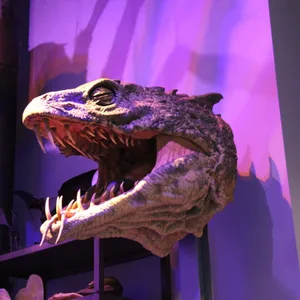

A legendary creature of the Middle Ages, the Basilisk is the king of serpents, said to kill with a single glance or its poisonous breath. It hatches from a rooster's egg incubated by a snake, and ranks among the most feared beasts in medieval bestiaries.
Basilisk
Basilisk
9 min read
Frequently asked questions
Key Facts
- Described by Pliny the Elder in the 1st century in his Natural History as the king of serpents, capable of killing with its gaze
- Taken up and elaborated in medieval bestiaries (12th – 13th century), where it became a moral and religious symbol
- According to tradition, it hatches from a rooster's egg incubated by a snake (or a toad), symbolizing a perversion of nature
- Its only known remedy is the gaze of a weasel, or the reflection of its own gaze in a mirror
- Isidore of Seville described it in the 7th century in his Etymologiae, fixing its depiction for the rest of the Middle Ages
Works & Achievements
The first Western encyclopedic text to describe the Basilisk in precise detail, this monumental work in 37 books served as the primary source for all medieval descriptions of the creature.
The definitive encyclopedia of the Middle Ages, whose Book XII on animals codifies the properties of the Basilisk. This text was copied thousands of times and transmitted the Basilisk tradition throughout Christian Europe.
An allegorical collection of Alexandrian origin that integrates the Basilisk into Christian symbolism, casting it as an embodiment of the devil and mortal sin. Translated into Latin and all the vernacular languages, it shaped medieval religious iconography.
The first bestiary written in a Romance language, it establishes the Basilisk's hybrid cockerel-serpent form that would become standard in Western iconography. This text helped popularize the creature beyond clerical circles.
One of the best-preserved illuminated bestiaries of the Middle Ages, it contains a depiction of the Basilisk among its most finely crafted illustrations. This manuscript shows how the creature's iconography had become codified by the 13th century.
An encyclopedic naturalist treatise that incorporates the Basilisk into a scholastic inquiry into the nature of monstrous animals. Albertus Magnus attempts to explain the creature's properties through rational analysis, anchoring it within late medieval scholarly thought.
Anecdotes
The Basilisk is described by **Pliny the Elder** in the **1st century** as a creature no longer than twelve fingers, yet whose breath could split rocks and wither plants in its path. The medieval knights who read this shuddered: so small a beast, so great a terror.
According to medieval bestiaries, the Basilisk hatches from an egg laid by an old cock aged seven years, then incubated by a snake or a toad in a dung heap. This unnatural birth made it, in the eyes of theologians, the perfect symbol of sin giving rise to death.
The only way to kill a Basilisk without dying oneself was to hold up a mirror: upon meeting its own gaze, the creature was struck down by its own power. **Alexander the Great** supposedly used this trick, according to a late medieval legend, during the conquest of **Persia**.
The weasel was said to be the only animal naturally immune to the Basilisk's gaze. To strengthen it before battle, it was fed rue (a bitter herb). This duel between the weasel and the Basilisk appears in many illuminated bestiaries from the **12th** to the **14th century**.
In the **Middle Ages**, it was believed that the Basilisk was so venomous that if a rider pierced it with his lance, the poison would travel up the shaft of the weapon and kill both horse and man. This detail, reported by **Isidore of Seville**, made the Basilisk a metaphor for an evil that contaminates everything it touches — even from a distance.
Primary Sources
The basilisk is a serpent from the province of Cyrene, at most twelve fingers in length. It bears a white marking on its head in the shape of a diadem. It kills shrubs with its breath, scorches grass, and shatters rocks: such is its deadly power.
The basilisk is called the king of serpents, for all others flee before it. It kills with its gaze, and it kills also with its breath; and if a man on horseback strikes it with a lance, the venom travels up through the wood and kills the rider.
The Basilisk is the most fearsome of all creatures; its gaze alone is enough to kill; it reigns over all serpents as a king over his subjects, and no herb grows where it has passed.
The weasel alone is immune to the Basilisk; it attacks and puts it to flight, and to do so it eats rue before the battle, for this herb fortifies it against the basilisk's venom.
The basilisk has the form of a cockerel down to the waist, and then that of a serpent; it kills by gaze and by breath, and none can withstand it save the weasel by its nature.
Key Places
A region of North Africa identified by Pliny the Elder as the birthplace of the Basilisk. Its rocky, sandy desert seemed to the ancients the ideal setting for a creature capable of desiccating all life.
An arid expanse mythologized by ancient and medieval authors as the domain of the Basilisk. Its barrenness was attributed to the creature's passing — its breath scorching vegetation and poisoning springs.
It was in the copying workshops of abbeys (Canterbury, Saint Albans, Paris) that illuminators gave the Basilisk its definitive iconographic form: a winged cockerel with a serpent's tail, immortalized in hundreds of manuscripts.
The intellectual birthplace of the *Physiologus*, the allegorical zoological text that established the Basilisk as a Christian symbol of evil. The Alexandrian library and philosophical circles transmitted this tradition throughout the medieval world.
Typical Objects

The fatal weapon against the Basilisk, the mirror reflected its own lethal gaze back at it. In bestiaries, the knight armed with a polished shield represented the virtue that turns evil against itself.

According to medieval tradition, the Basilisk was born from an egg laid by an old seven-year-old rooster, incubated in dung by a serpent. This paradoxical object symbolized the unnatural birth of evil.

The only animal naturally immune to the Basilisk, the weasel was depicted as its adversary in illuminated manuscripts. It would eat rue before the battle to strengthen its immunity.

A bitter, pungent plant reputed to protect against the Basilisk's venom. Medieval bestiaries note that weasels would consume it before facing the king of serpents.

A weapon theoretically ineffective against the Basilisk: its venom traveled up the shaft to the rider. This detail, drawn from Isidore of Seville, illustrated the absolute danger of the creature, even from afar.

The Basilisk's distinctive mark, often depicted as a white crown-shaped spot on its head, symbolizing its royalty among serpents in illuminated bestiaries.

An illustrated manuscript cataloguing real and legendary creatures along with their moral and religious symbolism. The Basilisk appeared among the most feared beasts, carefully illustrated by monk scribes.
School Curriculum
Vocabulary & Tags
Key Vocabulary
Tags
Daily Life
Morning
In the arid lands of Cyrenaica, the Basilisk stirs at dawn. Its poisonous breath spreads through the early hours of the day, withering plants and cracking stones around its lair. The rare travelers who venture into these regions quickly learn to recognize the signs of its passing: blackened vegetation, dried-up springs, and soil bleached white as if scorched by intense heat.
Afternoon
During the hottest hours, the Basilisk reigns as absolute master over all other serpents, which yield the ground before it. It moves with its head held high — the only snake that does not crawl flat on its belly — thus proclaiming its royalty. Its gaze alone is enough to petrify or kill any living being that dares meet it. Even birds flying overhead plummet, struck dead before they can flee.
Evening
At night, the Basilisk withdraws to its caves or to the ruins of ancient buildings. Medieval bestiaries imagine it keeping constant watch over its territory, like a wicked king brooding over a desolate kingdom. The monks who copied these texts saw in it the image of the devil prowling 'like a roaring lion, seeking whom he may devour' — active even in the darkness.
Food
The Basilisk does not feed as other animals do: it absorbs the miasmas of the soil and the corrupted air of swamps. Some medieval texts claim it sustains itself on stone, its venom so potent that it digests minerals themselves. Its very existence is a negation of ordinary life — it creates nothing; it only lays waste.
Clothing
A creature, not a human, the Basilisk wears no clothing. Its 'adornment' is entirely natural: scales gleaming like polished metal, a white crown-shaped mark on its head, and the wings of a rooster in later depictions. In coats of arms and heraldry, it is sometimes rendered in vivid colors — venomous green, blood red — to convey its royal and deadly nature.
Housing
According to ancient sources, the Basilisk inhabits the deserts of North Africa, notably Cyrenaica and Libya. Medieval authors place it in underground passages, ruins, poisoned marshes, or any barren and accursed place. Wherever it settles, life retreats: plants die, water turns foul, stones crack apart. Its lair is a dead zone, unmistakable in its absolute desolation.
Historical Timeline
Period Vocabulary
Visual Style
Style des bestiaires enluminés médiévaux : fond or, couleurs intenses lapis-lazuli et vermillon, trait noir épais, créature hybride coq-serpent couronnée sur parchemin ivoire.
Sound Ambience
Une atmosphère de caverne obscure et de désert aride : sifflements inquiétants, pierres fendues par un souffle brûlant, silence menaçant du repaire du roi des serpents.
Liens externes & ressources
Références
Œuvres
Historia Naturalis — Pline l'Ancien
77 ap. J.-C.
Etymologiae — Isidore de Séville
vers 620
Physiologus
IIe-IVe siècle
Bestiaire de Philippe de Thaon
vers 1121-1135
Bestiaire d'Aberdeen (Aberdeen Bestiary)
vers 1200
De animalibus — Albert le Grand
vers 1260