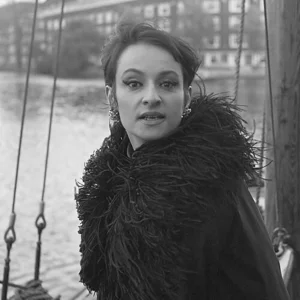

Barbara (1930–1997) was a French singer-songwriter, nicknamed “the Lady in Black.” A pianist and poet of song, she is known for intimate works such as “Nantes” and “The Black Eagle.”
Barbara(1930 — 1997)
Barbara
France
9 min read
Frequently asked questions
Famous Quotes
« Life is like a toothache. At first you don’t believe it, you think it will pass. Then it really hurts, then it passes.»
« I would like to sing for those who are alone.»
Key Facts
- 1930: born in Paris under the name Monique Andrée Serf
- 1964: release of “Nantes,” an autobiographical song about her father’s death, which brings her to wide public attention
- 1968: triumph at the Théâtre des Capucines with “The Black Eagle”
- 1987: AIDS activism through the song “Sid’amour à mort”
- 1997: death at Précy-sur-Marne, leaving behind a landmark body of work in French chanson
Works & Achievements
One of the first songs to bring Barbara to a wide audience. Over a melancholy piano melody, she expresses longing and absence — themes that would run through her entire body of work.
Considered one of the pinnacles of French chanson, this autobiographical song recounts the death of her father. Its poetic narrative and spare piano accompaniment have made it an absolute benchmark of the genre.
A hymn to Franco-German reconciliation, this song was celebrated on both sides of the Rhine. It is still studied in French-German classrooms as a symbol of post-war European friendship.
A song dedicated to her audience — "my greatest love story is you." This title embodies the intimate, all-encompassing bond Barbara shared with her listeners, a relationship at the heart of her entire artistic approach.
A dreamlike and mysterious song open to many interpretations, often read as a metaphor for intimate trauma. It remains one of the most celebrated and widely discussed works in her repertoire.
A pacifist song set against war, built on a subverted lullaby melody. It illustrates Barbara's ability to blend poetic lightness with a deeply humanist message.
An exceptional collaboration with actor Gérard Depardieu, weaving together theatre and song. The show sold out every performance and marked the last great chapter of Barbara's career on stage.
Anecdotes
Born Monique Andrée Serf on June 9, 1930, in Paris, into a Jewish family of Russian origin, the future Barbara was forced to flee with her family during the Nazi Occupation. Driven from Paris, they lived in hiding, regularly changing safe houses in the south of France. This fugitive childhood would haunt her entire body of work, infusing her songs with a deep melancholy and quiet resilience.
In 1963, Barbara traveled to Nantes to the bedside of her father — a man she barely knew — who was dying of cancer. From this painful journey came the song “Nantes,” one of her masterpieces: with haunting precision she describes the train ride, the hospital room, and her father's death at dawn. The song was received as a revelation and established Barbara as a major voice in French chanson.
During a tour of Germany in 1964, Barbara was deeply moved by the warm reception from audiences in Göttingen. At a time when the scars of World War II were still raw, she composed a love song addressed to German youth, sung in French. “Göttingen” became an anthem of Franco-German reconciliation and was even cited in official speeches from both countries.
Barbara was a confirmed night owl who composed her songs at night, often at the piano until dawn in her house in Précy-sur-Marne. She would sleep until mid-afternoon and refused any morning commitments. This unconventional schedule, which she defended as an artistic necessity, earned her a reputation as a mysterious artist living outside ordinary time.
From 1987 onward, Barbara threw herself into the fight against the AIDS epidemic, organizing benefit concerts and writing “SID’amour à mort.” She visited patients in hospitals and helped break the taboos surrounding the disease at a time when it was still heavily stigmatized. This humanitarian commitment remains one of the most significant chapters of the final years of her career.
Primary Sources
I was born in Paris, in the 20th arrondissement, in the Quartier de la Chine. I am the daughter of a man I barely knew, barely loved, and who barely loved me. That absence built everything.
It is in Nantes where I feel the most pain / Where I had to live and suffer / It is there I planted my shame and my anger / And where I nearly died.
Of course, it is not the Seine / It is not the Bois de Vincennes / But it is quite lovely all the same / In Göttingen, in Göttingen.
One fine day, or perhaps one night / Near a lake I had fallen asleep / When suddenly, as if tearing through the sky / Coming from nowhere / A black eagle appeared.
My most beautiful love story / Is you / You are the ones who shape it, who live it / From that very first evening.
Key Places
The working-class neighborhood where Barbara was born, in the area known as "la Chine." Her early performances in the cabarets of the Left Bank shaped her intimate and poetic style.
The music hall on the Rue de la Gaîté where Barbara enjoyed her greatest stage triumphs, most notably in 1967. Bobino is inseparable from her artistic story and the myth she built around herself.
The city Barbara traveled to in 1963 to be at the bedside of her dying father. This painful experience inspired her most celebrated song, now considered a masterpiece of intimate French chanson.
The German university town where Barbara performed in 1964. Moved by the warmth of the audience, she wrote her anthem to Franco-German reconciliation there — a song still studied in bilingual classrooms today.
The village where Barbara owned her retreat — a house surrounded by a garden she considered her sanctuary. Far from Paris, it was here that she composed through the night and found the silence her inspiration required.
The city where Barbara passed away on November 24, 1997, after a long illness. Her death prompted an outpouring of tributes both in France and around the world.
Typical Objects

Barbara was above all a pianist and always composed at the piano. Her instrument was at the center of her creative work, and she refused to take the stage without it, making the voice-and-piano duo the signature of her concerts.

Barbara always wore black on stage, a powerful visual signature that earned her the nickname "Lady in Black." This deliberate choice evoked mourning, understated elegance, and an inimitable artistic identity.

Barbara worked on her lyrics in notebooks, endlessly rewriting until she found exactly the right word. She brought a true poet's care to language, refusing any approximation in her lyrics.

The dominant medium for music in France from 1960 to 1990, vinyl was the means by which the general public discovered Barbara's albums between tours. Her sleeve designs, often in black and white, extended her stage aesthetic.

The instrument of her direct dialogue with the audience, the microphone embodied the emotional closeness that characterized her concerts. Barbara was known for transforming large venues into spaces of an almost confidential intimacy.

Barbara kept many photographs from her tours and her encounters with audiences, reflecting her deep attachment to the bond between artist and admirer — a bond she celebrated in "Ma plus belle histoire d'amour."
School Curriculum
Vocabulary & Tags
Key Vocabulary
Daily Life
Morning
Barbara rarely got up before noon, sometimes even in the early afternoon. She had spent much of the previous night composing at the piano or reworking her lyrics in the silence of her house in Précy-sur-Marne. Morning barely existed in her schedule as an artist.
Afternoon
In the afternoon, Barbara would receive close friends, answer her correspondence, or work with her musicians on arranging new songs. She enjoyed walking in her garden in Précy-sur-Marne, where nature inspired images and ideas for her lyrics.
Evening
Evening and night were her preferred territory. After a late dinner often shared with friends or fellow artists, she would settle at her piano and compose until dawn. On concert nights, she would remain on stage for sometimes more than two hours in a state of total communion with her audience.
Food
Barbara had a simple, unpretentious relationship with food. She appreciated traditional French cooking and meals shared with friends in an intimate setting. Accounts describe a woman little attached to gastronomic social rituals, who preferred warm, low-key dinners with a small circle.
Clothing
On stage, Barbara invariably wore a long black dress — elegant and understated, often without conspicuous jewelry. In everyday life, she dressed simply, avoiding all ostentation. Black remained dominant, a color she embraced as both a visual identity and a philosophical statement.
Housing
Barbara lived mainly in her house in Précy-sur-Marne, in Seine-et-Marne, which she had furnished with care and called her haven of peace. It was a secluded home, surrounded by a garden, far from the Parisian hustle — a sanctuary she considered indispensable to her artistic creation.