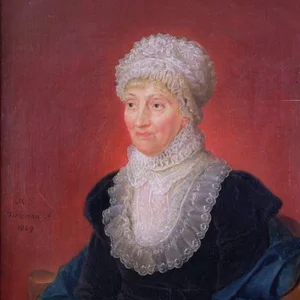

A pioneering astronomer from Hanover, Caroline Herschel discovered eight comets and helped map the sky alongside her brother William. She was the first woman to receive the Gold Medal of the Royal Astronomical Society, in 1828.
Caroline Herschel(1750 — 1848)
Caroline Herschel
royaume de Hanovre
7 min read
Frequently asked questions
Key Facts
- Born in 1750 in Hanover, she joined her brother William in England in 1772 to assist him in his astronomical work.
- In 1786, she discovered her first comet, becoming the first woman officially credited with such a discovery.
- In 1787, King George III granted her an official salary, making her the first woman to be paid for scientific work in England.
- She discovered a total of eight comets and contributed to the Flamsteed star catalogue index.
- In 1828, the Royal Astronomical Society awarded her its Gold Medal; she became an honorary member in 1835.
Works & Achievements
One of eight comets discovered by Caroline, this periodic comet bears her name and remains the most celebrated of her independent discoveries.
A supplementary catalogue correcting and completing Flamsteed's observations; published as an appendix to William's catalogue, it is recognized as an original scientific contribution.
A reference index enabling astronomers to quickly locate stars within Flamsteed's observations; a work that remained in use throughout the 19th century.
Revision and reorganization of the nebula catalogue established by William Herschel, submitted to the Royal Astronomical Society and praised as a remarkable achievement for a woman of 77.
A collection of journals and letters forming a valuable testimony on 18th-century scientific life and the position of women in the sciences.
Anecdotes
At the age of 10, Caroline contracted typhus, which stunted her growth and left her with a permanent height of barely 1.30 m. Her family intended her to become a servant, but her brother William brought her to Bath in 1772 so she could become a singer and assistant in his astronomical work. This move changed the course of her life.
In 1786, Caroline Herschel became the first woman to discover a comet, which she spotted with the naked eye from her garden in Slough. In total, she discovered eight in less than eleven years. King George III granted her an annual salary of 50 pounds sterling, making her the first woman paid by the British state for scientific work.
During observation nights with her brother William, Caroline did not merely record data: she would literally run through the darkness to log readings. One night in 1783, she seriously injured herself by striking an iron hook and had to be carried away as an emergency. She returned to work a few days later, refusing to let an injury interrupt the observations.
After William's death in 1822, Caroline, then 72 years old, returned to Hanover. Far from retiring, she set about reorganising and completing the vast catalogue of nebulous stars established by her brother. In 1828, the Royal Astronomical Society of London awarded her its gold medal — a distinction no woman received again for 168 years.
At 97, Caroline Herschel received a visit from the Crown Prince of Prussia, who wished to pay his respects. She recited her brother's work from memory and discussed astronomy with astonishing vivacity. She died at 98 in Hanover, leaving behind a colossal scientific body of work and a correspondence of several thousand letters.
Primary Sources
I have been, for near ten years past, the assistant (and where our means would allow it, the partner) of your father in all his labours.
On the 1st of August, 1786, I found a comet. I did not know what to make of it at first, but on calling to mind what I had seen in similar instances, I had no longer any doubt.
The errors I found in Flamsteed's catalogue gave me occasion to make this supplement, which I offer to astronomers as an useful addition.
I found I was to be trained for an assistant-astronomer, and by way of encouragement a telescope was given me. My brother began by making me acquainted with the use of the celestial globe.
Key Places
Caroline Herschel's birthplace, where she spent her childhood and to which she returned at age 72 after her brother's death. She died there in 1848.
English city where Caroline joined her brother William in 1772. It was there that she began her musical and astronomical training, and where she first started observing the sky.
The Herschel family home near Windsor, where Caroline discovered several of her comets and where the major observations leading to the nebula catalogue were carried out.
Scientific institution with which Caroline corresponded and whose star catalogues she used to establish her own reference works.
Learned society that awarded her its gold medal in 1828 and elected her an honorary member in 1835, officially recognising her contributions to astronomy.
Typical Objects

Instrument handcrafted by William and then used by Caroline for her nocturnal observations. It was with a small telescope of this type that she discovered her eight comets.

Large bound notebook in which Caroline recorded each night the positions, times and descriptions of the celestial objects she observed. Her registers are today preserved in the archives of the Royal Astronomical Society.

Calculation works indispensable to the 18th-century astronomer for converting observations into usable data. Caroline consulted and corrected them tirelessly.

Sphere mapping the stars and constellations, the first tool with which William introduced his sister to astronomy as early as 1772.

Small shuttered lamp used during observation nights to read her notes without dazzling the eye adapted to darkness, a common technique among astronomers of the era.

The scientist's everyday tools, with which she wrote thousands of letters, catalogues and observation notes throughout her long career.
School Curriculum
Vocabulary & Tags
Key Vocabulary
Daily Life
Morning
Caroline woke early to transcribe and organize the notes taken during the night. She calculated the positions of observed objects using logarithmic tables and wrote letters to corresponding astronomers. Morning was the only time when daylight allowed her to carry out this meticulous desk work.
Afternoon
The afternoon was devoted to revising star catalogs, correcting errors in existing publications, and managing the household she shared with William. She sometimes received scientific visitors or took part in musical rehearsals, having been trained as a concert singer in Bath.
Evening
As night fell, Caroline took up her position in the garden or in the observation room. She pointed her telescope, meticulously recorded each new object, and called out data to her brother William when he was observing with the large instrument. Clear nights could stretch on until dawn.
Food
Simple and frugal meals, typical of an 18th-century British household: porridge in the morning, cold meats, cheeses, and bread at midday, soups and stews in the evening. During long observation nights, she made do with hot tea and biscuits brought out into the garden so as not to interrupt the work.
Clothing
Wool or cotton dresses in muted tones (grey, brown, dark blue), with a practical cut suited to moving about the garden at night. A thick shawl for cold observation nights, a white cap indoors, and outfits free of superfluous ornament — reflecting her preference for practicality over elegance.
Housing
Observatory House in Slough, a spacious residence surrounded by a large garden where William's enormous 12-metre telescope was installed. Caroline had a small workroom there for her calculations and writings. In Hanover, she lived in a modest but comfortable apartment, surrounded by her papers and instruments.
Historical Timeline
Period Vocabulary
Visual Style
Style portrait anglais du XVIIIe siècle, clair-obscur à la bougie, tonalités bleues nocturnes et brunes chaleureuses, atmosphère savante et intime d'un cabinet d'astronomie.
Sound Ambience
Atmosphère nocturne d'un observatoire privé anglais du XVIIIe siècle : silence étoilé, crissement de plume sur le papier, grincements du télescope et bruits de la nature environnante.
Liens externes & ressources
Références
Œuvres
Découverte de la comète de Herschel-Rigollet (35P)
1788
Catalogue of 560 Stars observed by Flamsteed
1798
Index to Flamsteed's Observations of the Fixed Stars
1798
Revised Catalogue of Nebulae and Clusters of Stars (NGC)
1828
Journal autobiographique et correspondance
1772-1848