
Élisabeth Vigée Le Brun (1755–1842) was one of the greatest portrait painters of the 18th century. Official painter to Marie Antoinette, she completed more than 660 portraits before fleeing the French Revolution. The first woman admitted to the Royal Academy of Painting, she embodied female excellence in an artistic world dominated by men.
Élisabeth Vigée Le Brun(1755 — 1842)
Élisabeth Vigée Le Brun
France
9 min read
Frequently asked questions
Famous Quotes
« I have never lost my taste for work; it is work that has sustained me through the most painful moments of my life.»
« Work is the great remedy for all suffering.»
Key Facts
- 1776: admitted to the Académie de Saint-Luc, she begins her career as a portrait painter to Parisian high society
- 1779: first portrait of Marie Antoinette, becoming the queen of France's official painter
- 1783: elected to the Royal Academy of Painting and Sculpture, one of the few women ever admitted
- 1789: flees Paris on the eve of the French Revolution and travels across Europe for twelve years (Italy, Austria, Russia)
- 1835–1837: writes her *Souvenirs*, invaluable memoirs on the artistic and aristocratic life of her time
Works & Achievements
The official portrait of the queen, replacing the controversial painting in a muslin dress. This work codifies the majestic yet approachable image of Marie-Antoinette and was reproduced in numerous copies for embassies.
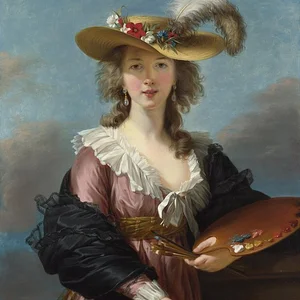
A direct homage to Rubens's self-portrait held in London, this bold work shows the artist holding her palette and brushes. It asserts her technical mastery and her awareness of her place in the history of art.
A scandalous portrait withdrawn from the Salon of 1783, depicting the queen in a simple outfit inspired by neoclassical taste. It illustrates Vigée Le Brun's desire to modernize the court portrait.
A grand state portrait intended to restore the queen's image in the eyes of the public. Vigée Le Brun portrays Marie-Antoinette as a loving mother, anticipating the Romantic iconography of motherhood.
An allegorical painting presented upon Vigée Le Brun's admission to the Royal Academy. This mythological work demonstrated her ability to move beyond portraiture and engage with the noble genres.
One of the artist's most celebrated works, depicting the painter tenderly embracing her daughter. This painting illustrates the fusion between the art of portraiture and the new sentimental values of the Age of Enlightenment.
Painted in Saint Petersburg, this portrait is representative of Vigée Le Brun's Russian output, combining psychological refinement with formal elegance. It testifies to her success among the European aristocracy.
Anecdotes
Élisabeth Vigée Le Brun painted Marie-Antoinette's portrait without a pannier dress in 1783, presenting the queen in a simple white muslin gown. The painting caused a scandal at the Salon exhibition: the queen was accused of having herself painted in her chemise, and the work had to be withdrawn and replaced by a more formal version.
On the evening of the storming of the Bastille, July 14, 1789, Vigée Le Brun was hosting a Greek-themed costume supper at her home on the rue du Gros-Chenet in Paris. This lavish feast, recounted in her Souvenirs, was later used against her as evidence of her aristocratic sympathies, forcing her into exile as early as October 1789.
During her exile, Vigée Le Brun was welcomed in triumph at every court in Europe: Rome, Vienna, Saint Petersburg, London. In Saint Petersburg, the Tsarina commissioned numerous portraits from her, and she was elected a member of the Imperial Academy of Fine Arts — an exceedingly rare distinction for a foreign woman.
Vigée Le Brun was admitted to the Académie royale de peinture et de sculpture in 1783, on the same day as her rival Adélaïde Labille-Guiard. This exceptional dual admission caused considerable grumbling: academicians usually admitted no more than four women, and some protested that their talent was being exaggerated by their connections at court.
In her Souvenirs, written when she was over seventy years old, Vigée Le Brun describes her method for painting flesh tones in precise detail: she mixed her colors in advance on a special palette and disciplined herself never to use pure black, preferring warm tones to render the liveliness of skin. She painted more than 660 portraits over the course of her career.
Primary Sources
I had such a passion for my art that, often, when beginning a portrait, I would not give myself time to eat. I worked from morning to night without noticing the hours passing.
Madame Le Brun came to paint my full-length portrait with my daughter. She is very pleasant and paints with surprising speed.
Mademoiselle Vigée, wife of Le Brun, was admitted as a member of the Academy upon the presentation of her painting representing Peace Bringing Back Abundance.
His Imperial Majesty did me the honor of visiting my studio and commissioned several portraits of the imperial family. I am overwhelmed with honors in this country.
Key Places
It was in this Parisian studio that Vigée Le Brun worked during the 1780s and received the most distinguished figures, including Marie-Antoinette. She also hosted the famous Greek supper there in July 1789.
Vigée Le Brun was regularly invited to Versailles to paint portraits of the royal family. She produced around twenty portraits of Marie-Antoinette there between 1778 and 1789, becoming the queen's unofficial painter.
The first stage of her exile in 1789–1790, Italy allowed her to study the Old Masters and establish her international reputation. She was elected a member of the Accademia di San Luca in Rome.
Vigée Le Brun spent six years in Russia (1795–1801), painting the high nobility and the imperial family. She was elected a member of the Imperial Academy of Fine Arts, a consecration of her European renown.
In this town near Paris, Vigée Le Brun acquired a country house in 1820 where she spent her final years, painting landscapes and receiving her friends.
Typical Objects

Vigée Le Brun carefully prepared her color mixtures before each session, avoiding pure black and favoring warm tones. Her distinctive palette allowed her to achieve luminous flesh tones that made her reputation.

Eighteenth-century painters used large mirrors to check the reversed composition of their works. Vigée Le Brun also made use of one for her many self-portraits, a genre in which she excelled.

This light, natural garment, rooted in Neoclassical influences, was at the heart of the 1783 scandal when she painted Marie-Antoinette in this outfit, deemed too simple for a queen. It symbolizes the aesthetic shift toward an ideal of naturalness in the eighteenth century.

Like many artists of her time influenced by Neoclassicism, Vigée Le Brun collected casts and replicas of antique works. Her self-portraits and model compositions frequently drew inspiration from the poses of Greek and Roman statuary.

During her twelve years of exile across Europe, Vigée Le Brun recorded her observations on courts, landscapes, and the arts. These notes would later feed into her Souvenirs published at the end of her life.

Heir to her father's pastel tradition, Vigée Le Brun also mastered these techniques for preparatory studies and cabinet portraits, more intimate and quicker to produce than large oil paintings.
School Curriculum
Vocabulary & Tags
Key Vocabulary
Daily Life
Morning
Vigée Le Brun rose early and devoted the first hours of the day to preparing her palette and pigments. She received her models from the morning onward to take advantage of natural light, an indispensable condition for painting skin tones. A sitting could last two to three hours before a break.
Afternoon
The afternoon was often dedicated to retouching, backgrounds, and drapery — work less demanding in terms of natural light. She also received visitors in her studio — collectors, critics, artist friends — and corresponded with her European patrons. During Salon season, she oversaw the framing and hanging of her works.
Evening
Vigée Le Brun's evenings were very social: she frequented the literary and musical salons of the Parisian aristocracy, where she mingled with philosophers, composers, and writers. She herself hosted renowned dinner parties at her townhouse, bringing together artists and courtiers in an atmosphere of refined gaiety that she describes with nostalgia in her Souvenirs.
Food
Eighteenth-century French cuisine held sway at her table: broths, roasts, fine pastries, and Burgundy wines. Vigée Le Brun mentions in her Souvenirs that she often ate little and late when absorbed in her work. During her travels, she adapted to local cuisines, particularly appreciating Italian and Russian dishes.
Clothing
As a portraitist of the elite, Vigée Le Brun paid particular attention to her appearance. She often wore silk or satin gowns in delicate colors, sometimes adorned with lace or fur. In her studio, she worked in more practical attire, as evidenced by her famous self-portrait with a turban shawl, combining comfort and elegance.
Housing
In Paris, Vigée Le Brun lived in a townhouse on the rue du Gros-Chenet, whose bright studio with tall windows served as both workplace and reception room. During her exile, she stayed in high-end furnished apartments in Rome, Vienna, Saint Petersburg, and London, always in neighborhoods frequented by the local aristocracy. In Louveciennes, she spent her final years in a country house surrounded by a garden she loved to paint.
Historical Timeline
Period Vocabulary
Visual Style
Style néoclassique élégant influencé par Rubens, avec des tons chauds et lumineux, des figures féminines idéalisées et une attention particulière aux textures de la soie, de la dentelle et des carnations.
Sound Ambience
Ambiance feutrée d'un atelier parisien du XVIIIe siècle, mêlant les sons de la création picturale aux bruits d'une société aristocratique raffinée.
Liens externes & ressources
Références
Œuvres
Autoportrait au chapeau de paille
1782
Marie-Antoinette en robe de mousseline (dit 'en chemise')
1783
Marie-Antoinette et ses enfants
1787
Portrait de la comtesse Golovine
1797-1800