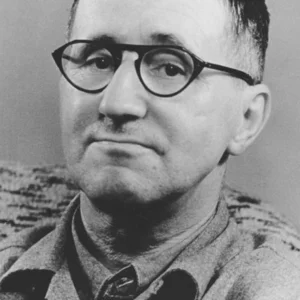

Bertolt Brecht was a 20th-century German playwright, director, and poet. A theorist of *epic theatre* and of the distancing effect, he profoundly renewed dramatic art and tied his work to a Marxist political commitment.
Bertolt Brecht(1898 — 1956)
Bertolt Brecht
Autriche, République démocratique allemande, république de Weimar, Empire allemand
7 min read
Frequently asked questions
Famous Quotes
« Unhappy the land that needs heroes.»
Key Facts
- Born in **1898** in **Augsburg** (Germany)
- In **1928**, created *The Threepenny Opera* with composer **Kurt Weill**, a huge success
- Fled Nazi Germany in **1933** and lived in exile until **1947** (Scandinavia, then the United States)
- Wrote his major plays in exile: *Mother Courage and Her Children* (**1939**), *Life of Galileo*, *The Caucasian Chalk Circle*
- Founded the **Berliner Ensemble** in East Berlin in **1949**; died in **1956**
Works & Achievements
A satirical musical set to Kurt Weill's music, a huge success that mocks bourgeois society through the world of London's criminals.
A play denouncing capitalism through the story of a young Salvation Army activist confronted with the stockyards of Chicago.
The chronicle of a canteen woman who survives the Thirty Years' War while losing all three of her children: one of the most powerful anti-war plays in modern theatre.
A drama about the scientist and his recantation before the Inquisition, questioning the responsibility of the intellectual in the face of power.
A parable in which a good woman must invent a ruthless cousin in order to survive, raising the question of whether one can be good in an unjust world.
A parable-play about justice and motherhood, famous for its frame-narrative structure and its social questioning.
A major theoretical essay setting out “epic theatre” and the alienation effect, intended to awaken the spectator's critical mind.
A collection of late poems, lucid and disillusioned, written after the East Berlin workers' uprising of June 1953.
Anecdotes
In 1928, the premiere of *The Threepenny Opera* at the Theater am Schiffbauerdamm in Berlin was an unexpected triumph. The song *Mack the Knife* (The Ballad of Mack the Knife) became a hit hummed all across Berlin, to the point that cafés and orchestras were clamoring to play it.
On 21 October 1947, **Brecht** was summoned before the House Un-American Activities Committee (HUAC) in **Washington**, suspected of communist sympathies. He fended off the senators' questions with disconcerting irony, denying that he had ever been a member of the Communist Party, then left the United States the very next day, never to return.
When **Hitler** came to power on **30 January 1933**, Brecht fled Germany the day after the Reichstag fire (27 February 1933). Thus began fifteen years of exile that took him to Denmark, Sweden, Finland and then the United States, his suitcase always packed and ready.
To illustrate his theory of the “alienation effect” (*Verfremdungseffekt*), Brecht wanted the spectator never to identify with the characters but to remain critical. He had placards displayed announcing the action to come, and asked the actors to “show” their character rather than become it.
Upon his return to East Germany in **1949**, Brecht obtained the means to found his own company, the *Berliner Ensemble*, with his wife, the actress **Helene Weigel**. Wary of the regime nonetheless, he had taken care to keep an Austrian passport and to place his royalties with a West German publisher.
Primary Sources
And the shark, he has teeth, and he wears them on his face. And Macheath, he has a knife, but the knife you cannot see.
The theatre as we know it shows the structure of society — represented on the stage — as incapable of being changed by the society sitting in the auditorium. On the contrary, the point is to make it changeable.
No, no, no, no, no, never. (in response to the question of whether he had been a member of the Communist Party)
Truly, I live in dark times! [...] We who wished to lay the foundations of kindness could not ourselves be kind.
After the uprising of June 17th [...] would it not be simpler, in that case, for the government to dissolve the people and elect another?
Key Places
Brecht's hometown, an industrial, middle-class city in southern Germany where he spent his childhood and youth.
Berlin theater where *The Threepenny Opera* triumphed in 1928, later the home of the Berliner Ensemble after 1954.
On the island of Funen, where Brecht settled at the start of his exile and wrote some of his major works of the late 1930s.
A suburb of Los Angeles where Brecht lived in exile from 1941 to 1947, mingling with the colony of émigré German intellectuals.
Capital of East Germany, where Brecht founded the Berliner Ensemble in 1949 and spent his final years.
Brecht is buried here near the house where he lived; his grave lies next to that of the philosopher Hegel.
Typical Objects

Brecht used exaggerated masks and makeup to prevent the spectator from identifying with the character and to underline the constructed nature of the role. It is a concrete tool of the “distancing effect.”

Boards and signs announcing the action to come, hung above the stage. They break the dramatic illusion by revealing the course of events in advance.

Brecht is almost always photographed with a cigar or cigarette between his lips. He made it an attribute of reflection, comparing the good theatre spectator to a smoker calmly seated at a table.

The everyday working tool of a prolific playwright who endlessly reworked his texts, often in collaboration. It symbolizes his collective and continuous output.

The flat cap and the leather jacket made up Brecht's deliberately proletarian look. An outfit-as-manifesto displaying his solidarity with the working class.

The drumroll of the mute Kattrin, who warns a besieged town at the cost of her life, is a symbolic object of the play. It embodies silent revolt against war.
School Curriculum
Vocabulary & Tags
Key Vocabulary
Daily Life
Morning
An early riser and tireless worker, Brecht often began his day at his typewriter or at his desk cluttered with papers. He liked to surround himself with collaborators, men and women with whom he discussed and endlessly reworked his texts.
Afternoon
The afternoon was devoted to rehearsals, where Brecht spent hours directing actors and technicians. A meticulous director, he would try things out, cut, and start over, demanding that every gesture serve the political clarity of the play.
Evening
In the evening, he attended performances, observing the audience's reactions, or gathered with artist and intellectual friends for political and literary discussions, cigar in hand.
Food
Brecht had simple and rather frugal tastes, true to his image as a man of the people. In exile, he shared the modest meals of the émigré community; coffee and tobacco accompanied his long hours of work.
Clothing
He cultivated a deliberately proletarian look: flat cap, leather or grey canvas jacket, shirt without a tie. This outfit contrasted with bourgeois elegance and displayed his commitment alongside the workers.
Housing
Throughout his years of exile, Brecht lived in modest, temporary lodgings, from Denmark to California. In East Berlin, he finally settled into an apartment on the Chausseestrasse, near the theatre and the cemetery where he now rests.
Historical Timeline
Period Vocabulary
Liens externes & ressources
Références
Œuvres
L'Opéra de quat'sous (Die Dreigroschenoper)
1928
Sainte Jeanne des abattoirs
1931
Mère Courage et ses enfants
1939
La Vie de Galilée (Leben des Galilei)
1939
La Bonne Âme du Se-Tchouan
1943
Le Cercle de craie caucasien
1945
Petit Organon pour le théâtre
1948