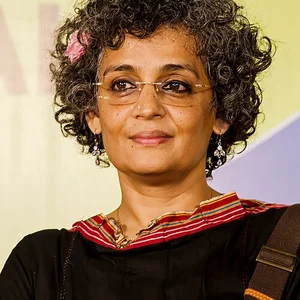

Arundhati Roy is an Indian novelist, essayist, and activist born in 1961. Her novel The God of Small Things (1997) won the Booker Prize. She is a vocal advocate against nuclear weapons, dam construction, and social inequality in India.
Arundhati Roy(1961 — ?)
Arundhati Roy
Inde
8 min read
Frequently asked questions
Famous Quotes
« There is no such thing as nonviolence in an unequal society.»
« Another end of the world is possible.»
Key Facts
- 1961: Born in Shillong, in the state of Meghalaya, India
- 1997: Publication of The God of Small Things, awarded the Booker Prize
- 1998: Condemnation of Indian and Pakistani nuclear tests in the essay The Algebra of Infinite Justice
- 2002: Found guilty of contempt of the Indian Supreme Court for her activism against the Narmada Dam
- 2017: Publication of The Ministry of Utmost Happiness, her second novel
Works & Achievements
A polyphonic novel about a Kerala family torn apart by caste taboos and forbidden love. Winner of the Booker Prize, it is considered a masterpiece of postcolonial literature.
A major political essay against India's 1998 nuclear tests, published in Outlook and Frontline. Roy denounces militarist nationalism and the illusion that nuclear power guarantees security.
A thoroughly researched long essay on the Sardar Sarovar dam project and the forced displacement of hundreds of thousands of people. A founding text of the anti-dam movement in India.
A collection of essays on globalization, privatization, and popular resistance. Roy develops her critique of neoliberalism and international financial institutions (IMF, World Bank).
A speech delivered in Santa Fe one year after September 11, which became a landmark text of the anti-globalization movement. Roy calls for nonviolent resistance against American empire.
An immersive reportage in the forests of Chhattisgarh among Naxalite guerrillas and tribal communities. A controversial text on state violence and the armed resistance of the poorest.
Her second novel, twenty years after the first, weaving together the fates of marginalized characters — hijras, Kashmiris, activists — in a fractured India. Acclaimed for its ambition and polyphony.
Anecdotes
Arundhati Roy spent five years writing her debut novel, The God of Small Things, often by hand in a notebook. When it won the Booker Prize in 1997, she became the first Indian author to receive the honor, and the book went on to sell more than six million copies worldwide.
In 1998, following India's nuclear tests (Operation Shakti), Arundhati Roy published a landmark essay titled The End of Imagination, in which she openly condemned her own government's nuclear program. This courageous stance drew fierce criticism but also earned her enormous admiration around the world.
In 2002, Arundhati Roy was sentenced to a symbolic one-day prison term for contempt of the Indian Supreme Court, after publicly criticizing the tribunal's ruling on the Narmada dam. She turned herself in voluntarily, accompanied by a crowd of journalists and activists, turning the sentence into an act of resistance.
Roy long refused to write a second novel, believing her political and social struggles were more urgent than fiction. It was not until 2017 — twenty years after her first book — that she published The Ministry of Utmost Happiness, a polyphonic novel about the fault lines of contemporary India.
Born into a mixed family — a Syrian Christian mother and a Bengali Hindu father — Arundhati Roy grew up in Aymanam, Kerala. This dual cultural heritage deeply shaped her perspective on caste, religion, and social inequality in India, themes that run throughout her entire body of work.
Primary Sources
Unlike us, the bomb is incapable of differentiating between the sublime and the ridiculous. It can't tell the difference between a hero and a coward.
The displacement of people is not just a physical uprooting. It is the demolition of the structure of their lives, the destruction of the ground beneath their feet.
Our strategy should be not only to confront empire, but to lay siege to it. To deprive it of oxygen. To shame it. To mock it. With our art, our music, our literature, our stubbornness, our joy, our brilliance, our sheer relentlessness.
Ammu knew that in their world, there was a Love Law. A law that forbade certain things. Things that could not be said. That could not be done. Things that could not be desired.
The forest is full of police camps. The tribals know every path, every tree, every season — but the state knows how to burn a forest.
Key Places
Arundhati Roy's birthplace, located in the Syrian Christian region of Kerala. This village is the exact setting of The God of Small Things, with its canals, rice paddies, and centuries-old social hierarchies.
The region at the heart of her fight against large dam projects, most notably the Sardar Sarovar Dam. Roy marched here alongside displaced communities and wrote her essay The Greater Common Good on the ground.
The city where Roy primarily lives and where she was convicted by the Supreme Court in 2002. It is also from Delhi that she publishes most of her political essays.
A dense forest home to tribal communities and Maoist guerrillas (Naxalites). Roy spent time here to write Walking with the Comrades (2010), a firsthand account of armed resistance and tribal poverty.
Roy participated in the 2004 World Social Forum in Mumbai, a major gathering of the global alter-globalization movement. She delivered landmark speeches there on American imperialism and popular resistance.
Typical Objects

Roy writes her texts by hand before typing them up, always keeping a notebook with her. Handwriting represents for her a form of resistance to the immediacy of the digital age.

A handwoven fabric associated with the Gandhian tradition of non-violent resistance, Roy regularly wears it during public speeches and activist marches.

A symbol of her on-the-ground commitment, Roy has taken part in numerous marches and rallies with the Narmada Bachao Andolan movement against large dam projects.

The first edition of her award-winning novel, covered in marginal notes, reflects her working method at the intersection of literature and political engagement.

This movement resisting dam construction in the Narmada Valley is one of the causes to which Roy devoted the most energy throughout the 1990s and 2000s.

Used to type her political essays under sometimes precarious conditions, during her travels to rural and tribal areas of India.
School Curriculum
Vocabulary & Tags
Key Vocabulary
Tags
Daily Life
Morning
Arundhati Roy rises early, often before dawn, and begins her day with an hour of reading the Indian and international press. She drinks a masala chai prepared in the Kerala tradition, standing in her kitchen before settling at her desk to write by hand.
Afternoon
Afternoons are often devoted to documentary research, interviews with activists or journalists, and revising her texts. During her fieldwork periods, she travels to rural or tribal areas, notebook in hand, meeting communities displaced by large industrial projects.
Evening
In the evenings, Roy frequently takes part in activist collective meetings, conferences, or public debates in Delhi or other Indian cities. She reads widely — literature, history, constitutional law — and often writes her essays at night, in the quiet.
Food
Her diet is largely vegetarian, shaped by Kerala cuisine: red rice, sambar (lentil soup), thoran (vegetables sautéed with coconut), and fish for family meals. She eats little meat and favors local, seasonal produce.
Clothing
Roy typically wears simple cotton saris or understated salwar kameez at public appearances, deliberately avoiding any display of wealth or status. Hand-spun khaddar cotton — the fabric associated with Gandhi and nonviolent resistance — is one of her preferred materials.
Housing
Roy lives primarily in Delhi in a simple apartment crowded with books, newspapers, and manuscripts. She has maintained close ties with Aymanam, her home village in Kerala, which she returns to regularly and whose atmosphere permeates her literary work deeply.
Historical Timeline
Period Vocabulary
Visual Style
Esthétique Kerala rural et documentaire militant — paysages luxuriants de moussons, portraits en lumière naturelle, tension entre Inde traditionnelle et modernité inégale.
Sound Ambience
Mélange des sons du Kerala rural et des marches militantes indiennes — backwaters, moussons, manifestations et forêts tribales du Chhattisgarh.
Liens externes & ressources
Références
Œuvres
Le Dieu des Petits Riens (The God of Small Things)
1997
The End of Imagination
1998
The Greater Common Good
1999
Power Politics
2001
Come September (discours)
2002
Walking with the Comrades
2010
Le Ministère du Bonheur Suprême (The Ministry of Utmost Happiness)
2017