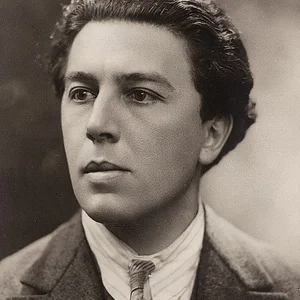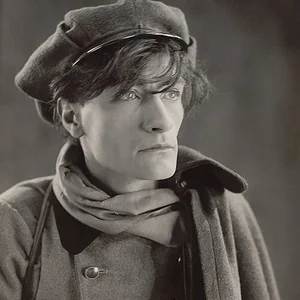

Antonin Artaud (1896-1948) was a French poet, actor, and theatre theorist. The inventor of the “Theatre of Cruelty,” he profoundly reshaped how the stage was conceived in the 20th century, all while leading a life marked by illness and psychiatric confinement.
Antonin Artaud(1896 — 1948)
Antonin Artaud
France
6 min read
Frequently asked questions
Famous Quotes
« Where there is a stink of shit, there is a smell of being.»
« All writing is garbage.»
Key Facts
- Born on 4 September 1896 in Marseille, died on 4 March 1948 in Ivry-sur-Seine.
- Member of the Surrealist movement in the mid-1920s, from which he was expelled in 1926.
- Acted in silent films, notably as Marat in Abel Gance's Napoléon (1927) and the monk Massieu in Carl Dreyer's The Passion of Joan of Arc (1928).
- Published The Theatre and Its Double in 1938, the founding collection that set out the “Theatre of Cruelty.”
- Confined to psychiatric hospitals from 1937 to 1946, notably at Rodez, where he underwent electroshock treatments.
Works & Achievements
First poetry collections in which Artaud explores the suffering of thinking and writing. They foreshadow all his work to come.
An experimental theatre company founded with Roger Vitrac, meant to shock and to radically renew the French stage.
Artaud plays the monk Jean Massieu in Carl Dreyer's silent masterpiece, one of his most famous roles.
The only major production in which Artaud tried to apply the Theatre of Cruelty. A public failure, but a major milestone in the history of theatre.
A collection of essays and manifestos, a founding text of modern theatre that would influence directors all over the world.
A powerful essay on the painter and on madness, awarded the Sainte-Beuve Prize.
A radio work blending voices, screams and noises, banned from broadcast: a sonic manifesto of his art.
Anecdotes
In 1928, the Danish director Carl Theodor Dreyer cast Artaud in the role of the monk Jean Massieu in the silent film *The Passion of Joan of Arc*. His gaunt, intense face is today one of the most famous images of the cinema of that era.
In 1931, at the Colonial Exhibition in Paris, Artaud attended a performance by Balinese dancers. Fascinated by these coded gestures, these masks and these sounds that bypass words, he found there the inspiration for his “theatre of cruelty,” a theatre that seeks to strike the senses before reason.
In 1936, Artaud travelled to Mexico and lived for several weeks among the Tarahumara, a people of the northern Sierra. He took part in traditional rituals and brought back from this journey texts in which he sought another way of feeling the world.
Committed from 1937 to 1946, Artaud underwent many electroshock sessions at the Rodez psychiatric hospital, a very brutal treatment of the time. He would harbour a deep resentment over it and would speak of it at length in his letters and his final writings.
In 1947, Artaud recorded for French radio *To Have Done with the Judgment of God*, blending screams, glossolalia (invented words) and percussion. The broadcast was banned the day before its scheduled airing, which sparked a heated controversy among artists.
Primary Sources
I suffer from a frightful disease of the mind. My thought abandons me at every level.
The masterpieces of the past are good for the past: they are not good for us.
The theatre, like the plague, is a crisis resolved by death or by cure.
An authentic madman is a man who preferred to go mad rather than forfeit a certain higher idea of human honor.
Man is sick because he is badly constructed.
Key Places
Antonin Artaud's birthplace, where he grew up in a family of shipowners and began writing poems as a teenager.
The center of his artistic life: avant-garde theater, Surrealism, cinema, and the founding of the Alfred Jarry Theater.
A mountainous region in northern Mexico where Artaud stayed in 1936 among the Tarahumara people and their rituals.
The asylum where Artaud was committed from 1943 to 1946 and underwent electroshock sessions, but where he also began writing intensely again.
A town south of Paris where Artaud spent his final months in a clinic and where he died in March 1948.
Typical Objects

During his confinement, Artaud filled hundreds of notebooks with writing, drawings, and notes. They have become an essential source for understanding his thought.

Artaud made sheets covered with words and signs, sometimes burned with a cigarette, which he called “spells”. These objects blend writing, drawing, and ritual gesture.

Treated for pain from a very young age, Artaud became dependent on the opiates commonly prescribed at the time. These drugs accompanied his entire adult life.

A symbol of the inspiration drawn from the Asian theatre he saw in 1931. For Artaud, the mask embodies a theatre that speaks through the body rather than through text.

In 1947, Artaud used the microphone to record screams, percussion, and invented words. He turned radio into a true instrument of the theatre of cruelty.
School Curriculum
Vocabulary & Tags
Key Vocabulary
Daily Life
Morning
In his Parisian life as an actor and poet, Artaud often gets up late after nights spent writing or discussing art. The morning is for reading, jotting down ideas, and sometimes going to rehearsals at the theaters where he performs.
Afternoon
The afternoon is devoted to theatrical work: rehearsals, readings of texts, meetings with writers and directors in the neighborhood cafés. During his years of internment, by contrast, this time is shaped by treatments, supervised walks, and the writing of his notebooks.
Evening
In the evening comes the time for theater and cinema: performances, screenings, long conversations with the Surrealists. Later in his life, the evenings in the asylum are silent and solitary, spent writing by the faint light of a room.
Food
Artaud eats little and irregularly, weakened by illness and his dependence on opiates. During the war and his internment, he suffers from the malnutrition that then afflicted many residents of French asylums.
Clothing
He is photographed in a dark city suit, sometimes elegant during the Surrealist years, his face gaunt and striking. Toward the end of his life, his emaciated figure and worn clothes strike those who meet him.
Housing
As a young man, he lodges in modest rooms and hotels in Paris according to his means. From 1937 to 1946, his “home” becomes that of psychiatric hospitals, before a final room in a clinic in Ivry-sur-Seine.
Historical Timeline
Period Vocabulary
Liens externes & ressources
Références
Œuvres
L'Ombilic des Limbes / Le Pèse-Nerfs
1925
Théâtre Alfred-Jarry
1926-1929
La Passion de Jeanne d'Arc (rôle au cinéma)
1928
Les Cenci
1935
Le Théâtre et son double
1938
Van Gogh le suicidé de la société
1947
Pour en finir avec le jugement de dieu
1947