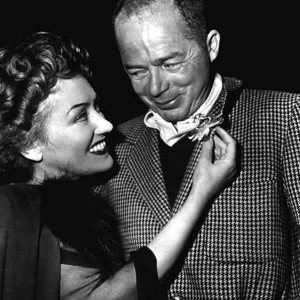

An American director, screenwriter, and producer of Austro-Hungarian origin, Billy Wilder is one of the major figures of classic Hollywood cinema. A master of both comedy and film noir, he directed masterpieces such as *Sunset Boulevard*, *Some Like It Hot*, and *The Apartment*.
Billy Wilder(1906 — 2002)
Billy Wilder
États-Unis, Autriche, Autriche-Hongrie
6 min read
Frequently asked questions
Key Facts
- Born in 1906 in Sucha (Galicia, Austria-Hungary) and died in 2002 in Los Angeles
- Emigrated to the United States in 1934 to flee Nazism, after starting out as a screenwriter in Berlin
- Directed *Double Indemnity* (1944), a film noir classic
- Directed *Sunset Boulevard* (1950), a critical look at Hollywood
- Won six Oscars over the course of his career, including those for *The Apartment* (1960)
Works & Achievements
A foundational film noir about a murder disguised as an accident; a model of the genre for its darkness and razor-sharp dialogue.
An unflinching portrait of an alcoholic; it won the Oscars for Best Picture and Best Director.
A cruel satire of Hollywood seen through a forgotten former silent-film star; one of the greatest films about cinema itself.
A comedy with Marilyn Monroe, the source of the legendary image of her dress billowing over a subway grate.
A masterful adaptation of Agatha Christie, a suspenseful courtroom drama famous for its final twist.
A slapstick comedy about two musicians disguised as women, often cited among the greatest comedies in the history of cinema.
A bittersweet comedy about careerism in the office; winner of five Oscars, including Best Picture, Director and Screenplay.
Anecdotes
An Austrian Jew, Billy Wilder fled Germany in 1933 as soon as Hitler came to power: he passed through Paris before reaching Hollywood in 1934. His mother, grandmother and stepfather, who stayed behind in Europe, perished in the Holocaust. This intimate wound quietly haunted his work throughout his life.
When he landed in the United States, Wilder barely spoke English. He often said he learned it by listening to the radio, to baseball game broadcasts and to the lyrics of popular songs, a dictionary always within reach. A few years later, however, he was writing the most biting dialogue in Hollywood.
The famous closing line of *Some Like It Hot* (1959), “Nobody's perfect,” was at first only a placeholder scribbled down by Wilder and his co-writer I.A.L. Diamond, for want of anything better. Lacking a more brilliant idea, they kept it — and it became one of the most famous endings in cinema.
In 1960, *The Apartment* earned Wilder himself three Oscars in a single night (Best Picture as producer, Best Director and Best Screenplay), an unprecedented feat at the time. He was nominated for the Oscars 21 times over the course of his career.
Wilder was a passionate art collector, amassing works by Picasso, Miró, Calder and Schiele. In 1989, he sold part of his collection at Christie's for around 32.6 million dollars, proving that his eye was as sharp behind a camera as it was in front of a painting.
Primary Sources
If you have a problem with the third act, the real problem is in the first act.
Grab the audience by the throat right from the start, and never let go.
I have talked to my doctor and my psychiatrist: they tell me I am too old and too rich to go through it again.
I thank America for taking me in when I was a refugee who could barely speak English.
Key Places
Small town in the Austro-Hungarian Empire, today Sucha Beskidzka in Poland, where Billy Wilder was born in 1906.
Austrian capital where Wilder grew up and started out as a journalist in the 1920s, in the midst of an intense cultural scene.
Metropolis of the Weimar Republic where Wilder worked as a screenwriter for the UFA studios before the Nazis came to power.
The first stop on Wilder's path into exile in 1933, where he directed a film before making his way to the United States.
District of Los Angeles and the film capital of the world, where Wilder built his career as a screenwriter and then director starting in 1934.
Wilder's residence in Los Angeles, where he kept his office and art collection for many years, and where he died in 2002.
Typical Objects

The central tool of the classic Hollywood director, heavy and mounted on a tripod or dolly. Wilder used it with restraint, serving the story rather than chasing effect.

A slate snapped in front of the camera to synchronize picture and sound and identify each take. A universal symbol of Hollywood filmmaking.

The screenwriter's working instrument: Wilder, a writer before he was a filmmaker, chiseled his dialogue at the typewriter with his partners Charles Brackett and later I.A.L. Diamond.

A working document recording dialogue, shots, and staging directions. For Wilder, everything began with the quality of the text.

The trophy of the Academy of Motion Picture Arts and Sciences. Wilder won six in all, a symbol of his success within the studio system.

A small switch or stick that Wilder liked to hold and twirl as he paced the set or his office while thinking through a scene.
School Curriculum
Vocabulary & Tags
Key Vocabulary
Tags
Daily Life
Morning
A meticulous director, Wilder started early, coffee in hand, rereading the day's script. When writing, he would join his co-writer in a modest office to craft and recraft the dialogue, line by line.
Afternoon
On set, the afternoon was spent directing actors and crew, often in few takes since he prepared everything in advance. Off set, he would pace his office while mulling over a scene, sometimes with a riding crop in hand.
Evening
In the evening, Wilder frequented the dinners and circles of Hollywood's European émigrés, where people spoke German and talked cinema. A lover of witticisms, he sharpened there the caustic wit that fed his films.
Food
His table reflected his dual world: the Viennese cuisine of his childhood (schnitzel, pastries, Viennese coffee) and the American habits of Los Angeles. He enjoyed the restaurants where the movie crowd gathered.
Clothing
Wilder took care over his studio-man look: a well-cut suit, shirt and tie, often topped with a hat. His understated elegance contrasted with the extravagance of some of the stars he directed.
Housing
Settled in Beverly Hills, he lived in an apartment and an office filled with modern artworks, his great passion. This refined setting contrasted with the modest origins of his youth in Central Europe.
Historical Timeline
Period Vocabulary
Liens externes & ressources
Références
Œuvres
Sept ans de réflexion (The Seven Year Itch)
1955
Témoin à charge (Witness for the Prosecution)
1957