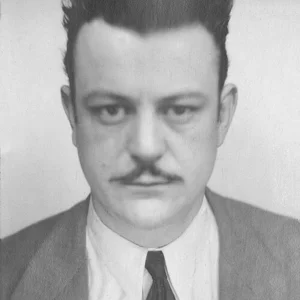

Boby Lapointe (1922-1972) was a French singer and singer-songwriter famous for his virtuoso lyrics packed with wordplay, puns and spoonerisms. A native of **Pézenas**, he left his mark on French song through his humour and verbal inventiveness.
Boby Lapointe(1922 — 1972)
Boby Lapointe
France
6 min read
Frequently asked questions
Famous Quotes
« Ta Katie t'a quitté»
Key Facts
- Born on **16 April 1922** in **Pézenas** (Hérault)
- Brought to public attention through François Truffaut's film *Shoot the Piano Player* (1960), in which he performs 'Avanie et Framboise'
- Author of cult songs such as 'Ta Katie t'a quitté', 'Aragon et Castille' and 'Marcelle'
- Invented a *bibi-binaire* numbering system (a playful base-16 system)
- Died on **29 June 1972** in **Pézenas**, at the age of 50
Works & Achievements
A song built as an extended pun that brought him to wide public attention, notably thanks to cinema.
Probably his most famous song, a showcase of his humor and his playing with sounds.
A tour de force of alliteration in “t” and “k,” a true feat of pronunciation.
An emblematic title of his writing, full of double meanings and traps for the ear.
A tender and funny song that became a classic, often covered for children.
A sung portrait full of puns, an example of his art of blending humor and melancholy.
A burlesque song that reveals his taste for nonsense and the absurd.
A personal mathematical invention, a playful and sonorous base 16, presented on television.
Anecdotes
A maths enthusiast, Boby Lapointe invented a base-16 number system that he named the “bibi-binary system.” He created new names and new symbols for counting, and even presented it on television with both seriousness and humour. It was the genuine work of a logician hidden behind the laughter.
In 1960, the filmmaker François Truffaut gave him a small role as a cabaret singer in the film “Shoot the Piano Player.” Because Boby sang very fast and his lyrics overflowed with wordplay, Truffaut added subtitles on screen so the audience wouldn’t miss a single word of “Avanie et Framboise”: something never seen before in a French song.
Boby Lapointe packed his songs with puns, spoonerisms and portmanteau words, so much so that performers sometimes took a while to grasp all of his inventions. In “Ta Katie t’a quitté,” he strings together “t” and “k” sounds at a dizzying speed, turning the song into a real pronunciation exercise.
During the Second World War, the young Boby was sent to the Compulsory Work Service (STO) in Austria, like many French people of his generation. He managed to escape, then earned his living through a wide variety of odd jobs before devoting himself fully to songwriting.
Proud of his home town of Pézenas, in the Hérault, Boby Lapointe remained attached to it all his life and died there in 1972. Today the town pays tribute to him, and his name stays linked to this Languedoc town also famous for its past connection to Molière.
Primary Sources
Avanie and Framboise are the udders of destiny.
Your Katie has quit you, you've got your tactic and your tactic was cracked.
For whom, why, by what, how? None of it means anything or makes any sense — a song built entirely on wordplay.
The mommy of the fish, she's ever so sweet, and I do love her with a squeeze of lemon.
Key Places
Town in the Hérault where Boby Lapointe was born in 1922 and died in 1972. A Languedoc town to which he remained deeply attached throughout his life.
The capital where he broke through in the cabarets and music halls starting in the late 1950s. The heart of French song at the time.
District of small venues and cabarets where singer-songwriters performed. Boby honed his repertoire there in front of an audience of regulars.
Country where the young Boby was sent under the Compulsory Work Service (STO) during the war, and from which he managed to escape.
Typical Objects

A simple instrument that backed his songs to better showcase the rapid-fire delivery of his lyrics. The music stayed understated to let the wordplay shine.

A standing microphone from the small Parisian venues where Boby performed. Essential for getting lyrics sung at full speed to be heard.

The notebook where he jotted down puns, spoonerisms and portmanteau words before turning them into songs. The true laboratory of his verbal humor.

A small vinyl record that let his songs reach audiences beyond the cabarets. The flagship format of French song in the 1960s.

A base-16 numbering system he invented, with its own names and symbols for counting. A surprising blend of mathematics and sound poetry.

The small platform in cabarets and music halls where he delivered his “song act.” A place of direct connection with a close, attentive audience.
School Curriculum
Vocabulary & Tags
Key Vocabulary
Daily Life
Morning
After a late night at the cabaret, a singer like Boby would often ease gently into his morning. It was the time to jot down ideas for puns and to rework lyrics that were still rough around the edges.
Afternoon
The afternoon was for rehearsing songs, fine-tuning the rhythm of such fast-paced lyrics, and sometimes meeting other artists or venue managers. Boby also enjoyed polishing his calculations and his bibi-binary system.
Evening
The evening was the heart of his craft: stepping onto the small stage of a cabaret to deliver his “tour de chant” before an intimate audience. The laughter and immediate reactions fed his inspiration.
Food
He shared the simple diet of post-war France, shaped by memories of rationing. Bistro meals, dishes from the Languedoc of his native region, and a shared glass after the show set the rhythm of his life.
Clothing
On stage and in everyday life, he wore the understated outfit of cabaret singers of the 1950s and 1960s: jacket, shirt, sometimes a tie. Nothing extravagant, for it was the words that were meant to shine.
Housing
He divided his life between his hometown of Pézenas and the Paris region, where the venues were. Modest lodgings, fitting for an artist who took a long time to truly make a living from his music.