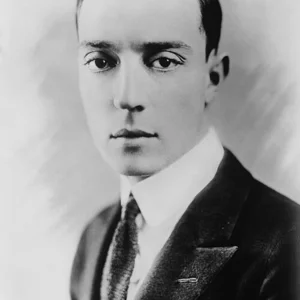

American actor, director, and stuntman, a major figure of silent slapstick cinema. Nicknamed “the man who never laughs,” he played a deadpan character confronting a mechanical and hostile world.
Buster Keaton(1895 — 1966)
Buster Keaton
États-Unis
6 min read
Frequently asked questions
Key Facts
- Born in 1895 in Piqua (Kansas), he started out as a child in music hall as part of the family act “The Three Keatons”
- Directed and starred in The General in 1926, regarded as his masterpiece
- Made classics such as The Navigator (1924) and Our Hospitality (1923)
- Performed his own dangerous stunts, like the building facade that collapses around him in Steamboat Bill, Jr. (1928)
- Died in 1966 in Woodland Hills (California), rediscovered and celebrated at the end of his life
Works & Achievements
Short film in which a couple assembles a prefabricated house with catastrophic results; a masterpiece of mechanical gags that revealed him as an auteur.
Feature film blending comedy and historical reconstruction, famous for its stunts on a waterfall.
A projectionist falls asleep and steps into the movie screen: a dizzying, avant-garde meditation on cinematic illusion.
A comedy set aboard a drifting ocean liner, one of his greatest commercial successes.
A slapstick epic set during the American Civil War, often cited as his absolute masterpiece and one of the greatest silent films.
Comedy famous for the gag of the collapsing building facade, one of the most iconic images in cinema.
His first film at MGM, the last great success before he lost his creative independence.
Experimental short film written by Samuel Beckett, a final major role that cemented Keaton's standing with the avant-garde.
Anecdotes
In “Steamboat Bill, Jr.” (1928), Buster Keaton performed one of the most dangerous stunts in the history of cinema: the façade of a two-ton house collapses on top of him, and he is saved only because an open window falls exactly where his body stands. The margin of error was just a few centimeters; the entire crew had preferred to look away during the take.
Keaton was nicknamed “the man who never laughs” or “the Great Stone Face.” Very early on, he understood that his deadpan expression made audiences laugh more than if he had smiled, and he made it his trademark for the rest of his career.
During the filming of “Sherlock Jr.” (1924), Keaton fractured a vertebra in his neck during a scene in which a jet of water from a water tower hurled him onto the railroad tracks. He finished the take and only discovered how serious the injury was years later, during a medical examination.
Keaton came from vaudeville: as a child, he was part of the family act “The Three Keatons,” in which his father literally threw him across the stage. This early training in falls and acrobatics explains his exceptional physical control on screen.
For “The General” (1926), Keaton had a real steam locomotive plunge into a river from a collapsing bridge: it was the most expensive shot in silent-era cinema. The wreck of the machine remained in the Oregon river for decades and became a tourist attraction.
Primary Sources
“The secret of the comic effect of my deadpan face was that I refused to laugh at my own gags.”
“I never tried to use a double or a stuntman. I did all my own falls and stunts.”
On its release the film was judged disappointing, the critic faulting Keaton for blending slapstick comedy with a reenactment of the Civil War, before its reappraisal as a masterpiece.
Key Places
Small town where Buster Keaton was born in 1895, during a tour by his vaudeville performer parents.
Capital of silent film where Keaton shot most of his work and set up his studio in the 1920s.
Independent studio where he conceived and directed his masterpieces between 1920 and 1928.
Region where the famous collapsing bridge scene from “The General” was filmed in 1926, featuring a real locomotive plunging into the river.
Neighborhood where Buster Keaton died of lung cancer in 1966.
Typical Objects

A flat-topped hat that Keaton made himself by flattening a Stetson. It became the signature mark of his on-screen character.

A silent-film camera operated by hand by the cameraman. Keaton mastered it technically, calculating the shooting speed of his gags himself.

A Civil War locomotive at the heart of his 1926 film. Keaton turned it into a genuine character, even going so far as to send one plunging into a river.

A text panel inserted between shots to convey dialogue or commentary in a silent film. Keaton used them sparingly, favoring visual action.

A device that projects film onto a large screen in darkened theaters. Central to “Sherlock Jr.,” where Keaton literally steps into the screen.

An ill-fitting slapstick costume typical of his character, which heightened the comedy of his falls and acrobatics.
School Curriculum
Vocabulary & Tags
Key Vocabulary
Tags
Daily Life
Morning
At the peak of his career, Keaton arrived early at his Hollywood studio. He often devoted the morning to dreaming up and testing gags with his team of gagmen, improvising the mechanics of a scene before filming it.
Afternoon
The afternoon was reserved for shooting and stunts, which he performed himself at the risk of his life. A self-taught engineer, he personally oversaw the props, the special effects, and the technical calculations behind his stunts.
Evening
In the evening, Keaton liked to play baseball or bridge with his crew, whom he regarded as family. He also screened the day's rushes to decide on the editing and fine-tune the comic timing.
Food
Keaton ate simply, in the American style of his time, but his drinking became a major problem after he lost his studio in the 1930s, a dark period that he eventually overcame.
Clothing
On screen, he wore his recognizable slapstick costume: a too-tight jacket, oversized trousers, and above all his flat hat (the porkpie). In private, he dressed with the understated elegance of a 1920s Hollywood star.
Housing
In his prosperous years, Keaton lived in a vast Beverly Hills mansion nicknamed the “Italian Villa,” a symbol of his success. After his financial setbacks, he lived in far more modest quarters before finding a stable life again in Woodland Hills.
Historical Timeline
Period Vocabulary
Liens externes & ressources
Références
Œuvres
One Week
1920
Our Hospitality
1923
The Navigator
1924