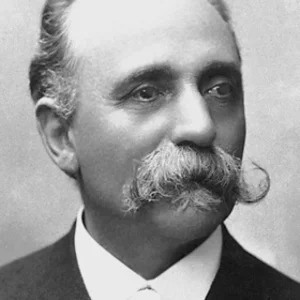

Italian physician and biologist, a pioneer in the study of the nervous system. In 1873 he developed a method for staining nerve cells (the “black reaction”) that revolutionized neuroanatomy. He received the Nobel Prize in Medicine in 1906.
Camillo Golgi(1843 — 1926)
Camillo Golgi
empire d'Autriche, royaume d'Italie, royaume de Sardaigne
6 min read
Frequently asked questions
Key Facts
- Born in 1843 in Corteno (today Corteno Golgi), Italy
- Developed the “black reaction” in 1873, a method of staining nerve cells with silver nitrate
- Described the Golgi apparatus, a cellular organelle, in 1898
- Received the 1906 Nobel Prize in Physiology or Medicine, shared with Santiago Ramón y Cajal
- Died in 1926 in Pavia
Works & Achievements
A silver nitrate staining technique that makes entire nerve cells visible. It laid the foundations of modern neuroanatomy and is still used today.
Golgi distinguished two main types of neurons according to the length of their projection; some neurons still bear his name.
Demonstration that fever attacks coincide with the multiplication and release of parasites into the blood, a major step in understanding the disease.
Identification of an internal organelle of the cell, present in almost all cells and essential to the sorting of proteins; it bears his name.
Identification of sensory receptors located in the tendons, which inform the brain of muscle tension.
Award given jointly to Golgi and Cajal “in recognition of their work on the structure of the nervous system.”
Anecdotes
In 1873, Camillo Golgi developed his famous “black reaction” almost by chance, in the kitchen of a small hospital for the incurable where he worked, for lack of a laboratory. By impregnating fragments of brain with silver nitrate, he obtained nerve cells entirely blackened against a yellow background, finally visible in all their detail.
In 1906, Golgi shared the Nobel Prize in Medicine with the Spaniard Santiago Ramón y Cajal, who had nonetheless used his own staining method. The paradox was complete: the two men scientifically detested each other, for Golgi believed that the nervous system formed a continuous network, whereas Cajal defended the idea that neurons are separate cells — and it was Cajal who was right.
During his Nobel acceptance speech in Stockholm, Golgi used the platform to openly attack the neuron theory defended by Cajal, who was seated in the very same room. It was one of the most tense moments in the history of the scientific Nobel Prizes.
While studying malaria, Golgi discovered that the bouts of fever coincided with the moment when the parasites multiply and burst in the blood: this is “Golgi's law.” This observation made it possible to better understand and treat the disease.
In 1898, while observing stained nerve cells, Golgi described a network of tiny filaments inside the cell. This “Golgi apparatus” still bears his name today and appears in every biology textbook: it is an essential organelle present in almost all of our cells.
Primary Sources
I have obtained magnificent results with a method that seems to me destined for a great future, by letting potassium bichromate act at length, then silver nitrate, on hardened fragments of the brain.
Although the neuron doctrine is fashionable today, I do not believe I can regard it as definitively established; the facts I have observed lead me, on the contrary, to accept the continuity of the nervous network.
Within the cell body a fine reticular apparatus is revealed, stained black by the silver impregnation, whose arrangement deserves the greatest attention.
The febrile attack corresponds with remarkable regularity to the moment of segmentation and release of the parasites into the patient's blood.
Key Places
Mountain village in Lombardy where Camillo Golgi was born in 1843. The town added his name in tribute.
Golgi studied medicine there and later became a professor; it was the heart of his scientific career and his research on the nervous system.
Small hospital where Golgi, a young doctor, developed his “black reaction” in a kitchen turned into a makeshift laboratory.
City where Golgi received the Nobel Prize in Medicine in 1906 and gave his famous speech defending the nerve network theory.
Lombard city where Golgi spent most of his life and where he died in 1926.
Typical Objects

An indispensable instrument for Golgi to observe stained nerve cells. Advances in lenses during the 19th century made it possible to distinguish ever finer structures.

A silver salt used in the “black reaction”: it is deposited in nerve cells and stains them an intense black. It is the key reagent of Golgi's method.

A chemical used to harden and fix fragments of brain tissue before staining. The first step in preparing samples.

A precision device used to cut tissues into extremely thin slices, essential for observing them under the microscope.

Small glass plates between which the stained sample is placed for examination under the microscope. The basic support for all histology work.

Before scientific photography became common, Golgi drew the cells he observed by hand. These precise drawings served as evidence and as material for publication.
School Curriculum
Vocabulary & Tags
Key Vocabulary
Daily Life
Morning
Golgi begins his day early at the University of Pavia, where he teaches and directs his histology laboratory. The morning is devoted to lectures, medical consultations, and supervising his students.
Afternoon
The afternoon is spent at the microscope, observing and drawing slices of brain stained by his method. Preparing the samples is a long and painstaking process, sometimes spread over several days.
Evening
In the evening, Golgi writes his scientific papers, corresponds with other European researchers, and reads medical journals. It is also the time for intellectual debates, sometimes heated, about the nature of the nervous system.
Food
The food is that of the Lombard middle class of the period: bread, polenta, rice, vegetables, cheeses, and wine from northern Italy. Meals are moments of family and academic sociability.
Clothing
Like the professors and physicians of the 19th century, Golgi wears a dark suit, waistcoat, a stiff-collared shirt, and a bow tie or necktie. At the hospital or in the laboratory, he puts on a coat to protect his clothes from the reagents.
Housing
Golgi lives in Pavia in a comfortable middle-class home, near the university. His house and his laboratory are closely linked, science occupying a large part of his daily life.
Historical Timeline
Period Vocabulary
Liens externes & ressources
Références
Œuvres
La réaction noire (méthode de Golgi)
1873
Description des cellules de Golgi
1873-1875
Loi de Golgi sur le paludisme
1886
Découverte de l'appareil de Golgi
1898
Description des corpuscules tendineux de Golgi
1880
Prix Nobel de physiologie ou médecine
1906