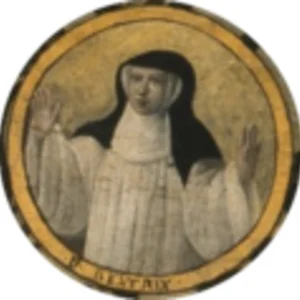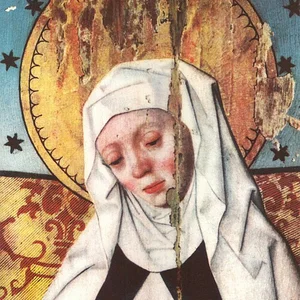

A mystic and Swedish saint of the 14th century, Bridget of Sweden was a wife, mother of eight children, then a pilgrim and founder of the Order of the Most Holy Savior. Her divine revelations, dictated and spread throughout Europe, gave her exceptional spiritual authority.
Bridget of Sweden(1303 — 1373)
Bridget of Sweden
Suède
7 min read
Frequently asked questions
Famous Quotes
« "The love of God is a fire that consumes all that is not God."»
Key Facts
- 1303: Born in Finsta, Sweden, into a noble family
- 1316: Married Ulf Gudmarsson; together they had eight children, including Saint Catherine of Sweden
- 1346: Founded the Order of the Most Holy Savior (Bridgettines) in Vadstena
- 1349: Departed on pilgrimage to Rome, where she lived until her death
- 1373: Died in Rome; canonized in 1391 by Boniface IX
Works & Achievements
Eight books of mystical revelations dictated by Bridget to her confessors and translated into Latin. Widely circulated throughout Europe, they represent the major work of female medieval mysticism.
Twenty-one chapters which Bridget claimed were dictated by an angel, intended for the Matins office of the sisters of the Order of the Most Holy Savior, centered on the praise of the Virgin Mary.
The founding rule of the Order of the Most Holy Savior (Bridgettines), a double order of nuns and monks. It was officially approved by Pope Urban V in 1370.
One of Bridget's most tangible achievements, this Swedish double monastery became the spiritual center of her order and a major European pilgrimage site following her canonization.
Bridget sent numerous messages, received through divine inspiration, to popes (Clement VI, Innocent VI, Urban V) and kings, urging them to reform the Church and return to Rome.
Anecdotes
At the age of seven, Birgitta reportedly had a vision of the Virgin Mary offering her a crown. This early experience left a profound mark on her and shaped her entire spiritual life. She interpreted this sign as a divine mission she would carry until her death.
Birgitta served as lady-in-waiting to Queen Blanche of Namur at the Swedish court, where she attempted to guide King Magnus IV and his wife toward greater piety and justice. Frustrated by their indifference to her warnings, she left the court and devoted herself entirely to religious life following her husband's death in 1344.
In 1349, in the midst of the Black Death, Birgitta left Sweden for Rome to seek papal approval for her religious order. She never returned to Sweden, spending the last twenty-five years of her life between Rome and numerous pilgrimages, including a journey to the Holy Land in 1372, a year before her death.
Her revelations, dictated to her confessors — notably the Spanish monk Alfonso of Jaén — were translated into Latin and circulated throughout Europe. These texts gave her extraordinary moral authority: she publicly urged the popes to leave Avignon and return to Rome, which she considered a sacred duty.
After her death in Rome in 1373, her body was brought back to Sweden by her daughter Catherine, who would herself become a saint. The long journey from Rome to Vadstena was marked by many expressions of popular veneration, a testament to her reputation for holiness that had already been well established during her lifetime.
Primary Sources
Our Lord spoke thus to the bride: 'I am the Creator of all things and your Lord. I speak to you not for your sake alone, but for the salvation of all.'
Birgitta received a divine command to found a religious order at Vadstena, a place chosen by Christ himself: 'This place you see is holy, and I will be honored there.'
Texts dictated to Birgitta by an angel for the Matins office of the sisters of the Order of the Most Holy Savior, praising the Virgin Mary across twenty-one chapters.
The order shall be double: nuns and brothers will live separately but under the same roof, united in prayer, under the governance of an abbess.
Birgitta urges the pope to return to Rome, the rightful seat of the Church: 'Rome awaits its shepherd. Christendom bleeds from your absence.'
Key Places
Birgitta's birthplace around 1303, on her family's noble estate. This cradle shaped her devout and aristocratic upbringing.
After her husband's death in 1344, Birgitta withdrew to this Cistercian monastery, where she began receiving her revelations and dictating them to her confessors.
The town where Birgitta founded the mother monastery of the Order of the Most Holy Savior, on land granted by King Magnus IV. Her relics rest here to this day.
Birgitta settled here permanently in 1349 and lived until her death in 1373. She moved in papal court circles and led a life of influential penance.
Birgitta undertook a pilgrimage to the Holy Land in 1372, at nearly seventy years of age. The experience deepened her final revelations on the Passion of Christ.
Typical Objects

Bridget dictated her revelations to her confessors, who transcribed them onto wax tablets before copying them out in Latin. These writing instruments were the everyday tools through which her mystical work was transmitted.

A central tool of medieval devotion, the rosary accompanied Bridget through her long hours of contemplation and recitation of Marian prayers that structured her days.

After her husband's death, Bridget adopted the austere dress of a pious widow, and later the habit of her religious community: a grey or brown robe with a veil, signifying her renunciation of the world.

Bridget undertook numerous pilgrimages, notably to Compostela, Rome, and Jerusalem. The pilgrim's staff was her most common iconographic attribute in medieval representations.

Bridget's Revelationes Celestae were copied onto parchment and distributed throughout Europe. This text formed the heart of her spiritual and political influence.

In iconography, Bridget is often depicted wearing a crown, a reference to her childhood vision in which the Virgin Mary offered her a crown — a symbol of her mystical calling.
School Curriculum
Vocabulary & Tags
Key Vocabulary
Tags
Daily Life
Morning
Birgitta rose before dawn to attend the offices of Matins and Lauds, prayers recited or sung together in the chapel. She then spent a long period in silent contemplation, which was often the source of her revelations, which she would immediately dictate to her confessor.
Afternoon
The afternoon was devoted to directing her community, to spiritual and political correspondence, and sometimes to meeting pilgrims or dignitaries who came to consult her in Rome. She also oversaw the copying and translation of her revelations into Latin.
Evening
In the evening, Birgitta attended the offices of Vespers and Compline before a frugal meal taken in silence or accompanied by spiritual reading. She practiced bodily penances and extended her prayer before taking a brief sleep on an austere bed.
Food
Her diet was that of a penitent religious woman: bread, vegetables, legumes, and fish on days of abstinence. She fasted frequently and abstained from meat, in keeping with the ascetic practices of her time and the rule of her community.
Clothing
After her husband's death, Birgitta wore dark mourning clothes, then adopted the habit of her community: a gray or ash-brown wool robe, a white wimple covering the head and neck, and a pilgrim's cloak when traveling.
Housing
In Rome, Birgitta lived in a modest house near the church of San Lorenzo in Damaso, in deliberately austere conditions despite her noble origins. The main room served at once as a prayer cell, a place for dictating her revelations, and a reception room for spiritual visitors.
Historical Timeline
Period Vocabulary
Visual Style
Un style évoquant l'enluminure gothique nordique et italienne du XIVe siècle, avec fonds dorés, drapés intenses en bleu et rouge, et une atmosphère à la fois austère et lumineuse.
Sound Ambience
L'univers sonore de Brigitte mêle les chants liturgiques grégoriens des heures canoniales, le silence contemplatif du monastère et les bruits du pèlerinage médiéval, entre forêts suédoises et rues romaines.
Liens externes & ressources
Références
Œuvres
Revelationes Celestae (Révélations célestes)
1346–1373, publiées posthumément
Sermo Angelicus
vers 1354
Regula Salvatoris (Règle du Sauveur)
1346, approuvée en 1370
Fondation du monastère de Vadstena
1346 (fondation), 1384 (consécration officielle)
Lettres et exhortations aux papes et souverains
1349–1373