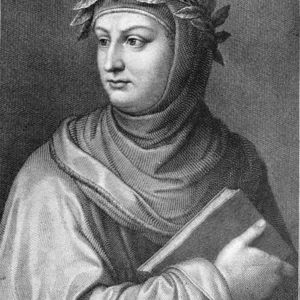

A 14th-century Italian writer, Boccaccio is the author of the Decameron, a collection of one hundred tales told by a group of people sheltering from the Black Death in 1348. A diplomat in the service of Florence, he was also a pioneering humanist and close friend of Petrarch.
Boccaccio(1313 — 1375)
Giovanni Boccaccio
République florentine
7 min read
Frequently asked questions
Key Facts
- 1313: born in Certaldo or Florence
- 1348: witnessed the Black Death in Florence, an experience that inspired the setting of the Decameron
- 1349–1353: wrote the Decameron, a masterpiece of Italian prose
- Ambassador of the Florentine Republic to the Pope and other courts
- 1375: died in Certaldo
Works & Achievements
A collection of one hundred tales told by ten young people who have fled to the countryside to escape the plague. A masterpiece of Italian prose, it would go on to influence Shakespeare, Chaucer, and the entire European narrative tradition.
A narrative poem in octave stanzas telling the story of Troilus and Criseyde. It directly inspired Chaucer and, through him, Shakespeare.
The first major prose novel in Italian literature, inspired by a French chanson de geste. A testament to Boccaccio's early literary ambitions.
The first Western collection devoted entirely to biographies of famous women, from Antiquity to Boccaccio's own time. A pioneering work that anticipated Renaissance debates on the role of women.
A vast encyclopedia of Greco-Roman mythology in fifteen books. A standard reference for humanist scholars for more than two centuries.
The first biography of Dante Alighieri. Through this work, Boccaccio helped secure official recognition for the Florentine poet and spread knowledge of his writings.
A collection of moral biographies of great figures from Antiquity through Boccaccio's era. Translated into French by Laurent de Premierfait, it had a profound influence on medieval European literature.
Anecdotes
Boccaccio is said to have first met Fiammetta — the woman who inspired his literary muse — at the church of San Lorenzo in Naples on Holy Saturday, 1336. This woman, most likely a Neapolitan noblewoman, would haunt his work for years, though historians still debate her true identity.
During the great Black Death of 1348 in Florence, Boccaccio lost his father and stepmother. As a direct witness to the epidemic, he described terrifying scenes in the preface to the Decameron: corpses piled in the streets, families abandoning their own sick, an entire society on the brink of moral collapse.
Petrarch, whom he met in 1350, became his dearest friend and intellectual model. Boccaccio admired the poet so deeply that he gave him a manuscript of Livy as a gift, and undertook a long journey on foot to visit him in Padua despite his fragile health.
Late in life, a fanatical monk predicted his eternal damnation on account of his supposedly indecent writings. Boccaccio, seized by fear, wanted to burn the Decameron. Petrarch talked him out of it by letter, reminding him of the literary and moral value of his work — and posterity proved him right.
Boccaccio was one of the first humanists in the West to learn ancient Greek. He brought the scholar Leontius Pilatus from Constantinople to teach Greek in Florence, even offered him lodging in his own home, and oversaw the first Latin translation of the Iliad and the Odyssey made directly from the Greek text.
Primary Sources
In the year of our Lord 1348, in the noble city of Florence, the fairest of all Italian cities, there appeared a deadly pestilence... so many men and women died in that city that it is a terrible thing even to hear it told.
You are my master, you are my light, and if I have ever written anything worthy of being read, it is to you that I owe it, to your lessons and your example.
I thought it would be worthwhile to gather into a single volume the lives of these celebrated women, so that their memory might not fade and that the women of our time might have examples to follow.
Love is a sickness of the soul, a willing madness that turns man away from all virtue and all use of reason.
Poetry is not idle falsehood: it is a science veiled in fictions, and beneath those fictions lie the deepest truths that philosophers have sought to express.
Key Places
Boccaccio's birthplace and the heart of his intellectual life. It was here that he lived through the plague of 1348 and delivered his famous lectures on Dante in 1373.
Boccaccio lived here from around 1327 to 1340, at the court of King Robert of Anjou. It was here that he met Fiammetta, discovered poetry, and began his earliest works.
The ancestral home of the Boccaccio family. Boccaccio retired here in his later years and died in 1375; his house-museum is now a site of literary remembrance.
The seat of the papacy in the 14th century, Avignon was the political and cultural center of Europe. Boccaccio traveled there on diplomatic missions on behalf of Florence.
The city where Petrarch resided, whom Boccaccio visited on several occasions. These meetings strengthened their friendship and enriched the humanist exchanges of the era.
Typical Objects

Boccaccio copied his own works and those of the Ancients by hand. He bequeathed his library to his friend the Augustinian monk Martino da Signa, a testament to his love of books.

The everyday tools of the medieval writer. Boccaccio was a tireless copyist, reproducing Greek and Latin texts to share them with fellow humanists.

In his encyclopedic work De montibus, Boccaccio compiled a geographical inventory of the known world, reflecting the intellectual curiosity of 14th-century humanists.

The son of a merchant from the Florentine guild, Boccaccio first wore the clothes of trade before adopting the dress of scholars. The dark, understated garment reflected the status of the educated bourgeoisie.

Medieval writing was often done by candlelight. Boccaccio worked late into the night, annotating manuscripts and composing his works at his home in Certaldo.

Common writing materials in the 14th century. Boccaccio took notes during his mythological and historical research to compile his encyclopedias.
School Curriculum
Vocabulary & Tags
Key Vocabulary
Tags
Daily Life
Morning
Boccaccio rose early, following the rhythm set by church bells. He began his day with prayer, then devoted himself to copying or reading manuscripts in the morning light, which was considered the most favorable time for intellectual work.
Afternoon
Afternoons were often given over to diplomatic affairs or meetings with fellow men of letters. In Florence, he frequented the library of the Santo Spirito convent and discussed literature and philosophy with humanists of his generation.
Evening
In the evenings, in the cultivated circles he moved in, people gathered for readings aloud, literary discussions, and sometimes music. The society of tales told in the Decameron reflects this culture of orality and shared storytelling.
Food
Like any prosperous Florentine of the fourteenth century, Boccaccio ate wheat bread, vegetables, olive oil, cheese, game, and fish on the lean days prescribed by the Church. Tuscan wine was the common drink, often watered down.
Clothing
Boccaccio wore the long dark robe of Florentine scholars and notables, often in fine wool or good-quality cloth. A fur-lined cloak for winter, hose, and leather shoes completed his attire — understated but befitting his standing.
Housing
He lived in several houses as his fortunes changed — a modest one in Naples, one in Florence in a bourgeois neighborhood, and finally his ancestral home in Certaldo where he retired. The Tuscan medieval house, built of stone and wood, was organized around an inner courtyard, with a study and a library.
Historical Timeline
Period Vocabulary
Visual Style
Palette inspirée des fresques florentines du XIVe siècle : ocres chauds, ors byzantins, bleus lapis et rouges profonds dans un cadre gothique toscan.
Sound Ambience
Ambiance sonore de la Florence médiévale du XIVe siècle : cloches, rue animée, plume sur parchemin et musique de cour toscane.
Liens externes & ressources
Références
Œuvres
Le Décaméron
1349-1353
Filostrato
vers 1335
Filocolo
vers 1336-1338
De mulieribus claris (Des femmes illustres)
1361-1362
De Genealogia Deorum Gentilium
1360-1374
Vita di Dante (Trattatello in laude di Dante)
vers 1351-1355
De Casibus Virorum Illustrium
1355-1374