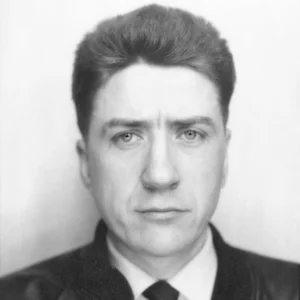

Swiss painter and architect (1874–1946), Charles L'Eplattenier was the founding master of the School of Art in La Chaux-de-Fonds. He is best known for being the teacher of the young Le Corbusier, whom he introduced to Art Nouveau and the decorative arts.
Charles L'Eplattenier(1874 — 1946)
Charles L'Eplattenier
Suisse
8 min read
Frequently asked questions
Key Facts
- Born in 1874 in Neuchâtel, died in 1946 in La Chaux-de-Fonds
- Founded and directed the School of Art in La Chaux-de-Fonds from 1897
- Teacher and mentor to the young Charles-Édouard Jeanneret, the future Le Corbusier
- Developed an Art Nouveau style inspired by the natural motifs of the Jura region
- Created numerous mural decorations and architectural projects in French-speaking Switzerland
Works & Achievements
L'Eplattenier established an innovative section within the La Chaux-de-Fonds School of Art, training well-rounded artists with mastery of painting, sculpture, architecture, and decorative arts. The program produced a generation of major Swiss artists, including Le Corbusier and sculptor Léon Perrin.
L'Eplattenier directed and oversaw the construction of the Villa Fallet in La Chaux-de-Fonds, the young Jeanneret's first architectural project. The carved stone decorations on the façade perfectly illustrate the naturalistic 'fir tree style' he had developed and taught to his students.
One of L'Eplattenier's most significant architectural works, this building demonstrates his command of monumental architecture, combining formal restraint with symbolic decoration. It stands as an important example of Art Nouveau architecture in the French-speaking part of Switzerland.
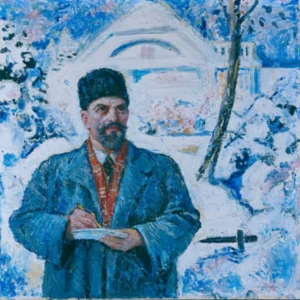
Throughout his career, L'Eplattenier painted the forests, mountains, and snow-covered landscapes of the Jura. These works reflect his deep attachment to the regional natural world, which underpinned his entire artistic philosophy and teaching practice.
L'Eplattenier designed numerous ornaments, mosaics, and decorative bas-reliefs for public and private buildings in La Chaux-de-Fonds. These creations represent the fullest expression of his 'fir tree style' applied to urban architecture.
Anecdotes
Charles L'Eplattenier recognized early on the exceptional talent of the young Charles-Édouard Jeanneret, the future Le Corbusier, who had initially enrolled in art engraving at the École d'art de La Chaux-de-Fonds. Convinced that this student had an extraordinary future ahead of him, he deliberately steered him toward architecture and the decorative arts, opening the door to a destiny that would transform architecture worldwide.
L'Eplattenier developed an original artistic philosophy rooted in close observation of the Jura region's natural landscape. He would take his students to draw in the pine forests, asking them to depict pine cones, ferns, and snowflakes in order to create decorative motifs that were authentically regional. This 'fir-tree style,' the signature of the École de La Chaux-de-Fonds, achieved remarkable success in local decorative arts and earned the city international recognition.
In 1905, L'Eplattenier founded within the École d'art de La Chaux-de-Fonds the 'Cours supérieur d'art et de décoration' — an innovative program training well-rounded artists with mastery of drawing, painting, sculpture, and architecture. This pedagogical initiative, groundbreaking for its time, aimed to reunify the arts that industrialization had driven apart, in the spirit of what the British Arts and Crafts movement advocated.
The relationship between L'Eplattenier and Jeanneret was intense but complex: the master saw in his student a continuator of his regionalist work, while the young man burned with the desire to discover Europe and break free from the Jura tradition. After Jeanneret's formative travels to Vienna, Berlin, and Paris between 1907 and 1911, the two men went their separate artistic ways, though Le Corbusier always acknowledged the decisive influence of his 'maître' on his formation.
Primary Sources
The correspondence held at the Fondation Le Corbusier in Paris bears witness to the intense intellectual relationship between the master and his pupil: L'Eplattenier guided Jeanneret in his reading, recommended journeys to him, and commented on his early architectural projects with both rigor and encouragement.
L'Eplattenier sets out his vision of a total artistic education, bringing together fine arts and decorative arts within a single curriculum, rooted in the observation of the Jura landscape as the source of all authentic and living ornament.
In the local press, L'Eplattenier championed his vision of a Swiss regional art grounded in the Jura landscape, opposing ornament imported with no connection to a culture or territory, and called for the creation of a genuine Swiss artistic school.
Le Corbusier evokes L'Eplattenier's founding role in his own formation, emphasizing that his master taught him to look at nature differently and to conceive of ornament not as an addition but as the expression of a deep structure underlying form.
Key Places
A watchmaking city in the Neuchâtel Jura where L'Eplattenier taught throughout his career at the School of Art. It was here that he developed the 'fir tree style' and trained Le Corbusier, leaving a lasting mark on the city's architecture and decorative arts — La Chaux-de-Fonds is today a UNESCO World Heritage Site.
The birthplace of Charles L'Eplattenier, in the canton of Neuchâtel. The Neuchâtel region, with its Jura forest landscapes and artisanal traditions, profoundly shaped the painter's artistic sensibility and fed his pursuit of a regional art rooted in the local land.
L'Eplattenier stayed here for his artistic training in the 1890s, immersing himself in the ferment of Parisian Art Nouveau. Like many artists of his generation, he regarded Paris as the undisputed capital of decorative modernism and a constant point of reference.
The first architectural work by Jeanneret (the future Le Corbusier), built in 1905–1907 under L'Eplattenier's direct supervision. The villa perfectly illustrates the 'fir tree style', with its carved stone ornaments inspired by Jura flora.
L'Eplattenier completed part of his artistic training here before continuing to Paris. The city was at the time a thriving centre of Central European decorative arts, and this stay enriched the young Swiss artist's visual vocabulary with Austro-Hungarian influences.
Typical Objects

L'Eplattenier constantly practiced and taught drawing from nature. The sketchbook was the fundamental tool of his pedagogy, allowing him to capture Jurassian plant motifs and transform them into architectural ornaments.

The pine cone, fir tree, and fern were the natural motifs at the heart of the 'sapin style' developed by L'Eplattenier. He had his students draw these forms to build an ornamental vocabulary that was authentically regional, distinct from Parisian influences.

A painter as much as an architect-decorator, L'Eplattenier produced numerous studies in watercolor and gouache, particularly of Jurassian landscapes. These light techniques also served to add color to his interior decoration and fresco projects.

In his studio, L'Eplattenier worked with plaster casts to experiment with his decorative motifs before transposing them into stone, wood, or metal on buildings. These models were a valuable teaching tool for his students.

Like many Art Nouveau artists, L'Eplattenier owned reproductions of Japanese prints and reference works such as Owen Jones's 'Grammar of Ornament' (1856). He used them in his teaching to illustrate the stylization of natural forms.

L'Eplattenier trained his students in the decorative arts just as much as in architecture. Technical drawing instruments were therefore ever-present in his advanced course, reflecting his conviction that art and construction should form a single discipline.
School Curriculum
Vocabulary & Tags
Key Vocabulary
Daily Life
Morning
L'Eplattenier began his days early, often with a drawing or a study of the surrounding nature, true to his own pedagogy of direct observation. He then prepared his lessons with care, selecting reproductions of artworks, natural specimens, or ornament plates to discuss with his students.
Afternoon
His afternoons were divided between teaching at the École d'art de La Chaux-de-Fonds — where he supervised his students' work with demanding yet benevolent guidance — and creating in his own studio. He painted, designed decorative projects, and monitored the progress of architectural works for which he served as artistic director in the city.
Evening
In the evenings, L'Eplattenier read widely — treatises on ornament, foreign art journals, essays on the philosophy of art — and corresponded with former students who had gone on study trips across Europe. He occasionally hosted fellow artists for lively discussions on regional art and the role of the artist in an industrial society.
Food
Like most inhabitants of the Swiss Jura of his time, L'Eplattenier had a simple, nourishing diet: meats, local cheeses, bread, seasonal vegetables, and regional charcuterie. The midday meal was the main break in his busy working day.
Clothing
As an art teacher and respected cultural figure in La Chaux-de-Fonds, L'Eplattenier dressed soberly but neatly, in the bourgeois manner of the Belle Époque: a dark suit, white shirt, and tie. In his studio or on outdoor sketching excursions in the Jura forest, he wore more practical clothing.
Housing
L'Eplattenier lived in La Chaux-de-Fonds, in a home befitting his standing as a recognized art teacher. His interior reflected his artistic convictions: carefully chosen decorative objects, natural materials, an abundance of books on art and botany, and no doubt some of his own painted works on the walls.
Historical Timeline
Period Vocabulary
Liens externes & ressources
Références
Œuvres
Supervision de la Villa Fallet
1905-1907
Crématorium de La Chaux-de-Fonds
vers 1909-1912
Paysages jurassiens — œuvre picturale
1895-1940
Décors, mosaïques et ornements pour bâtiments de La Chaux-de-Fonds
1900-1930