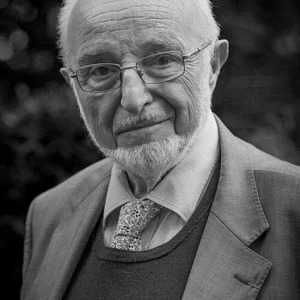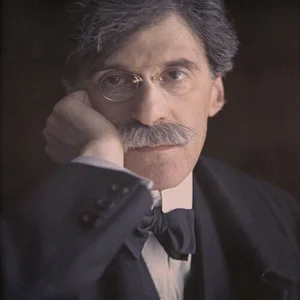

Alfred Stieglitz (1864–1946) was an American photographer and gallery owner who played a fundamental role in establishing photography as a fine art in its own right. He founded Gallery 291 in New York and edited influential journals such as Camera Notes and Camera Work.
Alfred Stieglitz(1864 — 1946)
Alfred Stieglitz
États-Unis
8 min read
Frequently asked questions
Famous Quotes
« Photography is my passion, the search for truth my obsession.»
« In photography there is a reality so subtle that it becomes more real than reality.»
Key Facts
- 1864: Born in Hoboken, New Jersey
- 1902: Founded the Photo-Secession movement to promote artistic photography
- 1903–1917: Edited Camera Work magazine, an international benchmark for art photography
- 1905–1917: Directed Gallery 291 in New York, a showcase for American and European modern art
- 1946: Died in New York, leaving a body of work of more than 3,000 photographs
Works & Achievements
Photograph taken during a snowstorm in New York, depicting horse-drawn carriages on a snow-covered street. It is considered one of the first works to establish photography as an art form in the tradition of realist painting.
An avant-garde photography publication founded and edited by Stieglitz, renowned for the exceptional quality of its photogravures. It brought the work of the greatest photographers and modern artists to an international audience of connoisseurs.
A photograph of poor passengers on the deck of a transatlantic ocean liner, often cited as the first iconic image of American modernist photography. Stieglitz prioritizes pure formal composition over any anecdotal narrative.
More than three hundred photographs of his companion and future wife, forming a psychological and sensual portrait of a woman artist spanning two decades. This series is considered one of the most ambitious photographic portraits in the history of art.
A series of several hundred photographs of cloud formations taken at Lake George. Stieglitz sought to demonstrate that photography could express pure inner states, independent of any recognizable subject — an approach bordering on abstraction.
At gallery 291, Stieglitz organized the first American exhibitions of Rodin, Matisse, Picasso, Cézanne, and Braque. This exhibition program stands as a collective intellectual achievement that permanently transformed American artistic life.
Anecdotes
In January 1893, Alfred Stieglitz waited more than three hours in a snowstorm on Fifth Avenue in New York, his feet frozen, to capture the perfect shot that would become 'Winter – Fifth Avenue'. This image, taken with a cumbersome camera amid gusting winds, was hailed as a work of art in its own right and helped legitimize photography as equal in stature to painting.
Gallery 291, opened in 1905 at 291 Fifth Avenue, was the first gallery in the United States to exhibit works by Picasso, Matisse, and Cézanne, even before these artists were widely recognized in Europe. Stieglitz combined photographs and avant-garde paintings under one roof, asserting that both mediums deserved equal artistic consideration.
In 1907, during a transatlantic voyage to Europe, Stieglitz photographed 'The Steerage', an image depicting third-class passengers on the lower deck of the ocean liner. He regarded it as his most important work: he saw in it a pure formal composition, free of any sentimentality, and a harbinger of modernist photography.
Stieglitz printed his journal Camera Work (1903–1917) on luxury Japanese paper with high-precision photogravures, in a limited edition of approximately 1,000 copies. Refusing all commercial advertising, he personally funded the publication for fourteen years, making it as much an art object as a photographic manifesto.
In 1916, Stieglitz received a roll of drawings sent by an unknown young artist, Georgia O'Keeffe. He was so impressed that he immediately put them on display without notifying her. When she arrived at his gallery, furious, a long artistic and intellectual collaboration began; they married in 1924 and remained bound together until his death in 1946.
Primary Sources
Camera Work will be devoted to photographic art, its progress and the development of the artists who give it its value. It will not be the organ of a society or club, but will be published solely in the interest of art.
Your work is the most important thing I have seen in many years — the sharpest thinking, the most direct vision. It is absolutely pure. It is the quintessence of what Camera Work has striven to achieve.
I saw shapes related to one another. A picture of shapes and, beneath them, a new vision that held me: people, round hats, an iron footbridge, masts, white ropes, a stairway, conical straw hats... Everything connected to me as never before.
I wanted to photograph clouds to find out if I had learned anything in forty years of photography... I wanted to know if what I had learned about light and shadow, space and time, had meaning.
Key Places
The birthplace of Alfred Stieglitz in 1864. His family, of German origin, had settled there in comfortable prosperity, allowing him to receive a solid education before his departure for Germany.
Stieglitz studied engineering and then photography under Hermann Wilhelm Vogel at the Technische Hochschule from 1881 onward. It was here that he discovered his artistic vocation and gained rigorous technical training.
Founded in 1905 at 291 Fifth Avenue, this gallery became the nerve center of modern art in the United States. Stieglitz exhibited photographs and European avant-garde works there for twelve years, making it a unique hub of intellectual debate.
The Stieglitz family's summer retreat since his childhood. As an adult, he returned every summer to photograph nature, sky, and clouds, giving rise to his celebrated *Equivalents* series in the 1920s.
The last gallery founded by Stieglitz, in 1925, devoted exclusively to modern American artists such as Georgia O'Keeffe and John Marin. He worked there until shortly before his death in 1946.
Typical Objects

Stieglitz worked primarily with large-format plate cameras — heavy, cumbersome instruments requiring considerable technical mastery. His disciplined use of this craftsman's tool reflected his conviction that technical rigor and artistic ambition were inseparable.
A journal founded by Stieglitz in 1903, printed on Japan paper with exceptionally high-quality photogravures. Each issue was a work of art in its own right, designed to prove that photographic reproduction could rival the finest traditional prints and engravings.

Stieglitz spent long hours in the darkroom developing and printing his own photographs. For him, mastery of the chemical process was just as essential to photographic creation as the act of taking the picture itself.

Stieglitz began his career using light-sensitive glass plates before moving on to flexible film. These fragile, heavy plates demanded meticulous preparation and careful handling in transport — reinforcing the idea that photography was a demanding art form.

The walls of Gallery 291 hosted the first American exhibitions of these European masters. Stieglitz deliberately hung their work alongside photographs to assert the equivalence of both forms of artistic expression.

Stieglitz maintained a rich correspondence with artists, critics, and collectors around the world. His letters, preserved at Yale University, are a major primary source for understanding the networks that shaped modern American art.
School Curriculum
Vocabulary & Tags
Key Vocabulary
Tags
Daily Life
Morning
Stieglitz rose early and often devoted his mornings to the darkroom: developing plates, printing and retouching proofs by natural light. He placed extreme importance on the technical quality of every print, tolerating no approximation.
Afternoon
Afternoons were dedicated to Gallery 291, where he received artists, critics, and collectors for long, passionate discussions about modern art. He personally arranged the hangings and wrote the exhibition texts, turning each show into an intellectual event.
Evening
Evenings frequently extended into dinners or gatherings with New York's avant-garde circles — painters, writers, and photographers who orbited the gallery. Stieglitz read widely in the European art press to stay connected to the aesthetic debates taking place across the Atlantic.
Food
Born into a prosperous bourgeois family, Stieglitz enjoyed comfortable food throughout his life, blending the Germanic culinary traditions he inherited from his family with urban American cuisine. During his summer stays at Lake George, he relished meals taken outdoors in the company of artist friends.
Clothing
Stieglitz typically dressed as an intellectual of the bourgeoisie: dark suit, starched white collar, and a soft felt hat. In the field, he favored more practical clothing to endure the long hours of waiting outdoors — particularly in winter, as during the making of *Winter – Fifth Avenue*.
Housing
Stieglitz lived primarily in New York in comfortable city apartments, often near his successive galleries. Each summer he retreated to the family estate of Oaklawn on Lake George in upstate New York, a large property surrounded by nature where he conducted his outdoor photographic experiments.
Historical Timeline
Period Vocabulary
Liens externes & ressources
Références
Œuvres
Camera Work (revue, 50 numéros)
1903–1917
The Steerage
1907
Portraits de Georgia O'Keeffe (série)
1918–1937
Equivalents (série de nuages)
1922–1931
Galerie 291 (programme d'expositions)
1905–1917