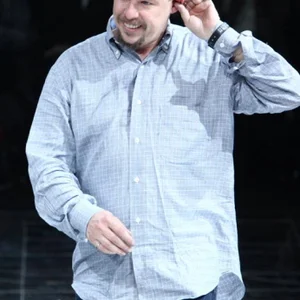

Alexander McQueen (1969–2010) was a revolutionary British fashion designer and founder of his eponymous house. Trained on Savile Row and at Central Saint Martins, he is known for his provocative collections blending beauty and darkness.
Alexander McQueen(1969 — 2010)
Alexander McQueen
Royaume-Uni
9 min read
Frequently asked questions
Famous Quotes
« Fashion should be a form of escapism, and not a form of imprisonment.»
« I want people to be afraid of the women I dress.»
Key Facts
- 1969: Born in London into a modest family
- 1992: Graduated from Central Saint Martins with a celebrated collection bought by Isabella Blow
- 1996: Appointed artistic director of Givenchy in Paris
- 2003: Awarded the title of Commander of the Order of the British Empire (CBE)
- 2010: Died at age 40, leaving a major legacy in global fashion
Works & Achievements
Provocative collection staging models in torn dresses crossing a Scottish moor, denouncing the English colonization of Scotland. It catapulted McQueen onto the international scene and established his reputation as a politically engaged and historically conscious designer.
Presented in a deconsecrated London church with models wearing masks evoking war, death and faith, this collection draws inspiration from Dante Alighieri's *The Divine Comedy*. It is considered one of the most accomplished and poetic of his entire career.
A memorable show concluded by the performance of industrial robotic arms painting the dress of model Shalom Harlow live on stage. This staging, on the boundary between contemporary art and fashion, redefined the notion of a fashion show as a total artistic event.
Presented in a room surrounded by one-way mirrors, this collection concluded with the opening of a central chamber revealing a naked woman covered in live butterflies. A conceptual masterpiece blending beauty, voyeurism and references to the history of Western art.
A tribute to the Scottish women who survived the Battle of Culloden (1746), the last major battle fought on British soil. This collection blends Victorian lace, tartans and ancient embroidery techniques in a dark and refined romanticism.
The last collection presented during his lifetime, imagining humanity's evolution toward a marine creature, and streamed live on the internet for the first time in fashion history. It featured the famous 'Armadillo' shoes later worn by Lady Gaga in the 'Bad Romance' video.
Anecdotes
At his graduation collection at Central Saint Martins in 1992, Alexander McQueen presented garments inspired by serial murders. Stylist Isabella Blow, who attended the show, was so captivated that she bought the entire collection for £5,000, paid in installments. This encounter marked the beginning of a friendship and patronage that would last until Isabella's death in 2007.
In 1995, McQueen sparked worldwide controversy with his 'Highland Rape' collection, which depicted models in torn dresses on a heather moorland. Far from glorifying violence, McQueen explained that he wanted to denounce the atrocities committed by the English during the colonization of Scotland — a painful tribute to his own origins. The collection shocked audiences but established McQueen as a political voice in fashion.
At the 'No. 13' show in 1999, model Shalom Harlow stood at the center of the stage, wearing a white dress. Two industrial robotic arms emerged and sprayed her with black and yellow paint within seconds, transforming the dress into a living work of art. This moment remains one of the most spectacular performances in the history of fashion.
For his 'Voss' collection in 2001, McQueen seated the audience around a large box with one-way mirror walls: throughout the show, the audience could see themselves but not the interior of the room. At the end, the mirrors lit up to reveal a naked woman surrounded by live moths — a direct reference to the paintings of Hieronymus Bosch and the work of Damien Hirst.
McQueen's last collection presented during his lifetime, 'Plato's Atlantis' in March 2010, was livestreamed on the internet via SHOWstudio — an absolute first in fashion. Lady Gaga tweeted the link during the show, causing the site to crash under the surge of visitors. McQueen thereby redefined the runway show as a global event accessible to all, just weeks before his death.
Primary Sources
I want to empower women. I want people to be afraid of the women I dress. Fashion should be a form of escapism, and not a form of imprisonment.
I find beauty in the grotesque, like most artists. I have to force people to look at things.
McQueen's collections were consistent in their exploration of what it means to be human — our fears, our mortality, our capacity for violence and for beauty.
I oscillate between life and death, happiness and sadness, good and evil. If I wasn't doing this, I'd be a serial killer.
Key Places
The legendary street in London's Mayfair district, renowned since the 18th century for its luxury tailors who dress aristocrats and global elites. It was here that McQueen learned the fundamentals of cutting and garment construction — a technique that would remain the foundation of all his creative work.
London's prestigious art school, now located in King's Cross, where McQueen earned his Master's degree in fashion design in 1992. It was here that his radical artistic vision took shape, and where his fateful meeting with Isabella Blow launched his international career.
The Parisian haute couture house where McQueen served as creative director from 1996 to 2001, succeeding John Galliano. Despite an occasionally tense relationship with management, he developed a bold vision there that profoundly modernised the image of this historic fashion house.
This major New York museum hosted the retrospective exhibition "Alexander McQueen: Savage Beauty" in 2011, one year after his death. With over 661,000 visitors, it became one of the most attended exhibitions in the history of the museum's Costume Institute.
This London museum of decorative arts hosted the European version of "Savage Beauty" in 2015, making it the most visited exhibition in the museum's entire history with 493,000 entries. Today it holds a significant permanent collection of Alexander McQueen pieces.
Typical Objects

Extremely low-waisted trousers, McQueen's signature since his earliest collections, which visually elongate the torso and expose the lower back. They symbolize his subversive approach to the body and influenced an entire generation of designers throughout the 1990s and 2000s.

The stylized skull became the emblematic motif of the Alexander McQueen house, appearing on silk scarves, rings, and accessories. It embodies McQueen's enduring fascination with death, beauty, and the fragility of human existence.

McQueen frequently used the corset as the centrepiece of his designs, combining tailoring techniques with historical references spanning the 17th to 19th centuries. Far from being a restrictive garment, he reinterpreted it as a kind of armour that protects and elevates the female body.

Created for the 'Plato's Atlantis' collection in 2010, these vertiginous armadillo-claw-shaped platform shoes became museum-worthy collector's pieces. Worn by Lady Gaga in the 'Bad Romance' music video, they illustrate McQueen's vision of the shoe as a wearable sculpture.

McQueen regularly used tartan as a reference to his roots and Scotland's history, often deconstructing, tearing, or subverting it from its traditional purpose. This checked cloth symbolizes his way of blending identity pride with aesthetic provocation.

Across many collections, McQueen incorporated ostrich feathers, shells, exoskeletons, and other natural elements directly into his creations. This use of raw materials reflects his vision of fashion as an extension of natural evolution and of the relationship between humanity and the natural world.
School Curriculum
Vocabulary & Tags
Key Vocabulary
Tags
Daily Life
Morning
McQueen typically began his days very early at his London studio in Clerkenwell, often before his teams arrived. Trained in the rigorous craftsmanship of Savile Row, he took part in the cutting and construction of pieces himself, handling scissors and fabric with the precision of a seasoned tailor.
Afternoon
Afternoons were dedicated to fittings with models, creative meetings with his jewellery and accessories teams, and research for upcoming collections. Passionate about art history, natural sciences, and cinema, he frequently visited London's museums — notably the Natural History Museum — to fuel his imagination.
Evening
McQueen maintained strong ties with the London art scene, mixing with contemporary artists such as Damien Hirst and Jake & Dinos Chapman, whose influence can be seen throughout his collections. During pre-collection periods, evenings would often stretch late into the night at the studio.
Food
Coming from a modest East End family, McQueen held on to simple eating habits despite his fame. He appreciated traditional British cooking and enjoyed preparing meals himself for the people close to him. During show preparation periods, meals were often eaten on the go, straight from the studio.
Clothing
In daily life, McQueen adopted a paradoxically casual style — jeans, t-shirt, and trainers — far removed from the extreme extravagance of his creations. He wore mainly dark, understated clothing, a sartorial simplicity that stood in sharp contrast to the sophistication of his work.
Housing
McQueen lived in London, a city he never truly wanted to leave, even during his years in Paris with Givenchy. He owned a house in the Mayfair neighbourhood, but the studio remained his real living space — the place where he spent most of his time and creative energy.
Historical Timeline
Period Vocabulary
Liens externes & ressources
Références
Œuvres
Collection 'Highland Rape' (automne-hiver 1995-1996)
1995
Collection 'Dante' (automne-hiver 1996-1997)
1996
Collection 'No. 13' (printemps-été 1999)
1999
Collection 'Voss' (printemps-été 2001)
2001
Collection 'Widows of Culloden' (automne-hiver 2006-2007)
2006
Collection 'Plato's Atlantis' (printemps-été 2010)
2010