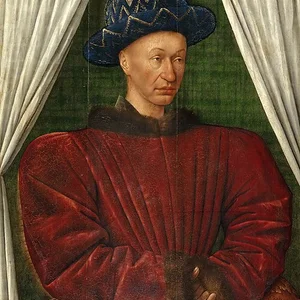

King of France (1422–1461), Charles VII is best known for his coronation at Reims in 1429, made possible by Joan of Arc, who restored French confidence during the Hundred Years' War. He continued the reconquest of French territory and ended the conflict with England in 1453.
Frequently asked questions
Key Facts
- 1429: Coronation at Reims through Joan of Arc's intervention, legitimizing his royal authority
- 1431: Capture and execution of Joan of Arc, despite the king's support
- 1435: Treaty of Arras with Burgundy, strengthening France's position
- 1453: End of the Hundred Years' War with the Battle of Castillon and liberation of Guyenne
- 1461: Death of the king, ending his 39-year reign
Works & Achievements
France's first permanent army, composed of professional cavalry soldiers paid by the king. This major reform put an end to the bands of mercenaries ravaging the country and gave the king a monopoly on military force.
An ordinance asserting the autonomy of the French Church from the papacy by limiting papal interference in French ecclesiastical appointments. It laid the foundations of Gallicanism.
A legal reform mandating the official codification of the kingdom's customary laws in order to unify and clarify the law. It represents a major milestone in the construction of the modern state.
Charles VII secured the right to levy direct taxation (the taille) without the consent of the Estates General, providing the crown with regular revenue and funding the standing army.
Systematic military campaigns that definitively expelled the English from the continent, with the exception of Calais. These victories brought to an end over a century of the Hundred Years' War.
A trial ordered by Charles VII that overturned Joan of Arc's conviction for heresy, restoring her memory and confirming the divine legitimacy of the coronation at Reims.
Anecdotes
Charles VII was nicknamed the "King of Bourges" by his detractors, because after the death of his father Charles VI in 1422, he controlled only part of central and southern France, while the English and Burgundians dominated Paris and the north. This mocking nickname illustrated the fragility of his position at the beginning of his reign.
The Treaty of Troyes of 1420, signed by his own father Charles VI, disinherited Charles in favor of the English king Henry V. His own mother, Isabeau of Bavaria, had cast doubt on his legitimacy by suggesting he was not the king's son. This trauma deeply marked the young prince, who himself doubted his right to the throne.
During their first meeting at Chinon in 1429, Charles VII reportedly hid among his courtiers to put Joan of Arc to the test. According to tradition, the young peasant girl recognized him immediately despite the ruse, which helped convince the king to entrust her with an army.
Charles VII was one of the first kings of France to create a standing army. In 1445, he established the compagnies d'ordonnance, paid and disciplined cavalry troops, putting an end to the feudal system in which each lord brought his own men. This major military reform made it possible to definitively drive the English out of the kingdom.
Despite Joan of Arc's decisive role in his accession to the throne, Charles VII did nothing to save her when she was captured by the Burgundians in 1430 and then sold to the English. He made no attempt to ransom her or negotiate her release. It was not until 1456, twenty-five years after her death, that he ordered a rehabilitation trial that overturned her conviction.
Primary Sources
This anonymous journal, kept by a Parisian clerk between 1405 and 1449, describes daily life in Paris under English and Burgundian occupation, and reports with hostility the events related to the party of Charles VII, whom he calls the "so-called dauphin".
The minutes of the Rouen trial in 1431 constitute an exceptional document, transcribing the interrogations of Joan of Arc, who claimed to have been sent by God to have Charles VII crowned at Reims and to drive the English out of France.
Official chronicler of Charles VII from 1437, Jean Chartier recounts the king's military campaigns and the gradual reconquest of the kingdom, describing in particular the triumphal entry of Charles VII into Paris in 1437.
By this ordinance of 1454, Charles VII prescribed the official drafting of the kingdom's customary laws, a first step toward the unification of French law. He ordered that "the customs, usages and practices of each region of our kingdom be compiled and set down in writing".
Key Places
Royal fortress on the Vienne river where Charles VII held his court. It was here that he received Joan of Arc in February 1429, an event that changed the course of the war.
Site of Charles VII's coronation on July 17, 1429, in the presence of Joan of Arc. This coronation, in the tradition of the kings of France, granted him a legitimacy that the Treaty of Troyes had sought to strip from him.
The de facto capital of Charles VII's kingdom during the early years of his reign, when Paris was in English hands. The city housed the court, the royal administration, and the Pragmatic Sanction of 1438.
Site of the decisive battle of July 17, 1453, where the French artillery of the Bureau brothers crushed the English army of Talbot, bringing the Hundred Years' War to an end.
Royal castle in Berry where Charles VII died on July 22, 1461, consumed by fear of being poisoned by his son, the future Louis XI, with whom he was in conflict.
Typical Objects

The crown worn by Charles VII at his coronation in Reims in 1429, a ceremony made possible by Joan of Arc that definitively legitimized his power against English claims.
📷 CC BY 4.0 · Wikimedia Commons ↗
The shield adorned with three golden fleurs-de-lis on an azure background, emblem of the royal House of France that Charles VII claimed against the Anglo-French dual monarchy.
A gunpowder artillery piece used by the Bureau brothers, masters of artillery under Charles VII. These cannons proved decisive at Castillon in 1453 and made the French army the most modern in Europe.
📷 CC0 · Wikimedia Commons ↗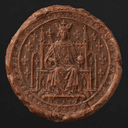
The great seal of majesty of Charles VII, affixed to royal ordinances, depicted the king seated on his throne and symbolized his sovereign authority over the reconquered kingdom.
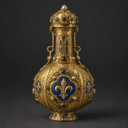
A sacred vial containing the oil used to anoint the kings of France at their coronation in Reims. Its use for Charles VII in 1429 reinforced the divine dimension of his legitimacy.
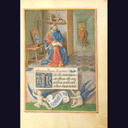
An illuminated manuscript of prayers that Charles VII used for his daily devotions. The king was known for his piety and regularly consulted his confessors.
📷 Public domain · Wikimedia Commons ↗School Curriculum
Vocabulary & Tags
Key Vocabulary
Daily Life
Morning
Charles VII rose relatively late, often after dawn, as he had a reputation for indolence in his youth. He attended morning mass in the castle chapel, surrounded by his chaplains. He would then have a light meal before receiving his closest advisors to discuss urgent matters of the kingdom.
Afternoon
The afternoon was devoted to royal councils, where Charles VII sat with his principal ministers and officers. He received ambassadors, signed ordinances, and listened to reports from his captains on the progress of the reconquest. The king sometimes withdrew for private audiences with trusted advisors such as Jacques Cœur or the constable de Richemont.
Evening
The royal supper was served with great ceremony, featuring several courses of meats and fish. Charles VII appreciated music and kept musicians at his court. Evenings might include entertainment, discussions with his intimates, or moments of private devotion. The king would retire to his chambers, often troubled by anxiety and melancholy.
Food
The royal table in the 15th century included roasted meats (beef, game, poultry), fish on lean days, white wheat bread, and pastries. Charles VII drank wine diluted with water. Imported spices (pepper, ginger, cinnamon) seasoned the dishes, a mark of wealth. Seasonal fruits and vegetables accompanied the meals.
Clothing
Charles VII wore the houppelande, a long, full-cut coat with flared sleeves, made of velvet or fine wool cloth, lined with fur in winter. His garments were dyed in the royal colors, blue and red, and adorned with embroidered golden fleurs-de-lis. He wore a chaperon or bonnet, and fitted hose. During ceremonies, he donned the royal blue mantle strewn with fleurs-de-lis.
Housing
Charles VII resided primarily in the castles of the Loire Valley: Chinon, Loches, Mehun-sur-Yèvre, and Bourges. These medieval fortresses featured great vaulted halls, chapels, and private apartments heated by immense fireplaces. The walls were hung with tapestries for insulation and decoration. After the reconquest of Paris in 1437, the king spent little time there, preferring his Loire residences.
Historical Timeline
Period Vocabulary
Visual Style
Un style visuel inspiré des enluminures et peintures de Jean Fouquet, évoquant la cour royale française du XVe siècle avec ses bleus royaux, ses ors et son architecture gothique flamboyant.
Sound Ambience
L'atmosphère sonore d'une cour royale du XVe siècle dans un château de la Loire, mêlant les échos de la vie de cour, les chants liturgiques et les bruits lointains d'une armée en transformation.
Liens externes & ressources
Références
Œuvres
Création des compagnies d'ordonnance
1445
Pragmatique Sanction de Bourges
1438
Ordonnance de Montils-lès-Tours
1454
Réforme fiscale et création de la taille permanente
1439-1440
Reconquête de la Normandie et de la Guyenne
1449-1453
Procès en réhabilitation de Jeanne d'Arc
1456