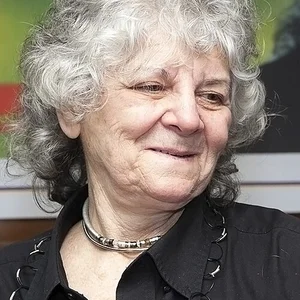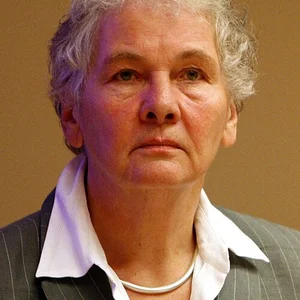

Christiane Nüsslein-Volhard is a German biologist born in 1942, a specialist in developmental genetics. Her work on the fruit fly (Drosophila) revealed how genes control the formation of the embryo. She received the Nobel Prize in Physiology or Medicine in 1995.
Christiane Nüsslein-Volhard(1942 — ?)
Christiane Nüsslein-Volhard
Allemagne
6 min read
Frequently asked questions
Key Facts
- Born on October 20, 1942, in Magdeburg, Germany
- With Eric Wieschaus, identified the genes controlling the embryonic development of Drosophila (work published in 1980)
- Received the Nobel Prize in Physiology or Medicine in 1995, shared with Eric Wieschaus and Edward B. Lewis
- First German woman to receive a Nobel Prize in the sciences
- Heads the genetics department of the Max Planck Institute for Developmental Biology in Tübingen
Works & Achievements
A systematic search for the genes controlling segmentation of the fruit fly embryo. This method, which involved examining countless mutants, revolutionized the study of development.
A landmark publication identifying 15 genes that govern the body plan of the larva. It is one of the most cited papers in developmental biology.
Demonstration that a protein distributed in a gradient tells each cell its position within the embryo. The first concrete proof of the concept of a morphogen.
Extension of her method to a vertebrate with transparent embryos. This work made the zebrafish an essential model animal in biology.
Awarded together with Eric Wieschaus and Edward Lewis for understanding the genetic control of early embryonic development.
A foundation she created to provide financial support for young German women researchers with children. It aims to keep talented women from leaving science.
A popular science book in which she explains how, starting from a single cell, genes build an entire organism.
Anecdotes
To discover which genes shape the embryo, Christiane Nüsslein-Volhard and her colleague Eric Wieschaus spent nearly a year hunched over a double-headed microscope that let them observe the same larva at the same time. They examined tens of thousands of mutant fly larvae to spot those whose bodies were poorly segmented. This patient work earned them the Nobel Prize in 1995.
Whenever the team found a new gene, it had to be given a name. One mutant larva, short and bristling with tiny spikes, looked like a hedgehog, so the gene responsible was christened “hedgehog.” The playful name stuck and today refers to a very important family of genes, found in human beings too.
In 1995, Christiane Nüsslein-Volhard became the first German woman to receive the Nobel Prize in Physiology or Medicine. She shared it with Eric Wieschaus and Edward Lewis, honored for working out how genes direct the very first stages of an embryo's development.
Having watched many talented young women researchers leave science after becoming mothers, in 2004 she set up a foundation bearing her name. It gives money to young German scientists with children to help them pay for childcare or household help and to keep up their research.
After her discoveries about the fruit fly, she wanted to study an animal closer to humans, one with a backbone. She chose the zebrafish, whose embryos are transparent: under the microscope you can literally watch the organs form day after day.
Primary Sources
In systematic searches for embryonic lethal mutants of Drosophila melanogaster we have identified 15 loci which when mutated alter the segmental pattern of the larva.
The bicoid morphogen is distributed in a concentration gradient from the front of the embryo, and it is this local concentration that tells each cell where it is located and what it must become.
The prize is awarded for their discoveries concerning the genetic control of early embryonic development.
Understanding how a single fertilized cell becomes a complete living being is one of the most fascinating questions in biology.
Key Places
City where Christiane Nüsslein-Volhard was born in 1942. Her family later moved to Frankfurt.
City where she grew up and began her biology studies at university. It was there that her passion for living things was born.
International research center where she carried out, together with Eric Wieschaus, the great genetic screen of the fruit fly in the late 1970s.
University where she earned her degree in biochemistry and then her doctorate in 1974.
Institute of which she became director in 1985 and where she pursued her research on the fruit fly and later the zebrafish.
Swedish capital where she received the Nobel Prize in Physiology or Medicine in December 1995.
Typical Objects

A special microscope that lets two people observe the same specimen at the same time. Nüsslein-Volhard and Wieschaus used it to examine thousands of mutant larvae together.

Small tubes containing a nutrient paste used to raise fruit flies. Their very short life cycle, about two weeks, makes it possible to study many generations.

An instrument used to draw up and dispense tiny volumes of liquid, on the order of a millionth of a liter. A basic tool for handling embryos, reagents and DNA solutions.

Rows of tanks used to raise zebrafish, which have become a major model animal. Their transparent embryos let you watch organs form directly.

Small round glass or plastic dishes used to observe and sort embryos and larvae under the microscope. Essential for sorting the thousands of specimens in genetic screens.

A logbook where the researcher records every experiment, cross and observation, with dates and results. It ensures that discoveries can be checked and reproduced.
School Curriculum
Vocabulary & Tags
Key Vocabulary
Daily Life
Morning
The morning of a researcher like her often begins in the laboratory, where she checks the fly crosses set up the day before and records the first results. Part of her time is devoted to observing embryos and larvae under the microscope.
Afternoon
The afternoon blends bench experiments, meetings with students and doctoral candidates, and the reading of scientific papers. As the director of an institute, she also dedicates time to organizing her team's research.
Evening
In the evening, work frequently continues with the writing of articles, the preparation of lectures, or the editing of manuscripts. It is also the time to cook, a passion she embraces and gladly shares.
Food
Her diet is that of a twentieth-century European: bread, vegetables, meat and fish, coffee and tea. A lover of good food, she enjoys preparing elaborate dishes herself.
Clothing
In the laboratory, she wears the obligatory white coat, sometimes gloves and protective goggles. Outside, her attire is that of a modern academic—simple and practical.
Housing
She lives in a comfortable home in a German university town, close to her research institute. Her daily life is divided between this residence and the laboratories of Tübingen.
Historical Timeline
Period Vocabulary
Liens externes & ressources
Références
Œuvres
Le crible génétique de Heidelberg (avec Eric Wieschaus)
1978-1980
Article « Mutations affecting segment number and polarity in Drosophila » (Nature)
1980
Découverte du gène et du morphogène bicoïd (avec Wolfgang Driever)
1988
Cribles génétiques sur le poisson-zèbre (« crible de Tübingen »)
1996
Prix Nobel de physiologie ou médecine
1995
Fondation Christiane Nüsslein-Volhard
2004
Livre « Coming to Life: How Genes Drive Development »
2006