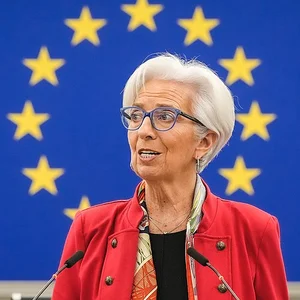

French business lawyer and politician, the first woman to head the International Monetary Fund (2011) and later the European Central Bank (2019). She had previously served as France's Minister of the Economy and Finance.
Christine Lagarde(1956 — ?)
Christine Lagarde
France
6 min read
Frequently asked questions
Key Facts
- 2007-2011: Minister of the Economy, Finance and Industry under the presidency of Nicolas Sarkozy
- 2011: becomes the first female Managing Director of the International Monetary Fund (IMF)
- 2011: manages the IMF's response to the eurozone debt crisis (Greece, Portugal, Ireland)
- 2019: appointed President of the European Central Bank (ECB), the first woman to hold the position
- Born on January 1, 1956, in Paris
Works & Achievements
She leads one of the largest law firms in the world, the first woman to hold this position. An experience that shapes her international standing.
She manages France's response to the 2008 financial crisis. Her command of the issues earns her an international reputation.
The first woman to head the IMF, she leads its aid programs for countries hit by the debt crisis. She is reappointed for a second term in 2016.
She directs the monetary policy of the eurozone. She rolls out a massive response to the Covid-19 pandemic, then confronts the return of inflation.
Under her leadership, the ECB launches a vast program to support the European economy during the Covid-19 crisis. An intervention unprecedented in its scale.
Anecdotes
In 2011, Christine Lagarde became the first woman to head the International Monetary Fund, an institution founded in 1944 and until then always led by a man. She took the helm in the midst of the eurozone debt crisis, as Greece threatened to bring down the entire single currency.
Before her political career, Christine Lagarde was a member of the French national synchronized swimming team in her youth. She has often said that this team sport taught her discipline, endurance, and the art of keeping her composure under pressure.
In 2009, while she was France's Minister of the Economy, the British newspaper the Financial Times named her the “best finance minister in the eurozone.” It was a rare honor for a French official in the English-speaking financial press.
After becoming President of the European Central Bank in 2019, Christine Lagarde is the first woman and also the first person without formal training as an economist (she is a lawyer) to hold the post. She had to steer the euro's monetary policy through the Covid-19 pandemic and then the return of inflation.
Christine Lagarde is known for her elegance and her fondness for colorful scarves and shawls, which have become something of a signature. A polyglot, she speaks fluent English, a language she mastered through many years working as a lawyer in the United States.
Primary Sources
I fully understand the responsibility entrusted to me at a moment when the global economy is going through a period of uncertainty and when international solidarity is more necessary than ever.
The European Central Bank will act with determination to ensure price stability and support growth in the euro area, within the framework of its mandate.
Extraordinary times require extraordinary action. There are no limits to our commitment to the euro.
Key Places
Birthplace of Christine Lagarde, born in 1956. It is also where she would carry out her ministerial duties at Bercy.
City in Normandy where Christine Lagarde grew up and sat her baccalauréat. Her youth there was marked by competitive synchronized swimming.
Home to the law firm Baker & McKenzie, where she built her international legal career. She would become its first woman chair.
Headquarters of the International Monetary Fund, which she led from 2011 to 2019. There she oversaw aid to countries in crisis.
Modern tower housing the European Central Bank, of which she has been president since 2019. The heart of eurozone monetary policy.
Seat of the ministry she headed from 2007 to 2011. There she faced the global financial crisis of 2008.
Typical Objects

An accessory that became a visual signature of Christine Lagarde, often worn knotted around the neck. It embodies her elegance and her polished public image.

A small mallet used to open and close the meetings of the ECB's Governing Council. It symbolizes the president's authority over monetary decisions.

The single currency of the eurozone, whose value and stability the ECB guarantees. Safeguarding it lies at the heart of Christine Lagarde's mission.

A document of analysis and forecasts published regularly by the International Monetary Fund. It guides the recommendations issued to member states.

A lectern bearing the logo of the IMF and later the ECB, from which Christine Lagarde announces major decisions. Every word spoken there is scrutinized by the financial markets.

Tools for tracking stock prices, interest rates, and global market indices in real time. They make it possible to react quickly to the upheavals of the economy.
School Curriculum
Vocabulary & Tags
Key Vocabulary
Daily Life
Morning
Christine Lagarde starts her days very early, often with a workout or a swim, true to her discipline as a former athlete. She then reads through the international financial press and the stock market indicators before her first meetings.
Afternoon
Her afternoons are filled with meetings with central bank governors, political leaders, and experts. She prepares her public statements, where every word can move global markets.
Evening
Her evenings are often devoted to official dinners, international summits, or flights between capitals. Whenever she can, she sets aside moments for reading and quiet.
Food
Christine Lagarde is known for being a vegetarian and for not drinking alcohol, a sober regimen she follows for the sake of healthy living. She favors light meals, suited to an intense schedule and frequent travel.
Clothing
She is renowned for her classic elegance: understated suits, often set off by a colorful silk scarf that has become her signature. Her carefully styled white hair is also part of her public image.
Housing
Over the course of her career, she has lived between France, the United States, and Germany, depending on her positions. Her homes are urban apartments close to the major centers of economic decision-making, in Washington and later in Frankfurt.
Historical Timeline
Period Vocabulary
Liens externes & ressources
Références
Œuvres
Présidence mondiale du cabinet Baker & McKenzie
1999-2004
Ministre de l'Économie et des Finances de la France
2007-2011
Direction générale du Fonds monétaire international
2011-2019
Présidence de la Banque centrale européenne
2019-
Programme d'achats d'urgence pandémique (PEPP)
2020