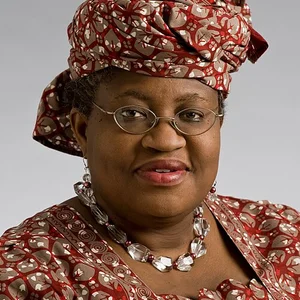

Nigerian economist and politician, twice Minister of Finance of Nigeria and Director-General of the World Trade Organization since 2021. She is the first woman and the first African to lead the WTO.
Ngozi Okonjo-Iweala(1954 — ?)
Ngozi Okonjo-Iweala
Nigeria
5 min read
Frequently asked questions
Key Facts
- Born on June 13, 1954, in Ogwashi-Ukwu (Nigeria)
- A 25-year career at the World Bank, including as Managing Director (2007-2011)
- Minister of Finance of Nigeria (2003-2006, then 2011-2015)
- First woman and first African appointed Director-General of the WTO in March 2021
- Reappointed for a second term as head of the WTO in 2024
Works & Achievements
Negotiated an 18-billion-dollar debt relief, freeing up funds for Nigeria's public services.
Publication of oil revenues shared among states, a first that reduced the embezzlement of funds.
An account of her economic reforms, which became a key reference on governance in Africa.
A firsthand account of the personal dangers of fighting corruption at the highest levels of the state.
The first woman and first African to hold this position; revived global trade negotiations after the pandemic.
Secured a historic agreement limiting fishing subsidies, along with measures on COVID-19 vaccines.
Mobilized funding for more equitable access to vaccines for poorer countries.
Anecdotes
In 2011, while she was Nigeria's Finance Minister, armed men kidnapped her 82-year-old mother to pressure Ngozi Okonjo-Iweala into abandoning her reforms against oil-sector corruption. She refused to give in, and her mother was freed a few days later. This episode shows the very real risks faced by those who took on fraudulent networks.
When she ran Nigeria's economy, she secured a historic deal in 2005-2006 to write off 18 billion dollars of Nigeria's debt with the Paris Club, the group of creditor nations. It was the first time a major African country had negotiated such relief, and it freed up money for schools and hospitals.
On 1 March 2021, Ngozi Okonjo-Iweala became the first woman and the first person from the African continent to lead the World Trade Organization (WTO) since its founding in 1995. Her appointment had been delayed for several months because a single country, the United States, opposed it, before changing its mind.
As a child, she lived through the Biafran civil war (1967-1970) in Nigeria: her family lost almost everything, and she watched her little sister, sick and starving, narrowly saved in an overcrowded clinic. She has said that this experience of poverty and hunger forged her determination to serve the most vulnerable.
She is known for the scarf tied around her head (the Nigerian gele) and has written several books, including one titled “Fighting Corruption Is Dangerous,” recounting bluntly the threats she received during her time as a government minister.
Primary Sources
A strong WTO is vital if we are to recover fully and rapidly from the damage caused by the COVID-19 pandemic.
Fighting corruption is dangerous. But not fighting it is even more so, because it steals the future of the poorest.
Reforming an economy thought to be unreformable demands courage, transparency, and the patience to explain to citizens what each reform is for.
Aid matters, but it is trade and investment that will lift Africa out of poverty for good.
Key Places
Town in southeastern Nigeria where she was born in 1954 and where her family has Igbo royal roots.
University where she earned her economics degree in 1976.
Institute where she obtained her doctorate in regional economics and development in 1981.
Capital of Nigeria where she served as Minister of Finance and carried out her reforms.
Institution where she worked for 25 years and became managing director in 2007.
The Centre William Rappard on the shore of Lake Geneva, where she has led the World Trade Organization since 2021.
Typical Objects

A knotted fabric headdress worn by women in Nigeria, which became the visual signature of Ngozi Okonjo-Iweala during her public appearances.

A mallet used to open and close the major WTO negotiations she chairs in Geneva.

The state's financial document, which she reformed and made more transparent as Minister of Finance.

Works she wrote, such as “Reforming the Unreformable,” explaining her reforms to the general public.

Digital tools she uses to track global trade indicators in real time and communicate with delegations.

An object at the heart of her fight at the WTO for fair access to vaccines for poor countries during the pandemic.
School Curriculum
Vocabulary & Tags
Key Vocabulary
Daily Life
Morning
Very early, she reviews global economic indicators and emails from delegations across several time zones. She then moves through a series of working meetings in her office at the WTO headquarters in Geneva.
Afternoon
The afternoon is devoted to negotiations between member countries, where she acts as a mediator to bring often-opposing positions closer together. She receives ambassadors and ministers, and prepares speeches for international conferences.
Evening
In the evening, she takes part in diplomatic dinners or video conferences with leaders from other continents. She also sets aside time to read reports and stay in touch with her family.
Food
Her diet blends international cuisine with Nigerian dishes such as jollof rice or yam-based soups. When traveling, she adapts to the official meals of summits and conferences.
Clothing
She wears colorful African outfits made of wax fabric and her famous gele (a knotted headwrap), proudly affirming her Nigerian identity in international arenas. She often pairs these outfits with understated jackets for meetings.
Housing
She lives in Geneva near the WTO headquarters, in housing suited to an international role, and for a long time lived between Washington and Abuja. Her stays are punctuated by frequent official trips.
Historical Timeline
Period Vocabulary
Liens externes & ressources
Références
Œuvres
Effacement de la dette nigériane (Club de Paris)
2005-2006
Réformes anti-corruption et transparence budgétaire
2003-2015
Reforming the Unreformable: Lessons from Nigeria (livre)
2012
Fighting Corruption Is Dangerous (livre)
2018
Direction générale de l'OMC
depuis 2021
Accords de la 12e conférence ministérielle de l'OMC
2022
Coprésidence d'initiatives mondiales pour les vaccins (COVAX, Gavi)
2020-2021