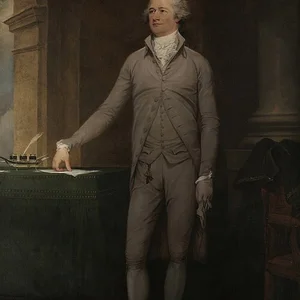

A Founding Father of the United States, Alexander Hamilton was the first Secretary of the Treasury (1789-1795). The architect of the American financial system, he created the first national bank and laid the foundations of the young United States' economy. He died in 1804 in a duel with Aaron Burr.
Alexander Hamilton(1757 — 1804)
Alexander Hamilton
États-Unis
5 min read
Frequently asked questions
Key Facts
- Took part in the American War of Independence as an aide-de-camp to George Washington (1777-1781)
- Co-author of the Federalist Papers (1787-1788) defending the ratification of the American Constitution
- First Secretary of the Treasury of the United States (1789-1795)
- Founded the First Bank of the United States in 1791
- Died on July 12, 1804 from injuries sustained in a duel with Vice President Aaron Burr
Works & Achievements
A series of 85 essays defending the Constitution. A foundational text of American political thought, most of which Hamilton wrote himself.
A plan for the federal government to assume the states' war debts and restore the country's credit. It established the financial credibility of the United States.
The first national bank, tasked with managing the government's finances and stabilizing the currency.
A plan to develop American industry. It laid the foundations for a modern, protectionist economic policy.
The establishment of a national monetary system with the dollar as its unit. It unified trade across the young nation.
A newspaper created by Hamilton, one of the oldest daily papers in the United States, still published today.
Anecdotes
Alexander Hamilton was born in the West Indies, on the island of Nevis, and he was an orphan and born out of wedlock. A gifted teenager, he so impressed the notables of his island with a letter describing a devastating hurricane that they pooled money to send him to study in North America.
During the War of Independence, Hamilton became aide-de-camp and personal secretary to General George Washington. He drafted much of his correspondence and remained one of his closest advisers, which launched his political career.
Hamilton is one of the main authors of the *Federalist Papers*, a series of 85 essays written to persuade Americans to adopt the Constitution. He alone wrote about 51 of them, sometimes several within a few days.
In 1804, Hamilton died in a pistol duel against Aaron Burr, the Vice President of the United States, with whom he was in political conflict. Struck in the abdomen near Weehawken, he died the next day in New York.
Even today, Alexander Hamilton's face appears on the American 10-dollar bill, even though he was never president. His life inspired the famous musical *Hamilton*, a huge success on Broadway.
Primary Sources
It has been frequently remarked that it seems to have been reserved to the people of this country to decide, by their conduct and example, the important question of whether societies of men are really capable of establishing good government from reflection and choice.
A nation's credit is measured by the regularity with which it honors its commitments; a national debt, if it is not excessive, will be to us a national blessing.
The growth of manufactures makes a country more independent and prosperous by multiplying employment and encouraging the industry of every class of the population.
You know how much I rely on your talents and your judgment in the conduct of the affairs of the Treasury.
Key Places
Hamilton's birthplace in the British West Indies. He spent a poor, difficult childhood there before moving to North America.
The institution (later Columbia University) where Hamilton pursued his higher education starting in 1773.
Site of the decisive 1781 victory where Hamilton led a heroic assault on the British redoubts.
City of the 1787 Constitutional Convention and the first capital, where Hamilton served as Secretary of the Treasury.
Site of the 1804 duel against Aaron Burr, where Hamilton was mortally wounded.
The home Hamilton had built in Harlem, his only personal residence, completed shortly before his death.
Typical Objects

Pair of flintlock pistols used for duels of honor. It was with such weapons that the fatal duel between Hamilton and Aaron Burr took place in 1804.

Writing instruments indispensable to Hamilton, a prolific writer. He composed thousands of pages of letters, reports, and political essays.

Paper currency issued by the young United States. Hamilton sought to stabilize the currency and to establish a solid national financial system.

Collection of 85 articles defending the Constitution. Hamilton was their principal author, and they remain a touchstone of American political thought.

Blue coat of the Continental Army worn by Hamilton as a lieutenant colonel. It symbolizes his military role alongside Washington.

Three-cornered hat typical of the 18th century. It was part of the everyday men's attire of the revolutionary era.
School Curriculum
Vocabulary & Tags
Key Vocabulary
Tags
Daily Life
Morning
Hamilton rose early and worked long hours from dawn onward. As Secretary of the Treasury, he studied the nation's accounts and drafted detailed reports before most of his colleagues had even arrived.
Afternoon
His afternoons were filled with meetings, discussions with other officials, and managing the country's financial affairs. A lawyer by training, he could also argue cases in court and advise clients.
Evening
In the evening, Hamilton often kept writing by candlelight, producing letters, essays, and political articles. He also enjoyed spending time with his family and attending the dinners of New York society.
Food
The diet of the American elite of the time included roasted meats, fish, bread, vegetables, and pies. Wine, cider, and tea accompanied meals, which were often shared at political dinners.
Clothing
Hamilton wore the elegant dress of the eighteenth-century gentleman: frock coat, waistcoat, breeches, stockings, and buckled shoes. As an officer, he had worn the blue uniform of the Continental Army.
Housing
He lived mainly in town houses in New York and Philadelphia. Late in his life, he had “The Grange” built, an elegant country residence in northern Manhattan.
Historical Timeline
Period Vocabulary
Liens externes & ressources
Références
Œuvres
Les Federalist Papers (avec Madison et Jay)
1787-1788
Rapport sur le crédit public
1790
Création de la First Bank of the United States
1791
Rapport sur les manufactures
1791
Création de la US Mint (Monnaie des États-Unis)
1792
Fondation du New-York Evening Post
1801