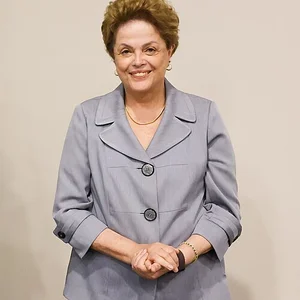

Brazilian economist and politician, she became in 2011 the first woman president of Brazil. A member of the Workers' Party (PT), she was removed from office by impeachment in 2016 amid an economic and political crisis.
Dilma Rousseff(1947 — ?)
Dilma Rousseff
Brésil
9 min read
Frequently asked questions
Famous Quotes
« I am not the president of the elites or the financial markets, I am the president of the middle class and the poor.»
Key Facts
- 1947: born in Belo Horizonte, Brazil
- 1960s–1970s: activist against the Brazilian military dictatorship, imprisoned and tortured (1970–1972)
- 2011: elected 36th president of Brazil, the first woman to hold the office
- 2014: re-elected president for a second term
- 2016: removed from office by the Chamber of Deputies and then the Senate (impeachment) for budget manipulation
- 2023: appointed president of the New Development Bank (the BRICS bank)
Works & Achievements
A vast public investment program in Brazilian infrastructure (housing, transport, energy, sanitation), led by Dilma Rousseff well before her presidency. She was its principal architect and supervisor, earning the nickname "mother of the PAC."
An ambitious social housing construction program developed under the presidency of Dilma Rousseff. It enabled the construction of more than 2.7 million homes for low-income families, significantly reducing Brazil's housing deficit.
An initiative launched by Dilma Rousseff to send doctors to rural and underserved areas of Brazil, notably recruiting thousands of Cuban physicians. The program significantly improved access to healthcare for millions of Brazilians living far from urban centers.
A legislative framework championed by Dilma Rousseff to exploit the enormous oil reserves discovered beneath a salt layer at the bottom of the Atlantic. She advocated for a model giving Petrobras and the Brazilian state a central role in this strategic resource.
Dilma Rousseff created and supported this commission tasked with investigating the crimes of the military dictatorship (1964–1985), of which she herself was a victim. The final report documented 434 cases of deaths and disappearances and named those responsible, opening a chapter of memorial reconciliation.
At the United Nations General Assembly, Dilma Rousseff denounced the surveillance of her communications by the American NSA, as revealed by Edward Snowden. The speech resonated worldwide and established Brazil as a champion of states' digital sovereignty.
Anecdotes
Arrested in 1970 by the Brazilian military dictatorship, Dilma Rousseff endured months of torture in secret detention centers. Despite the abuse, she refused to give up the names of her fellow activists — a resistance that earned her a reputation for exceptional courage among opponents of the regime.
On January 1, 2011, Dilma Rousseff was inaugurated as President of Brazil, becoming the first woman to hold that office in the country's history. In her inaugural address, she declared her intention to "open the doors so that other women may follow" — a phrase that became a symbol of women's political emancipation across Latin America.
In September 2013, Dilma Rousseff was the first to speak at the United Nations General Assembly, where she condemned the NSA surveillance programs that had targeted her personal communications, as revealed by Edward Snowden. The speech caused a sensation on the international stage and forced the United States into diplomatic explanations.
During her impeachment trial in 2016, Dilma Rousseff argued her case for several hours before the Brazilian Senate, accusing her opponents of staging an "institutional coup." Although removed from office, she retained her political rights, allowing her to remain an active figure in the opposition.
In 2023, after years away from the international stage, Dilma Rousseff was appointed president of the New Development Bank of the BRICS in Shanghai. For her supporters, this return symbolized recognition of her life's work despite an impeachment they had always contested.
Primary Sources
Venho para abrir portas para que outras mulheres, no futuro, também possam segui-las. E quero que cada brasileira se sinta representada por mim no Palácio do Planalto.
Sem o respeito à soberania, não há base para as relações entre as nações. As revelações de uma interceptação das comunicações brasileiras, de empresas e da Presidenta da República em especial, provocaram a indignação e o repúdio da opinião pública brasileira.
Dilma Vana Rousseff foi detida em janeiro de 1970 e mantida sob custódia do DOPS-SP e DOI/CODI, onde foi submetida a práticas de tortura documentadas por sobreviventes e investigadores.
Não cometi crime de responsabilidade. Não mereço, portanto, ser submetida a este processo. O que está em julgamento aqui não é apenas o meu mandato, mas a democracia brasileira.
Key Places
Birthplace of Dilma Rousseff, born on December 14, 1947, in the capital of Minas Gerais. It was here that she completed her secondary education and developed her earliest political convictions against the dictatorship.
City in southern Brazil where Dilma Rousseff built most of her political career, serving as Secretary of Energy for Rio Grande do Sul, then as Secretary-General of the state government before being noticed by Lula.
Seat of the Brazilian federal government and an architectural masterpiece by Oscar Niemeyer, where Dilma Rousseff served as president from 2011 to 2016. It was from this palace that she governed the country — and from which she was ultimately removed through impeachment.
Site where Dilma Rousseff was held and tortured between 1970 and 1972, operated by the military dictatorship to interrogate political opponents. It has since become a symbol of human rights violations in Brazil and a place of historical memory.
The chamber where Dilma Rousseff's impeachment trial took place in 2016. On August 31, senators voted 61 to 20 to remove her from office, bringing her presidential term to an end amid a deep political crisis.
Since 2023, Dilma Rousseff has served as president of the New Development Bank of the BRICS, headquartered in Shanghai. The role marks her return to the international stage and embodies the ambition of emerging nations to establish their own financial institutions.
Typical Objects

A symbol of the Brazilian presidency, this tricolor sash in the national colors is bestowed during the inauguration ceremony. Dilma Rousseff was the first woman to receive it, on January 1, 2011, in a gesture of considerable historical significance.

A sweeping infrastructure investment program for Brazil, the PAC was steered by Dilma Rousseff long before she became president. She was its chief architect, personally overseeing construction projects and earning the nickname "mother of the PAC."

The archives of the dictatorship's political police contain Dilma Rousseff's arrest records and interrogation reports. These documents, declassified after the return of democracy, provide evidence of her detention and her resistance.

Following Edward Snowden's 2013 revelations about NSA surveillance, Dilma Rousseff had her communications equipped with encrypted systems and cancelled a state visit to the United States as a sign of protest.

This booklet issued to beneficiaries of the conditional cash transfer program symbolizes the social policy championed by the PT. Continued and expanded under Dilma Rousseff, the program enabled millions of Brazilian families to escape extreme poverty.

Dilma Rousseff created and supported this commission, tasked with investigating the crimes of the military dictatorship (1964–1985), of which she was herself a victim. The final report, delivered in December 2014, documented 434 deaths and disappearances and named those responsible.
School Curriculum
Vocabulary & Tags
Key Vocabulary
Tags
Daily Life
Morning
Dilma Rousseff was known for her very demanding work schedule and started her days early, with a thorough press review and briefing meetings with her advisors in the first hours of the morning. Her team described her as an extremely rigorous woman, attentive to the smallest details of economic and political files.
Afternoon
Presidential afternoons were devoted to official audiences, interministerial meetings, and political negotiations. Dilma Rousseff had a reputation for mastering technical files often better than her own ministers, particularly in the areas of energy and the economy.
Evening
Her evenings were frequently occupied by protocol obligations, state dinners, or late working meetings. Close to her daughter Paula, she strived to preserve family time despite the crushing constraints of the presidential office.
Food
Dilma Rousseff appreciated the traditional Brazilian cuisine of Minas Gerais, the region she hails from, renowned for its hearty dishes based on black beans, pork, couve (collard greens), and fresh cheese. Her collaborators report that she ate simply, without ostentation.
Clothing
During her presidency, Dilma Rousseff adopted a sober but memorable professional style: brightly colored suits — red, blue, green — which became a true visual signature. Aware of being a historical symbol as the first female president, she paid particular attention to her public image.
Housing
Dilma Rousseff resided at the Palácio da Alvorada, the official residence of Brazilian presidents in Brasília, a masterpiece by Oscar Niemeyer featuring elegant arrow-shaped columns overlooking Lake Paranoá. She also maintained her personal residence in Porto Alegre, the city where she had built her political career before reaching the highest office.
Historical Timeline
Period Vocabulary
Liens externes & ressources
Références
Œuvres
Programme d'Accélération de la Croissance (PAC)
2007-2016
Programme Minha Casa Minha Vida (Ma maison, ma vie)
2009-2016
Programme Mais Médicos (Plus de médecins)
2013
Politique du Pré-Sal (pétrole sous-marin)
2010-2016
Création de la Commission nationale de la Vérité
2012-2014
Discours à l'ONU sur la souveraineté numérique
24 septembre 2013