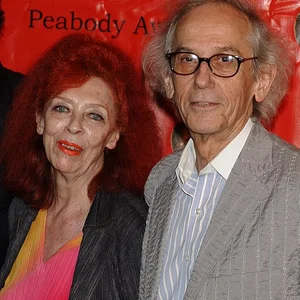

Christo Javacheff (1935–2020) and Jeanne-Claude Denat de Guillebon (1935–2009) were an artist duo known for their monumental installations wrapping buildings and natural landscapes. Their ephemeral works challenge our relationship to space and perception.
Christo and Jeanne-Claude
Christo and Jeanne-Claude
9 min read
Frequently asked questions
Key Facts
- 1962: wrapping of the Wall of Oil Barrels in Cologne, their first significant wrapping works
- 1972–1976: Running Fence, a 39-km fabric curtain across California
- 1985: wrapping of the Pont-Neuf in Paris with 40,000 m² of golden fabric
- 1995: wrapping of the Reichstag in Berlin, seen by 5 million visitors
- 2005: The Gates, 7,503 saffron-fabric gates installed in Central Park, New York
Works & Achievements
In Australia, 2.4 km of cliffs at Little Bay are wrapped in one million square metres of fabric. This is their first monumental installation in a natural landscape and a turning point in their international career.
A 40 km 'wall' of white fabric sweeps across the hills of California and plunges into the Pacific Ocean. After three and a half years of negotiations with 59 landowners, the work exists for only two weeks.
Paris's oldest bridge is covered in 40,916 square metres of golden fabric for nine days, welcoming three million visitors. The installation transforms a familiar monument into a luminous sculpture that reveals its architectural forms.
After twenty-four years of negotiations and a historic vote in the Bundestag, the German parliament is covered for two weeks in 100,000 square metres of silver fabric. Five million people witness this major artistic and symbolic event.
7,503 saffron-orange fabric gates line 37 km of pathways in Central Park, New York, for sixteen days in February. First proposed in 1979 and rejected for twenty-five years, the project becomes one of the most popular installations in contemporary art.
Three kilometres of floating walkways covered in orange fabric allow visitors to walk across Lake Iseo in Italy. With 1.2 million visitors in sixteen days, the work achieves unprecedented popular success for a contemporary art installation.
Realized posthumously according to Christo's plans (who died in 2020), this installation wraps the Arc de Triomphe in 25,000 square metres of recyclable silver fabric and 3,000 metres of red rope, fulfilling a dream conceived as far back as 1962.
Anecdotes
Christo and Jeanne-Claude were born on the same day — June 13, 1935 — he in Gabrovo, Bulgaria, and she in Casablanca, Morocco. They met in Paris in 1958 when Christo came to paint a portrait of Jeanne-Claude's mother. This shared birthday, which they loved to mention, seemed to predestine their extraordinary artistic union.
Wrapping the Reichstag in Berlin required twenty-four years of negotiations. Christo and Jeanne-Claude first submitted their proposal in 1971, facing repeated rejections from the German Parliament. It was only in 1995, after German reunification and a historic vote by the Bundestag (292 in favor, 223 against), that two weeks of spectacular wrapping could finally take place before five million visitors.
Christo and Jeanne-Claude always refused any patronage, sponsorship, or public subsidy for their projects. They self-financed their monumental works by selling Christo's preparatory drawings and models. For *The Gates* in Central Park in 2005, the budget reached 21 million dollars, entirely self-funded — a radical way of asserting their total artistic independence.
For decades, only Christo's name appeared to identify the duo. It was from 1994 onward that both artists officially insisted their works be systematically credited to "Christo and Jeanne-Claude." Jeanne-Claude was in fact a full co-creator and the logistical and financial director of all their projects since 1961.
*The Floating Piers*, completed in 2016 on Lake Iseo in Italy, drew 1.2 million visitors in sixteen days — far beyond all expectations. Visitors literally walked on water, across floating modules covered in saffron-yellow fabric. The work, entirely dismantled at the end of the exhibition, perfectly illustrates their philosophy: ephemeral art leaves only memory behind and does not scar the landscape.
Primary Sources
The Gates is a work of art for the joy and beauty of New York City, and we are glad it is freely accessible to the public.
Our project is not a political commentary on Germany or on Berlin. It is a temporary artistic event that celebrates the beauty of the architectural space and the silvery fabric.
We do not want our art to be owned, or even preserved. It disappears. And that disappearance is its strength — it compels people to truly see it, right now.
Accepting money from someone — a government, a corporation, a patron — means accepting a form of commitment. We prefer to remain completely free.
I have been dreaming of this project since 1962. We will use 25,000 m² of recyclable silver polypropylene fabric and 3,000 meters of red rope.
Key Places
In 1985, Christo and Jeanne-Claude wrapped the Pont Neuf, Paris's oldest bridge, in 40,916 m² of golden fabric for nine days. Three million visitors came to see this familiar monument through an entirely new lens.
In 1995, the German Parliament was wrapped in 100,000 m² of silver fabric after twenty-four years of negotiations. The event drew five million visitors and became one of the most-seen artworks of the twentieth century.
In February 2005, 7,503 saffron-colored gates (The Gates) transformed 37 km of Central Park's pathways. The installation drew more than a million visitors despite the winter cold and generated $254 million in economic impact for the city.
The site of The Floating Piers in 2016, a 3 km orange floating walkway connecting two islands to the shore. With 1.2 million visitors in sixteen days, the work exceeded all expectations and sparked worldwide enthusiasm.
In September 2021, L'Arc de Triomphe, Wrapped was realized posthumously according to Christo's plans, enveloping the monument in 25,000 m² of recyclable silver fabric. Conceived as early as 1962, this project became the duo's artistic testament.
The birthplace of Christo Javacheff in 1935. Under the communist regime, Christo studied at the Sofia Academy of Fine Arts before fleeing westward in 1957 via Prague and Vienna, eventually settling in Paris.
Typical Objects

The primary material of Christo and Jeanne-Claude's installations, used by the millions of square meters to wrap buildings, bridges, or landscapes. Its color (silver, gold, white) radically transforms how the wrapped object is perceived, revealing its essential forms.

Steel or textile rope systems used to hold wrappings and structures in place against wind and weather. Their engineering is as complex as that of a suspension bridge, mobilizing teams of specialist engineers.

Highly detailed graphic studies made by Christo to visualize projects before they were realized. These works on paper also serve as the main source of funding for the installations, sold in galleries and at international auctions.

A doorway-shaped metal structure from which a fabric panel hangs, used by the thousands in Central Park for the installation *The Gates* (2005). Each gate stands approximately 4.87 meters tall, and its saffron-orange panels ripple in the wind.

A modular high-density polyethylene element forming the floating walkways on Lake Iseo in 2016. Around 220,000 identical modules were assembled to create 3 km of pathway over the water, covered in saffron orange fabric.

Structures 6 meters tall and 8.66 meters in diameter — blue in Japan and yellow in California — planted in the rural landscape during the simultaneous installation *The Umbrellas* (1991). They evoked giant flowers transforming two territories on opposite sides of the globe at the same time.
School Curriculum
Vocabulary & Tags
Key Vocabulary
Daily Life
Morning
Christo and Jeanne-Claude began their day very early in their SoHo loft in New York, surrounded by scale models and preparatory drawings. Christo would draw from dawn, producing the graphic studies that funded their projects. Mornings were often devoted to phone calls with lawyers, engineers, and officials around the world.
Afternoon
Afternoons were dedicated to meetings with technical teams: engineers, architects, and specialists in synthetic materials. Jeanne-Claude handled administrative and financial negotiations with relentless rigor, while Christo refined the visual and artistic aspects. At installation sites, they personally oversaw every detail of the setup.
Evening
Evenings blended social life in New York's artistic circles with hard work. Christo would often continue drawing late into the night, producing works on paper that would be sold the following day. They received collectors, journalists, and political decision-makers who needed to be convinced of the merit of their monumental projects.
Food
Like many artists of their generation settled in New York, they lived simply, often having lunch at neighborhood diners or eating on the go between meetings. Their frequent travels to sites in Australia, Japan, or Italy exposed them to local cuisines. Christo, of Bulgarian origin, remained attached to simple, hearty food.
Clothing
Christo was often photographed in casual attire — a jacket or bomber — far from the dandyism of some contemporary artists. On worksites, they wore practical clothing suited to the terrain: boots and windbreakers, as they were physically present during every installation. Their image was that of craftsmen as much as artists.
Housing
From the 1960s onward, they lived and worked in a large loft in the SoHo neighborhood of New York, which served simultaneously as a studio, meeting room, and storage space for their models and archives. This studio-loft, typical of New York artists of the era, reflected a lifestyle entirely devoted to creation and the logistics of enormous projects.
Historical Timeline
Period Vocabulary
Liens externes & ressources
Références
Œuvres
Wrapped Coast (Côte enveloppée)
1969
Running Fence
1976
Wrapped Reichstag (Le Reichstag emballé)
1995
The Gates
2005
The Floating Piers (Les Jetées flottantes)
2016
L'Arc de Triomphe, Wrapped
2021