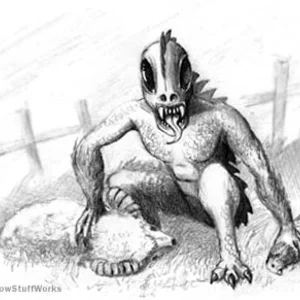

The Chupacabra is a legendary creature from Latin America whose name means "goat-sucker" in Spanish. First reported in Puerto Rico in the 1990s, it is associated with mysterious livestock mutilations and has become a major cultural and folkloric phenomenon.
Chupacabra
Chupacabra
8 min read
Frequently asked questions
Key Facts
- 1995: first sightings reported in Puerto Rico, linked to unexplained livestock deaths
- The name "chupacabra" literally means "goat-sucker" in Spanish
- The creature spread throughout Latin American folklore and into the United States during the 1990s–2000s
- No scientific evidence of the creature's existence has ever been established
- The phenomenon illustrates how modern urban legends are built and spread in the age of mass media
Works & Achievements
Chris Carter's series creates the cultural context in which the Chupacabra emerges. Its worldwide success demonstrates the public's appetite for mysterious creatures and government conspiracies.
This science-fiction film is directly responsible for the Chupacabra's physical description: the main Puerto Rican eyewitness drew on it when describing the creature she claimed to have seen.
A landmark scientific investigation that traces the myth back to its origins and demonstrates how a cinematic description, media hoaxes, and sick animals merged to create a worldwide legend.
The Chupacabra's appearance in the American satirical animated series as early as 1997 illustrates the speed at which the creature was absorbed into mainstream North American popular culture.
A Puerto Rican journalist specializing in unexplained phenomena, Martín publishes one of the first books on the creature, explicitly linking the Chupacabra to extraterrestrial phenomena and contributing to the nascent mythology.
The Chupacabra's inclusion in this American fantasy TV series illustrates how the Latin American folkloric creature has become fully integrated into the pantheon of monsters in global popular culture.
The Chupacabra's presence in numerous popular video games — most notably Red Dead Redemption — cements its status as an internationally recognized contemporary mythological monster, particularly among younger generations.
Anecdotes
The word 'Chupacabra' was coined by Puerto Rican comedian and journalist Silverio Pérez in 1995, following the first reports of animal carcasses found drained of blood in Canóvanas, Puerto Rico. The catchy name directly contributed to the rapid spread of the legend through Spanish-language media.
In 1995, the mayor of Canóvanas, José 'Chemo' Soto, organized armed expeditions into the forest to attempt to capture the creature. These official operations, covered by the international press, illustrate just how far the Chupacabra panic went beyond mere folklore to become a genuine social and political phenomenon.
Biologist Benjamin Radford conducted a five-year investigation published in 2011 in his book 'Tracking the Chupacabra'. He demonstrates that the original description of the creature — a biped with dorsal spines — was directly inspired by the 1995 science-fiction film 'Species', which the key eyewitness had watched shortly before making her claims.
In the 2000s, several animals presented as 'real Chupacabras' captured in Texas and Mexico turned out to be coyotes or dogs suffering from severe mange, a parasitic disease that grotesquely distorts their appearance. DNA analysis consistently confirmed their ordinary nature.
The Chupacabra became a phenomenon of cultural globalization: within less than ten years, 'sightings' were reported in Chile, Russia, the Philippines, and even Spain. This worldwide spread illustrates how the internet and mass media can transform a local legend into a global myth.
Primary Sources
Varios animales aparecieron muertos en la región de Canóvanas con heridas extrañas y aparentemente drenados de sangre, sin que se encontrara explicación científica inmediata.
The creature I saw was moving on two legs, stood about 1.2 meters tall, had large black almond-shaped eyes and a row of spines running down its back.
Post-mortem examinations of the recovered animals reveal circular puncture wounds at the neck; the hypothesis of natural predators (birds of prey, mustelids) cannot be entirely ruled out.
The chupacabra is a truly new monster, combining elements of vampire folklore, alien contact narratives, and contemporary anxieties about science and government cover-ups, born directly from the media ecosystem of the 1990s.
DNA analysis of the specimens identified as 'chupacabras' consistently confirmed they were domestic or feral canines suffering from severe sarcoptic mange, a condition caused by Sarcoptes scabiei mites.
Key Places
The absolute epicenter of the legend: it was in this municipality in northeastern Puerto Rico that the first sightings were reported in 1995. Mayor José Soto organized official search parties there, making Canóvanas the 'Chupacabra capital of the world.'
The only national rainforest in the United States, located near Canóvanas. Its wild, impenetrable nature made it the creature's supposed ideal hiding place in the popular imagination of the 1990s.
In 2007, a local resident filmed a strange animal she identified as a Chupacabra. DNA analysis revealed it to be a mangy coyote, but the town capitalized on the event by opening a Chupacabra museum, turning it into a pilgrimage site for cryptid enthusiasts.
In 1996, a series of unexplained events in this Brazilian city — known as the Varginha incident — were linked by some witnesses to creatures resembling the Chupacabra, illustrating the rapid spread of the myth across South America.
The capital of Puerto Rico and the media hub where Chupacabra panic was amplified by local television and radio stations in 1995. It was from San Juan that the story spread to Puerto Rican communities in New York and Miami.
Liens externes & ressources
Références
Œuvres
X-Files — épisodes liés aux créatures inconnues (série TV)
1993-2002
Chupacabra (épisode de South Park, saison 1)
1997
Jorge Martín — 'El Chupacabras: Un fenómeno extraterrestre'
1995
Chupacabra dans 'Grimm' (série NBC)
2012
Chupacabra dans la franchise 'Call of Duty' et jeux vidéo
2000s-2010s